The illusion

Three years since I first started blogging, I’m beginning to get a glimpse of the phantoms that real writers battle:

The illusion that, regardless of what happened yesterday, today you’ll have nothing to say.

The twinge of loss when you write something worth writing.

The pain of putting an idea out into the world.

The fear that something has left you that you can’t get back

It is like giving away anything real and true – love or friendship or money or some other long-treasured thing.  Our mind tricks us into feeling that these things we give away are ours, that they are finite, that the safest thing to do is to cling to them fiercely.

Over and over we practice creating and letting go.  We practice being open.  We dare to strive to be our best selves, reaching so far that we are exposed and vulnerable.  And yes, sometimes we fail. Our leap comes up short.  We crash into the chasm and end up sore, bruised and limping.

But mostly we discover that what we give away is a reflection of the abundance within us, is proof of our grace and all that we have to give.

So we sit back down again, ready to wrestle the illusion of scarcity to the ground, never giving up or giving in.

The ones we’re waiting for

Yeah, it’s us.

What if you knew that no one else was coming?  What if it’s up to you?  What if all the ideas you’re quietly kicking around are desperately needed by your organization and in the world?

I’ve seen too many amazingly capable people (at all levels – some very senior) spend their energy in side conversations  diagnosing the problem, all the while acting like it is someone else’s job to FIX the problem.

Maybe someone else isn’t coming.

Maybe their train got delayed or they got lost.

Maybe it’s just you.

How would you act now?

Waiting for a white knight who will set the right tone, expect the best, inspire others, make the tough call, lead with clarity of vision AND all the official authority that you might not have (but maybe you do!), that’s still just waiting.  And waiting around or complaining on the sidelines makes you part of the problem.   So does saying that you had a great idea but no one listened.  Having the idea isn’t enough.  You need to persuade people that it’s right.

It’s just us, and time’s a wastin’.

The list makes no sense without you

Try this: write down everything you currently do in your job.  Make a good, clear list with step-by-step instructions.  Imagine someone’s really going to read and use and follow this document.

Could they do it?  Could they follow all the steps and do what you do?

I hope not.

What you have to offer is so much more than a list.  We don’t need you to accomplish specified tasks that can be boiled down so succinctly.

We need the list to make no sense without you, because you are the one who makes things happen, who anticipates and makes things more joyful and surprising and unexpected for your customers and your co-workers.

We need the list to make no sense without you, because you naturally coach and mentor and advise and counsel people around you.

We need the list to make no sense without you, because even if some of the tasks seem small or less grandiose than you’d like them to be (right now), you do them with such relish, conviction, and quality that it always ends up being more than the sum of its parts.

We need the list to make no sense without you, because you are doing emotional work that has meaning and spirit and soul, and there’s no handbook for that.

Apply by Monday – looking for two great people

I’m looking for two great people to join my team, most likely in New York.  Both roles have incredible potential for impact.

One person, for the more junior role, is a crackerjack writer, thinker, synthesizer.  He or she will have wondered if her writing and organizational skills could be coupled with her passion for international issues and global development.  And she’ll discover that the answer is “yes.”

The other person, for the more senior role, is a fearless fundraiser, defined as I and you see this role in its fullest way and with all the strategic potential that implies.  This person will externally represent and build cornerstone partnerships for Acumen Fund, so she must be a natural storyteller and builder who has the grace, presence and poise to be thrust into any meeting or relationship (individual, institutional, corporate, government, you name it) and leave the person on the other end thinking, “Wow!”

The links above have all the specific details.

If this job is for you, or if you know someone you think is perfect, let me know AND apply directly.  We have audacious goals, for this team and for Acumen Fund, and I know we’ll get there.  I can’t wait to find the two people who are going to help make this happen.

The deadline is next Monday.  Please spread the word.

Confidence and Abilities

A woman I’ve gotten to know has had one of the most incredible professional trajectories I’ve ever had the pleasure to witness.  In six years she’s gone from an off-the-street volunteer/intern into a key player in a global organization.  It’s not just that her job title or her responsibilities have changed – she is a fundamentally different person (or, more accurately, she’s taken huge strides towards becoming the person she’s meant to be and who the world needs her to be).  Amazingly, the organization she works for has been able to keep up with her trajectory and give her bigger, more challenging roles.

When we talk about her career and her life, we keep coming back to the fact that one of her biggest challenges is having her confidence keep pace with her abilities.  While the people around her realize who she’s become, realize what a linchpin she is for her organization, at times the echoes of her former self, her former self-image, her former limitations, all reverberate, if only for her.

For a while I thought that this reflection was just for her, because most people don’t transform as quickly as she does.

But of course it is for all of us.

Most of us carry the mantle of our former selves – the intern we were, the person with the entry-level job clamoring for attention, with all those perceived limitations holding us back.

Worse, we make the mistake of spending time and energy clamoring for that bigger job, the new job title and formal responsibilities, energy that could instead be spent on actually doing bigger, better, more audacious things.  And we get even more confused when our asking for more actually gets us more, reinforcing the specious notion that real authority, ability, and voice come from anywhere but inside of us.


I disagree

Each time someone says that to me (emails it to me, comments it to me), my first reaction is to be a little surprised and, if I’m really honest, just a tiny bit hurt. (“I can’t believe someone unsubscribed from my blog!” or “Really, they didn’t find that David Brooks piece compelling?!”)

But then I remind myself: if no one’s vehemently disagreeing, then no one’s vehemently agreeing.

“Vehement” is the point.

Conversations are the point.

I’m not advocating for being controversial just for its own sake, but do have something to say and say it….if you do that, some people will beg to differ.

And that’s more than OK, it’s great.

Pushing, prodding, exploring, tripping, falling, and getting up again…that’s what it’s all about.  Otherwise, you’re just standing there, not doing much of anything.

Commit publicly

Here’s a good way to overcome the resistance and execute on the big ideas that terrify you: tell others about your grandiose plans.

You can decide how “public” you want your “public” announcements to be – if you want to go big, you can tell thousands of your loyal readers; or you can just talk to the people you’d dream of collaborating with, your colleagues, your spouse, maybe your boss.

Saying it over and over again has two effects: it makes the big idea more real to you; and you can replace your fear of getting started with how silly you’ll feel having talked about something to people you care about and having not followed through.

(The catch, of course, is that then you have to execute, otherwise you’re just a big talker.  But I know – and you know – that you can execute.  What’s holding you back is the fear of starting.)

It finally happened

Cranking through my inbox for a few hours doesn’t feel like real work.

Satisfying? Yes.

A relief?  Yes.

But not real work.

Pretty sure this is a good sign.

The problem with being a naysayer

The problem is that even when you’re right, it’s coming from the person who always dissents, so people will listen to you less.

It’s that you’re usually advocating holding off, holding back, or not starting.

It’s that, in fact, things usually are not right in the first place, but they get right once they’re in motion, not when they’re stuck on the drawing board.

But the worst part is that it keeps you safe.  You don’t experience the fear of maybe failing.  You don’t discover that things that are less planned, less orchestrated, less thought through sometimes work spectacularly.  You don’t learn when it’s time to say “hold on” and when it’s time to go.  Both have their moments.

(And of course no one thinks of themselves as being a naysayer, they’re just offering constructive criticism…)

Initiate

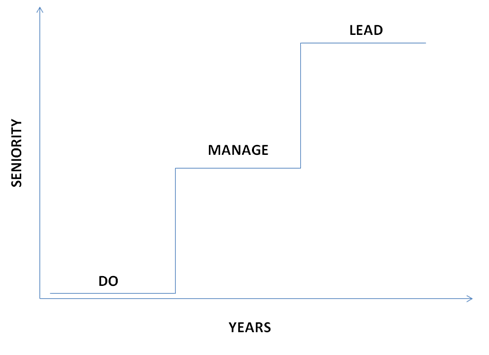
My first real job was as a management consultant, and after that I worked at a number of big companies, and from both I inherited a clear, incorrect sense of how my professional life should evolve.  It looked something like this:

Meaning:

  • As you’re starting out, your job is to DO: folks give you assignments, and it’s your job to execute (“build this model;” “complete these benchmarking interviews”; “write this proposal”).
  • Then eventually you become a “manager”: there are projects for you to run, and people for you to supervise, and you have to figure out how to do that well
  • And finally you are anointed a “leader” (aka Partner, C-level exec, etc.) – you’re in charge and you decide things

What always felt mysterious was how one jumps from one step to the next.  You could do a good job on stuff and eventually you’d be recognized and promoted (hopefully), but I knew that the cashflow models I was building as an entry-level consultant weren’t teaching me to sell projects, so how would I ever leap that chasm?  Plus, it’s a terrible waiting game: at its best, you set a bunch of ambitious goals, work to exceed those goals, and hope someone notices you and gives you that big promotion and a step up the ladder.  You’re out there checking off boxes, but you’re also waiting for someone to decide it’s OK for you to step forward and do the next thing.

This model is dead, ill-informed, outdated.   The only real purpose it served was to allow the people in charge to feel in charge, and to make sure that great ideas didn’t come from most of the organization.

Here’s a different chart so simple that it forces you to look it (and yourself) straight in the eye:

Every day, no matter where you sit in the organization and what you’ve been asked to do, you’re in a position to initiate things.  Ideas, seminars, journals, newsletters, blogs, new software projects, better sales pitches, partnerships that will change the game

When you initiate you come up with the idea and get it rolling.  You don’t need permission, because if you create something great and someone loves it so much that they want to grab it from you, that’s fine – you’ve created something of value, and you can go on to the next thing.

Instead of worrying about getting credit and your job title, worry about leverage.

Stop waiting around.  Stop asking for permission.  Start things and ask to be stopped.   Find people who will help, who can do some of the work, who can take some or all of the credit.  And then do it again.