I know it’s here somewhere

My wife likes to needle me for (according to her) not being good at looking for things.  Needless to say, I disagree.

(Admittedly, I did recently speak to a senior marketer at Proctor and Gamble who told me that P&G has done studies in homes in which they move one or two items in the pantry, and women crush men in their ability to figure out what was moved….something about how men and women’s memories about of spatial relations are fundamentally different.)

I didn’t help my case when, the other day, I failed to find the little needle for the bike pump, so I could inflate a soccer ball.  This tiny needle floats around our house, usually in the “junk drawer” that’s full of pens, keys, stickers, and other small household overflow items.  I rifled through the drawer twice and convinced myself if wasn’t there.

My wife came downstairs, opened the drawer, and pulled the darn thing out in about two seconds.

Friendly marital banter aside, here’s what I’ve begun to understand: we look in a different ways when we’re sure something is there.  And this isn’t just about keys and pens and tomato sauce.

It goes something like this: if you’re not sure something is there, you’re looking in order to 1) Confirm/refute your hypothesis that the thing is there AND 2) Find the thing.  Conversely, if you’re sure something is there, you’re just working #2, on finding the thing.  Evidence along the way that indicates that it’s not there is summarily ignored.

This applied to all proverbial needles in haystacks, to problems big and small.  Knowing the answer is out there – you just have to find it – is a completely different undertaking than looking around, not sure if the answer is out there in the first place.  If you do the latter, you’re likely to throw in the towel far too soon, and you’re also likely to look in the wrong places. If you’re sure the answer is out there, you hang on to that conviction doggedly.

This is why looking tentatively is so problematic; why high-paid consultants often end up confirming what we already knew and discourage us from pushing boundaries into the unknown; it’s why great entrepreneurs distinguish themselves.

The chorus of naysayers loves to jeer that a better way isn’t out there.  And they win when we give up, because it confirms their own fears and the status quo that they love so much.

The thing is, a better way IS out there. And you’re going to find it if you look hard enough.

I disagree

Each time someone says that to me (emails it to me, comments it to me), my first reaction is to be a little surprised and, if I’m really honest, just a tiny bit hurt. (“I can’t believe someone unsubscribed from my blog!” or “Really, they didn’t find that David Brooks piece compelling?!”)

But then I remind myself: if no one’s vehemently disagreeing, then no one’s vehemently agreeing.

“Vehement” is the point.

Conversations are the point.

I’m not advocating for being controversial just for its own sake, but do have something to say and say it….if you do that, some people will beg to differ.

And that’s more than OK, it’s great.

Pushing, prodding, exploring, tripping, falling, and getting up again…that’s what it’s all about.  Otherwise, you’re just standing there, not doing much of anything.

What you can’t measure

So what was the measurable impact of….?”

Of course this question matters a lot, a ton, the most maybe.

The catch is that we fail to fully appreciate three truths:

  1. You can only measure a subset of the things that matter
  2. We end up convincing ourselves that the things we are able to measure are a good approximation of the whole
  3. But they might not be

A friend was nice enough to send this Skype chat along to me the other day (names changed):

[9:53:08 PM] Felipe: for lent, i’m going to do the generosity experiment

[9:53:24 PM] Felipe: 40 days of saying yes to everything

[9:53:28 PM] Felipe: you are warned 🙂

[9:54:22 PM] Samuel: wow

[9:54:27 PM] Samuel: 40 days

[9:54:28 PM] Samuel: are you sure?

[9:54:45 PM] Felipe: lent is 40 days…i have nothing to give up

[9:54:54 PM] Samuel: ok

[9:55:09 PM] Samuel: Sasha Dichter will be happy to note this

[9:56:17 PM] Felipe: it’ll be on a smaller scale than his, for sure…but let’s see how it goes

(I’m not sure it will be on a smaller scale, really.  The most profound and lasting changes are personal.)

Folks have been asking me: “do we have to wait until February 14th, 2012 for the next Generosity Day.”  Of course not!!!  Start, go, share, inspire others…and if you have a free moment let me know how it went.

20-80-100 and Adjacent Possibility

Katya and I were comparing notes last week about our blogs and the experience of blogging.

One of the biggest impacts blogging has had on me is that it forces me to develop thoughts that would normally remain 20% developed (in the form of casual observation) and form them into blog posts, which are about 80% fleshed out.  (Katya and I both agreed that we’d leave the 100% development of ideas to professional journalists like Ellen McGirt at Fast Company…there’s something nice about the leeway blogging gives you not to be perfect, and in fact I think it’s just this leeway that gives space for creativity.)

Think about the impact, over years, of systematically taking ideas that are partially developed and developing them fully.  Think about what you learn over time, both at the level of the individual idea – because the act of writing takes you places you didn’t know you’d go – and over time, from repeating this action every day.

I’ve been reading Steven Johnson’s Where Good Ideas Come From – I’ll review it fully when I’m finished, as it’s one of the most interesting books I’ve read this year.  The foundational idea in the book is that great ideas are formed in the “adjacent possible” space, the space that’s right at the edge of understanding of a particular problem you’re working to solve.  Breakthrough insights typically come from the reassembly and reconfiguration of existing ideas that are right at the edge of what you know and what you don’t know.

This feels 100% right to me.  Generosity Day, for example, grew out of my Generosity Experiment more than a year ago, coupled with the experience of helping create Search for the Obvious at Acumen Fund (really the brainchild of James Wu), along with the ongoing hunch I’d carried around for 14 months (and explored occasionally in other blog posts) that there was something bigger that could and should come of my personal exploration of generosity.  Generosity Day was sitting in my adjacent possible space, and it took the panel at Social Media Week and the ensuing discussion with the other panelists to crystallize the “aha!” moment – that we were three days away from Generosity Day 2011, we just didn’t know it.

And if that’s right, then what serious bloggers do every day is expand – inch by inch, bit by bit – their own space of adjacent possibility.

The problem with being a naysayer

The problem is that even when you’re right, it’s coming from the person who always dissents, so people will listen to you less.

It’s that you’re usually advocating holding off, holding back, or not starting.

It’s that, in fact, things usually are not right in the first place, but they get right once they’re in motion, not when they’re stuck on the drawing board.

But the worst part is that it keeps you safe.  You don’t experience the fear of maybe failing.  You don’t discover that things that are less planned, less orchestrated, less thought through sometimes work spectacularly.  You don’t learn when it’s time to say “hold on” and when it’s time to go.  Both have their moments.

(And of course no one thinks of themselves as being a naysayer, they’re just offering constructive criticism…)

Generosity Day

Generosity Day is here!!!

We announced it on Friday, and it’s spread like wildfire over the weekend (1,000+ tweets, expecting 30-40 blog posts today at a minimum…for example on FastCompany, ABC News, Katya’s Nonprofit Marketing BlogMalaria No More, Beth Kanter’s blog, New York Public Library).

Our hunch was spot on: people are hungering for something more in their lives – more connection and more meaning.

When I put up my post on Friday, I was hoping this idea would spread.  It has.

But that’s not good enough.  Now I have a much bigger aspiration.  We need people to ACT.  Thousands of actions.   Millions of actions.  Tweeting ain’t enough.

So please, today, continue to spread the word AND to celebrate Generosity Day through your actions. It’s a day of practicing saying YES, because doing so will change you and change those around you.

Give to people on the street.  Tip outrageously.  Help a stranger.  Write a note telling someone how much you appreciate them.  Smile.  Donate (more) to a cause that means a lot to you.  Take clothes to GoodWill.  Share your toys (grownups and kids).  Be patient with yourself and with others.  Replace the toilet paper in the bathroom.  All generous acts count!

As you act generously, and as you witness acts of generosity, please keep folks updated using the #generosityday hashtag or post on www.facebook.com/generosityday

For example:

I just celebrated #generosityday by tipping my waiter 50%! Reboot Valentine’s Day by being generous! http://bit.ly/fJASGV

I’m commemorating #generosityday by volunteering for @pencilsofpromis!  Share your stories on www.facebook.com/generosityday

Just watched someone smile and shrug after being splashed by a car driving by.  It must be #generosityday

Happy Generosity Day, and here’s to the start of a new tradition!!!

(A HUGE thank you to all the people who have made this happen, especially Scott Case at Malaria No More for (inadvertently?) pulling together me, Katya Andresen and Ellen McGirt on a panel for Social Media Week, and to Katya and Ellen for their encouragement to do this now.)

Thank you to all the folks who have jumped in to spread the word, including:

Katya Andresen’s Nonprofit Marketing Blog, Ellen McGirt at FastCompany, Malaria No More, ABC News, the New York Public Library, Jennifer McCrea’s Exponential Fundraising Blog, The Marketoonist, Lucy Bernholz (Philanthropy 2173), Sharon Schneider (The Philanthropic Family), TBD, the Christopher and Dana Reeves FoundationHyderabad HappinessJocelyn Wyatt, Idea Transplant, New Frontier, Getting Attention Nonprofit Marketing Blog, Keoghzer’s Blog, Frugaltopia

Will innovative philanthropy always be a niche?

In preparation for the Feast Debate that I’m moderating next week, I was having a conversation today about trends in the philanthropic space.  Someone made the offhanded remark, “Well, there’s clearly a trend of philanthropic dollars being harder to come by and philanthropists being more interested in new models and in financial sustainability.”

Are we talking “trend” or “Trend” with a capital “T”?

Here’s how I think about this question, in terms of total dollars and how they are deployed: without a doubt the “trendsetters” in philanthropy (especially individual philanthropy) are the Buffett/Gates Billionaires who have pledged to give away at least half of their wealth and who are, by and large, younger, more active, and more wealthy than the previous generation of mega-donors.  It’s also clear that the talk in professional philanthropy circles continues to be around results, new approaches, more transparency and accountability.

But how people talk in philanthropy circles and forums and conferences and how actual real live philanthropists behave is not the same thing.  And part of me wonders – and fears – that the amount of talk is getting ahead of the amount of change, and at a certain point we have to ask ourselves what we think the future will look like and what we WANT it to look like.

Graphically, if there’s a leading edge of innovative philanthropy today (which there is…and let’s put aside the question, for now, of whether more innovative is more effective), do we expect and hope that 10 years from now there will be a slightly larger, more established group of innovative philanthropists (v1 in the chart below), or do we think we’re engaged in shifting the whole curve?

What kind of future do we want to create – one with a bigger niche of progressive philanthropists or, instead, do we want to see a shift in the center of gravity?  Because the actions we’d take, the measures of success, the audiences we’d address would be very different depending on which future we hope to see.

My hat’s in the ring for the wholesale shift, but if we’re going to get there we have to spend a lot more time working directly with philanthropists themselves – and not only the most active and engaged ones, but all across the spectrum.

Initiate

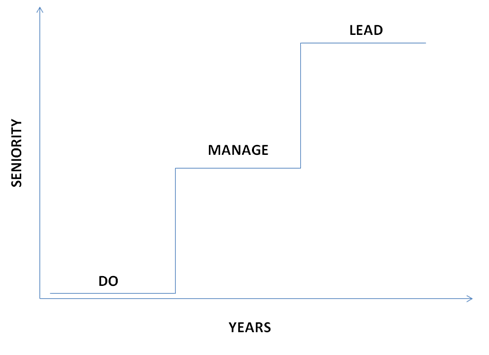
My first real job was as a management consultant, and after that I worked at a number of big companies, and from both I inherited a clear, incorrect sense of how my professional life should evolve.  It looked something like this:

Meaning:

  • As you’re starting out, your job is to DO: folks give you assignments, and it’s your job to execute (“build this model;” “complete these benchmarking interviews”; “write this proposal”).
  • Then eventually you become a “manager”: there are projects for you to run, and people for you to supervise, and you have to figure out how to do that well
  • And finally you are anointed a “leader” (aka Partner, C-level exec, etc.) – you’re in charge and you decide things

What always felt mysterious was how one jumps from one step to the next.  You could do a good job on stuff and eventually you’d be recognized and promoted (hopefully), but I knew that the cashflow models I was building as an entry-level consultant weren’t teaching me to sell projects, so how would I ever leap that chasm?  Plus, it’s a terrible waiting game: at its best, you set a bunch of ambitious goals, work to exceed those goals, and hope someone notices you and gives you that big promotion and a step up the ladder.  You’re out there checking off boxes, but you’re also waiting for someone to decide it’s OK for you to step forward and do the next thing.

This model is dead, ill-informed, outdated.   The only real purpose it served was to allow the people in charge to feel in charge, and to make sure that great ideas didn’t come from most of the organization.

Here’s a different chart so simple that it forces you to look it (and yourself) straight in the eye:

Every day, no matter where you sit in the organization and what you’ve been asked to do, you’re in a position to initiate things.  Ideas, seminars, journals, newsletters, blogs, new software projects, better sales pitches, partnerships that will change the game

When you initiate you come up with the idea and get it rolling.  You don’t need permission, because if you create something great and someone loves it so much that they want to grab it from you, that’s fine – you’ve created something of value, and you can go on to the next thing.

Instead of worrying about getting credit and your job title, worry about leverage.

Stop waiting around.  Stop asking for permission.  Start things and ask to be stopped.   Find people who will help, who can do some of the work, who can take some or all of the credit.  And then do it again.

Whom do we honor?

Recently I found myself in the elevator at Columbia Presbyterian Hospital, the doors closing on the name of yet another mega-Wall Street donor whose name was etched in marble, no doubt honoring a mega gift that built that wing of the hospital.

When I got upstairs I talked to a lovely couple.  The wife was a patient in the hospital who was at risk for giving birth to her twins at 26 weeks – more than 3 months before her due date.  She is a first grade teacher in the Bronx, worried that her students depend so much on her, worried that her sudden departure from the classroom would leave them without the support they needed.  Her husband is a social worker who does work for a number of local organizations in addition to some longer stints in India.

Where were their names on the wall?

Yes, I get it.  If someone chooses to part with tens of millions of dollars – maybe more – of their own money then by all means let’s write their names wherever they want to write them.  And maybe everything is working perfectly: the big name on the wall allows patients in need to get world-class care, so who cares what’s written where in what size font?

But walking through that grandiose hospital lobby, the names of subsequent Wall Street titans vying for all-caps supremacy in their etched legacy, I wished we had the same amount of space to write the names, in boldface, of people living lives of service: the teacher, the nurse, the social worker.

Incredibly Easy

Just saw this ad for Rice-A-Roni Quick Cook.  The tag line is “three minutes to dinner.”

For pasta??  How long does pasta normally take to prepare?

If you give me a pot of boiling water, some fresh pasta and a jar of tomato sauce, I’m positive that I can also create dinner in three minutes.

So what’s the point?

The point is that there’s a huge psychological difference between “easy” and “incredibly easy.”  This is why we’re better off asking people to do only one thing, because each subsequent step, no matter how easy, is nevertheless a step.

It’s not about how difficult the whole process is (cooking fresh pasta), it’s about how difficult the whole process is and how many perceived steps it has (Rice-A-Roni Quick Cook).

“Once and done” feels categorically different.

For example…

Goal “Easy” Incredibly easy
Make music portable Zune iPod
Cheap international calls Vonage Skype
Lose 10 pounds Stop eating dessert Eat only cabbage soup
3 minute dinner Fresh Pasta Rice-A-Roni Quickcook
Watch this video Articulate email followed by a video Email that just says “Please watch this video.”
Email this person? Here’s what you can write Here’s what you can write and her email address is incrediblyeasy@domain.com
Get a decision from your boss What do you think? Here’s what I think we should do.  Let me know if you disagree.
Get someone to make a donation We’d love if you could help in any way you can We need 10 donors to give $25,000 each to hit our goal.  We have 8 already.  Can I sign you up?

(And, to make this incredibly easy, click here for your very own, ready-made, “incredibly easy” chart to fill out.  Fill in the Goal and the “Easy” columns with the things that you’re having trouble getting people to act on, and fill in the “Incredibly easy” column with new ways to make these things Incredibly Easy.)