Eradicating the two-handed forehand

Last weekend I was playing tennis with my son.

To get a little more oomph on the ball, he has been hitting his forehand with two hands.  He’s definitely big enough now to hit it one-handed, so I decided to try to change the habit.

Me:                        Try hitting with one hand!

(thwack!!)             (two handed forehand)

Me:                        That’s great!  Remember, one handed!

(thwack!!!)            (two handed)

Me:                        Good job!

(thwack!!)            (two handed)

Me:                       Excellent.  Let’s try it with one hand now…

(thwack!!)            (yes, two handed again).


So, I tried another tactic.

Me:                        Let’s play a game.  You get one point for connecting with the ball, two points for hitting it over the net with two hands, and four points for hitting it over the net with one hand.

(thwack, thwack, thwack, thwack)           (ALL with one hand).


Kids are just kids, right?  That’s why this works, because they love simple, arbitrary games like this….  Something like “getting more points” for doing something would never motivate an adult.

Maybe, maybe not.

Too often we attack a problem or a behavior that we want to change (in ourselves, in someone else) by taking it head on.  This gets us there intellectually but not emotionally, which is why we so often fall short on making the changes we want to make.  We overestimate the capacity of our logical, deductive mind to influence behavior, based on a belief system that says that our logical, deductive mind is in charge – when it really isn’t.

One other observation.  While playing with my son, I started giving out “bonus” points for all sorts of things – long rallies, backhands, great gets, you name it.  But even with this good intention in mind, I would occasionally hold myself back in giving out these points – based on a vague notion of being “fair” and playing by the established rules.

Talk about crazy: being stingy in giving out made-up points in a made-up game, because I wanted to be fair.

It’s almost never the wrong time to be more liberal in giving out praise, rewards, acknowledgments that people value.  Yet somehow we hold back, keeping great words of encouragement to ourselves.

And so the two-handed forehands – the crutches people rely upon because they don’t know how good, strong, and capable they really are – persist.

Project leader or project doer

There’s a lot of confusion about this one, because you can “do” all the work and not lead, and you can effectively “lead” something without doing all the work.

So sometimes someone is asked to “lead” a project and what they hear is “please do all the work.”  And sometimes the fact that someone is asked to “do all the work” is confused with a leadership opportunity – it is a step towards leading, but it’s not the same thing.

“Leading” means: I’m ultimately accountable for the success of this thing.  If I’m successful at leading, it will be done better and faster than expected and all the people doing it will feel great about what they accomplished together.  They may not even notice that I “led” anything – in fact it could be a great sign if they didn’t.

The most interesting, underappreciated opportunities are leadership opportunities when you’re not in charge.  It’s important because it’s the top-LEFT quadrant in this 2×2 (lead but not doing) that has the most leverage, not the top right (leading and doing).

The upper right has you working as hard as is humanly possible and feeling in control, but there’s a limit to how much this quadrant scales.


Akil and Sciryl

A guy’s on the subway car with a guitar, ready to sing.  New guy for today, but really he’s just another guy with a guitar…the same old story.

But then a passenger yells out, “YOU KNOW ‘MONEY MONEY MONEY BY THE O’JAYS?  I WILL GIVE YOU TEN DOLLARS…TEN DOLLARS…IF YOU CAN GET THREE PASSENGERS TO SING ALONG TO THE CHORUS WHILE YOU SING!”

The guitarist says he’s game.

The passenger stands up, starts goading the guitarist, starts goading the other passengers – “C’MON NOW, THE BRAVE ONES ARE SINGING.  HOW ABOUT THE REST OF YOU?”

And then, ten seconds later, the trouble-making passenger starts bee-bopping.  He’s part of the band, he’s the front man, in fact.

“IT’S TRUE,” he says, “NO ONE ON THE TRAIN WOULD EVER BE THIS NICE TO A STREET PERFORMER!”

And the riffs continue.  “WE’RE NOT HOMELESS, WE’RE NOT HUNGRY.  IN FACT, WE SMELL BETTER THAN YOU….Just kidding…WE’RE JUST DOING WHAT WE LOVE, SHARING WHAT WE DO.  BUY A CD, GIVE A DONATION, WE TAKE CREDIT CARDS…JUST GIVE US YOUR PIN NUMBER…AND GO TO ISAWYOUGUYS.COM…THAT’S ISAWYOUGUYS.COM….ISAWYOUGUYS.COM.  HAVE A NICE DAY.”

These guys call themselves Akil and Sciryl (“lyrics” spelled backwards).  And you can indeed find them at isawyouguys.com.

Here’s the deal: you’re facing the same choices as these guys.  Your can choose to be a regular old street performer by showing up in the way you’re supposed to show up – you look appropriate, you act appropriate, you pitch in an appropriate way – in which case the only way you win is by being the single best street performer they’re looking for that day (and happening to sing the song they love).

Or, you can put on a show, a show they’ve never seen before, a show a lot of people won’t like but a few will stand up and say, “Finally, I’m sick of all these crappy performers, what I was dying for was a little entertainment!!  Let’s talk.”

It’s safe to be a street performer, and you won’t make any enemies.  But artists put on shows.  That’s what makes them artists.

The O’Jays certainly knew that.  Look at those outfits, look at those moves.  A SHOW.

Blog maintenance – for email subscribers

For those of you who subscribe to this blog by email, I just changed the “from” email address for the FeedBurner feed you receive.

There’s a small chance that new posts will get caught in your spam filter. If you don’t receive posts this week, please check your spam folder, and to be sure you can add sashadichterblogs [at] gmail.com to your “safe senders” list.

Thanks for subscribing!!

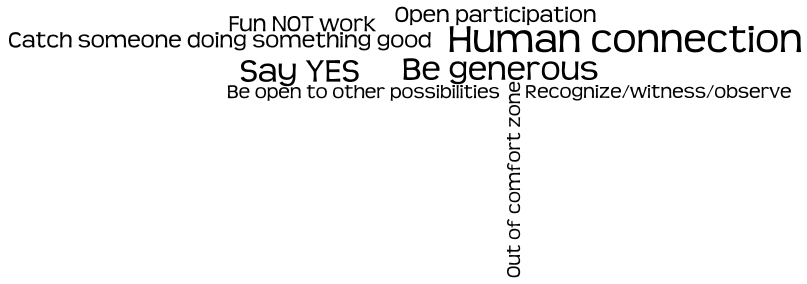
Generosity Day 2012 – the visual

Had a great planning meeting this week for Generosity Day 2012.  We had our original group that hatched the plan (Katya Andresen, Scott Case, Ellen McGirt) plus a few new friends who you’ll get to know soon enough.

I won’t go into too much now, except to share the Wordle of the principles that we feel underpin Generosity Day, and to say that, YES we’re doing it again in 2012.

This is just a first draft.  Ideas welcome.

Spam tax

Somehow the spam I’m getting is getting better with subject lines that make me open the message (hmmm, maybe they’re reading some of my posts!). Things like “Can we meet this week?” and “Following up about next week’s lunch.”

I’m a huge, huge fan of Chris Anderson’s email charter and believe that there’s a LOT we can do to free ourselves from the non-spam email onslaught by changing our own behaviors and expectations.

But spam is still a huge amount of all email sent (as much as 90% in 2009, though it has been dropping lately), and spam that’s getting through my (and your) email filter is getting smarter every day.

So here’s an idea: create a $0.10 spam tax that is platform-independent (works on Google as well as Outlook).  If an email recipient hits the “report spam” button:

  • They are automatically unsubscribed from that email list (this may be difficult to implement, but if possible it would prevent abuse of the “tax them” link while also killing two birds with one stone – unsubscribing + tax)
  • If more than a certain number of people (100) qualify an email as spam, the tax kicks in (again to prevent frivolity)
  • Implement this universally with a single searchable web-based database of spammers, also listed tax paid, etc.

There’s some work to be done to make the tax big enough to have this be a real deterrent – ideally the tax level would be greater than what spammers pay to buy my email address.

This feels like a pipe dream, but maybe someone can take the idea and make it better.

My Outlook “Block sender” button doesn’t feel like enough any more, since these people are actively cutting into my (and your) productive time, and it would be of great public value to architect a “sin tax” that puts a damper on this.

For the comments section: what would you do with the money collected through this tax?

Innovation isn’t really like apple pie

No one dislikes “innovation” as a concept.  It’s like mom and apple pie (in the US at least) – no one will ever, ever stand up and say, “I’d like us to innovate less!!”

No, that would be too obvious.  Instead they say, “Of course we want innovation but let’s….

…make sure we don’t go over anyone’s head.

…ensure we don’t surprise people, or offend anyone.

…get buy in from all potential stakeholders.

…form a working group to think it through a little more.

…dot every i and cross every t.

…not go too fast.

Sorry but it doesn’t work this way.

Not all innovation is about lone wolves in back rooms – in fact the most innovative cultures are highly collaborative.  At the same time, you have to decide what you value, and be willing to make tradeoffs to protect it; add one thing too many to the mix (that extra approval, that check and balance, that unwillingness to step on a few toes) and you extinguish the flame.

Everyone loves the idea of innovation, but most people are unwilling to take their culture to a place where innovation thrives.

That’s why it’s so rare.

No hobbies

People dabble in everything.  Restaurants and bed n’ breakfasts are popular semi-serious pursuits – romantic ideas right up until the moment when you’re mopping the floors or scrubbing pots with ammonia at 2am.  Then, they’re just hard work.

Of course restaurants that don’t work flame out (not 9 out of 10, which is the conventional wisdom, but three out of five in the first five years): if not enough people come through the door to buy dinner – or if you don’t manage your staff right, or purchasing right, or any other number of things – you don’t make ends meet and you’re forced to close up shop.

Nonprofit work is a sometimes hobby too, but without the floor-scrubbing to keep us honest.  So nonprofit service, philanthropy, board service or a part-time CEO role can be something we do a little bit on the side, when it’s easy and convenient (meaning: a little bit well) because, well, doing something is better than doing nothing.

It’s not though.

Doing something poorly and inattentively, especially service work, can be worse than nothing, because we’re making promises we can’t keep to people to whom too many promises have already been broken.  Real lives, real hopes, real dreams walk through our doors every day, and if we don’t treat these dreams with the respect, the seriousness, and the professionalism they deserve, we and they are better off just staying home.

We can do this just a few hours a week, do this as part of something bigger, do this in whatever way works in our lives.  But no hobbies, please.  It’s just too important.


Doing what you want

Even today, there’s so much griping about the opportunities we don’t get, the hierarchy and the job titles and all that nonsense.

Here’s an idea – why not be so darn valuable that you can write your own ticket?  Take whatever they’re asking you to do, double that, and do it without breaking a sweat.  And on top of that, do what you want.

It’s true, this isn’t a shortcut. If anything it’s a “long cut.”

No one said you’d get there without working really hard.  And at the end of all this you’re exactly where you want to be, which is way better than complaining about all that cool stuff they’re not letting you do.

What you’re not

This sign is in the window of a great omakase sushi bar in New York.

Eight words and you know what you’re in for.

Saying what you’re against is a great shorthand way to describe yourself.  You tap into all the emotions that the thing you aren’t (whatever that is) created in the years before you arrived.

Of course, you’re limiting yourself to the people who don’t like the thing that you’re standing up against, but that’s probably enough for now.

I don’t love the negativity this approach implies, but at least you’re standing for something and people will grok you pretty quickly.  It’s a start.