Generosity Day

Generosity Day is here!!!

We announced it on Friday, and it’s spread like wildfire over the weekend (1,000+ tweets, expecting 30-40 blog posts today at a minimum…for example on FastCompany, ABC News, Katya’s Nonprofit Marketing BlogMalaria No More, Beth Kanter’s blog, New York Public Library).

Our hunch was spot on: people are hungering for something more in their lives – more connection and more meaning.

When I put up my post on Friday, I was hoping this idea would spread.  It has.

But that’s not good enough.  Now I have a much bigger aspiration.  We need people to ACT.  Thousands of actions.   Millions of actions.  Tweeting ain’t enough.

So please, today, continue to spread the word AND to celebrate Generosity Day through your actions. It’s a day of practicing saying YES, because doing so will change you and change those around you.

Give to people on the street.  Tip outrageously.  Help a stranger.  Write a note telling someone how much you appreciate them.  Smile.  Donate (more) to a cause that means a lot to you.  Take clothes to GoodWill.  Share your toys (grownups and kids).  Be patient with yourself and with others.  Replace the toilet paper in the bathroom.  All generous acts count!

As you act generously, and as you witness acts of generosity, please keep folks updated using the #generosityday hashtag or post on www.facebook.com/generosityday

For example:

I just celebrated #generosityday by tipping my waiter 50%! Reboot Valentine’s Day by being generous! http://bit.ly/fJASGV

I’m commemorating #generosityday by volunteering for @pencilsofpromis!  Share your stories on www.facebook.com/generosityday

Just watched someone smile and shrug after being splashed by a car driving by.  It must be #generosityday

Happy Generosity Day, and here’s to the start of a new tradition!!!

(A HUGE thank you to all the people who have made this happen, especially Scott Case at Malaria No More for (inadvertently?) pulling together me, Katya Andresen and Ellen McGirt on a panel for Social Media Week, and to Katya and Ellen for their encouragement to do this now.)

Thank you to all the folks who have jumped in to spread the word, including:

Katya Andresen’s Nonprofit Marketing Blog, Ellen McGirt at FastCompany, Malaria No More, ABC News, the New York Public Library, Jennifer McCrea’s Exponential Fundraising Blog, The Marketoonist, Lucy Bernholz (Philanthropy 2173), Sharon Schneider (The Philanthropic Family), TBD, the Christopher and Dana Reeves FoundationHyderabad HappinessJocelyn Wyatt, Idea Transplant, New Frontier, Getting Attention Nonprofit Marketing Blog, Keoghzer’s Blog, Frugaltopia

Rebooting Valentine’s Day

I want all my readers to hear first.  This Monday, Valentine’s Day, is going to be rebooted as Generosity Day: one day of sharing love with everyone, of being generous to everyone, to see how it feels and to practice saying “Yes.”  Let’s make the day about love, action and human connection – because we can do better than smarmy greeting cards, overpriced roses, and stressed-out couples trying to create romantic meals on the fly.

I’ll share more on Monday morning (Valentine’s Day), but wanted to let my readers know today that I’m reaching out to a bunch of great bloggers who I respect to spread the word.  Would love your help in doing the same.

On the day of, we’ll be using the hashtag #generosityday to share what people are doing.  The goal is to spend Valentine’s Day being more generous, giving more money, sharing of yourself, being of service.  All acts of generosity, small and big alike, count.  But you have to say YES to everything that’s asked of you, all day long! It’s about creating more generosity in the world, and becoming a more open person along the way.

BACKGROUND: Longtime readers will remember my Generosity Experiment (here’s the blog post or, if you prefer, here’s the video).  My experiment lasted a month, and I found it transformative.  I bet you’ll love doing this for a day.

Examples of great things to do on #generosityday:

  • Give money to….a street musician, a homeless person, your favorite charity
  • Take old clothes from your closet and give them to goodwill
  • Leave a $5 tip for a $2 coffee
  • Introduce yourself to someone you see every day but have never said hello to
  • Bring in lunch for your co-workers
  • Give someone a compliment

If you like this idea, please:

  1. Between now and Monday, tell people (Facebook, Twitter, etc.) that you’re committing to a day of generosity this Valentine’s Day.  Committing in advance will help you follow through. (Sample Facebook/Twitter status update that you can post BEFORE MONDAY:  “I’m in!  Let’s reboot Valentine’s Day as #generosityday on Monday http://bit.ly/fJASGV”)
  2. Add to the list (above) of suggested generous actions by commenting on this post or contacting me directly.
  3. Share the idea with other bloggers and friends by emailing them the link to this page (http://bit.ly/fJASGV)

This could be big – but I’ll need your help to make it happen!

The future of impact investing

I’ve now spent four years in the impact investing space, and nearly three years as a blogger on philanthropy, generosity and social change.  The landscape looks radically different than it did just a few years ago.

On the upside, JP Morgan is now saying that impact investing might be a $1 trillion market; “impact investing” and “social entrepreneurs” are two of the top 10 philanthropy buzzwords of the decade; and we’ve seen a flourishing of philanthropy, especially by mega-donors, both in terms of total philanthropic dollars committed and in more visible and more public talk of results-oriented approaches.

At the same time we’ve seen the limits of markets: the global economy nearly collapsed in late 2008; microfinance, wunderkind of new philanthropy, was shaken to its core by a wave of suicides in southern India late last year.  No wonder that some are calling 2011 the year of reckoning for social enterprise.

Here’s my take on what this all means, from my talk at the 2010 NextGen:Charity conference.

(You also don’t want to miss these other great talks from the conference: Scott Case, Scott Harrison, Scott Belsky, and Nancy Lublin.)

Enjoy, and please share you reactions.

[vodpod id=Video.5460954&w=500&h=400&fv=id%3Dbotr_0uDsHjLx_E6iRurJJ_swf%26amp%3Bbackcolor%3D%23FF0000%26amp%3Bplaylist%3Dnone%26amp%3Brepeat%3Dlist%26amp%3Bsharing.code%3DE6iRurJJ%26amp%3Bsharing.link%3Dtrue%26amp%3Btitle%3DDichter1%26amp%3Bping.script%3Dhttp%3A%2F%2Fcontent.bitsontherun.com%2Fpings%2F%26amp%3Bimage%3Dundefined%26amp%3Bstretching%3Duniform%26amp%3Bheight%3D300%26amp%3Bwidth%3D520%26amp%3Bcontrolbar%3Dover%26amp%3Bautostart%3Dfalse%26amp%3Bskin%3Dhttp%3A%2F%2Fd1rhaz9gq9lm5b.cloudfront.net%2FOVMaINvn.zip%26amp%3Bfile%3Dhttp%3A%2F%2Fcontent.bitsontherun.com%2Fjwp%2F0uDsHjLx-878038.xml%26amp%3Bplaylistsize%3D200%26amp%3Bplayerready%3Djwplayer.api.playerReady]


Whom do we honor?

Recently I found myself in the elevator at Columbia Presbyterian Hospital, the doors closing on the name of yet another mega-Wall Street donor whose name was etched in marble, no doubt honoring a mega gift that built that wing of the hospital.

When I got upstairs I talked to a lovely couple.  The wife was a patient in the hospital who was at risk for giving birth to her twins at 26 weeks – more than 3 months before her due date.  She is a first grade teacher in the Bronx, worried that her students depend so much on her, worried that her sudden departure from the classroom would leave them without the support they needed.  Her husband is a social worker who does work for a number of local organizations in addition to some longer stints in India.

Where were their names on the wall?

Yes, I get it.  If someone chooses to part with tens of millions of dollars – maybe more – of their own money then by all means let’s write their names wherever they want to write them.  And maybe everything is working perfectly: the big name on the wall allows patients in need to get world-class care, so who cares what’s written where in what size font?

But walking through that grandiose hospital lobby, the names of subsequent Wall Street titans vying for all-caps supremacy in their etched legacy, I wished we had the same amount of space to write the names, in boldface, of people living lives of service: the teacher, the nurse, the social worker.

Here’s how I can help

When trying to console someone, I’ve often found myself, at a loss for what to do, saying “Let me know how I can help.”  Today, in just such a same situation, a friend modeled a different kind of behavior.  She said,  “Why don’t I….” and offered up a few very specific ideas of things she’d like to do to help.

This feels like the difference between not-so-helpful generic feedback (“Great job!”) and very useful, specific positive feedback (“What I particularly liked was when you…”).

Specifics help in all situations, especially when someone is feeling a sense of loss.  Usually, a big part of the gift you give is taking away someone else’s burden of making a decision.

Generosity arbitrage

Here’s a nifty transaction for the economically-minded among you (and for everyone else too):

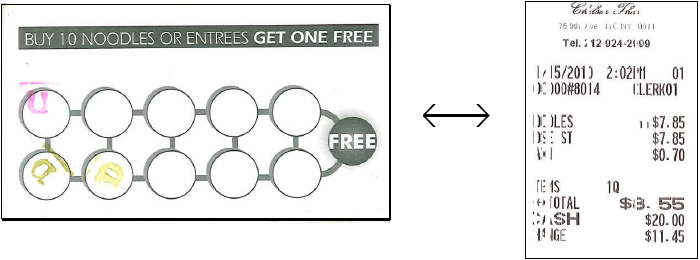
  1. I bought lunch at the local Thai restaurant for $8.55
  2. I got $0.45 change that I dropped in the tip jar, for which I got a smile
  3. I got a stamp on my “Buy 10 noodles or entrees get one free” card, which made me smile

The stamp is worth about $0.85 (1/10th the price of an entrée), though in reality a little less since I’ve been known to lose the card.  So basically the 45 cent tip I’m giving and the stamp I’m receiving are a wash, financially speaking.

Even though the transaction would have been almost identical – in terms of money changing hands – if I’d not gotten the stamp and I’d not left the tip,  that’s not how it felt at all.  How it felt was that we each (I and the restaurant owner) had taken the opportunity to trade gifts, we had each willingly acted generous with each other, and we both came out ahead as a result.

There’s a reason that there is a tradition of exchanging gifts – whether at holidays (synchronously) or birthdays (asynchronously).  It’s because gifts are special, irrational things that allow us to express love or thanks or hope.

One of the biggest problems about looking at everything through an economic lens is that you inevitably place more value on the things that are easy to count and easy to measure.

Don’t do me any favors

Building on last week’s post, some more thoughts on how to ask for things.

A friend and experienced public speaker recently shared that for any speech she thinks about an audience full of friends – people who want to see her succeed (different from a room full of clones of my inner critic…)

It’s the same with asks.  Go through the world acting generous and expecting generosity in return, and make asks with this mindset.  This will affect both the way you make asks and what you ask for:

  • the way you ask because in expecting generosity you will ask unapologetically, which inherently makes your ask stronger;
  • what you ask for because as a generous person you won’t fall into the trap of asking without giving back, nor will you act like you have nothing of value to give (of course you do!).

But “favors” are another thing entirely.  “Favors” to me feel like one-off, I’ll-go-out-of-my-way-this-one-time sort of things.  That’s absolutely fine when what you actually need is a favor (“help, I’m totally stuck, can you bail me out?”), but most of the time you don’t need to be bailed out.  Most of the time you need help from someone who’s on your side, who has the same goals, who is part of building what you’re building.

I see this dynamic play out a lot when someone at a nonprofit feels like they’re approaching someone more high-powered than they are – a major donor, a board member, etc.  With the mindset of asking for a favor, the donor is treated with kid gloves, the nonprofit staff member is sheepish and apologetic, and awkwardness and a “we/you” mentality ensues.

Ask for help, give help.  Leave favors for everyone else.

Letting go of my gift

A few weeks ago I emailed a Pakistani colleague to ask for her advice about which organization – among those recommended by Acumen Fund – to give to for flood relief.

While looking at the recommended organizations, I found myself thinking about all the things one thinks about in these situations: how much of the money will go directly to help people? How credible and well-managed is the organization?  What kind of difference will this make in people’s lives?

All normal questions, though in some way they felt absurd upon further reflection.  I gave what I could give because of the tragedy that these floods represent, because of the tens of millions of people whose lives have been uprooted and whose homes and livelihoods have been destroyed.  I gave as an act of solidarity, as a too-small act of expression of my shared humanity with those who are suffering.

But the actual gift – its monetary value – in the context of everything, is tiny, is miniscule, is quite literally a drop in the bucket.  It’s like casting a vote in an election – something totally irrational in terms of my ability to affect an outcome, but something that is fundamental as an expression of my rights as a citizen, an act in support of democracy, and a statement of my values.

In this way, the act of giving is an act of self-expression, a statement of my values and obligations as a citizen of the world, and, perhaps most importantly, an act of generosity.  And generosity is act that expects nothing in return.

This made me wonder again what was going on when I was pondering the potential efficacy of my gift.  Was I, in some way, unable fully to let go of the notion that “this is my money that I worked hard to earn, and I’m only parting with it in exchange for something tangible that I’m getting” (in this case for someone else).

This may be where I – where we – get tripped up.  The thing that we’re used to doing, that we’ve been trained to do, is to buy stuff. We part with money and in exchange we get……  whatever it is that we get.

Maybe philanthropy is something completely different, maybe it’s a sheep in wolf’s clothing: an act of self-expression disguised as a transaction.  In which case we’ve got the order all wrong – we cannot first go through all the learned calculations of what-am-I-getting-for-my-money but instead have to start with ourselves, who we are, and who we want to be.

I worry that in our pursuit of better, smarter philanthropy, we run the risk of trading in soft-heartedness for hard-headedness, and in so doing everyone ends up coming up short – because this is a false choice, one we don’t have to make.  Of course we want money to go the furthest, we want to support the best organizations, we want to make change.  But the “we” in the equation matters a lot.  We, people who give (and people who ask others to give), are affected by our own actions.  We are also striving to be the best version of ourselves.  And we, in the act of giving (the way we approach it, the reasons for our actions, the way we let these actions change us) have a chance to take another step towards becoming the person we hope to be.

A dollar fell out of my pocket today

A dollar fell out of my pocket today

while I was riding the subway.

A passenger tapped me and pointed to the folded bill

on the ground.

Meanwhile a homeless man was asking the car for money.

I looked at the dollar and realized it wasn’t my dollar.

So I handed it to the homeless man.

And I was left wondering.

Is it ever my dollar?

add to del.icio.us : Add to Blinkslist : add 

to furl : Digg 

it : add to ma.gnolia : Stumble It! : add 

to simpy :

seed the vine : : : TailRank : post to facebook

Reminder

I arrived in India yesterday. There’s nothing like landing in a big, populous, mostly poor country to remind us how much is handed to us – in terms of access and opportunities.

And if we remember that most of what we have has been given to us, it is so much easier to see that the only real choice we have is to keep on giving – so that we in turn can serve others who, for no reason at all, have been given less.  It is really the only way to show our gratitude and our humility.

post to facebook : add to del.icio.us : Add to Blinkslist : add to furl : Digg it : add to ma.gnolia : Stumble It! : add to simpy : seed the vine : : : TailRank