The generosity muscle

As we start to spread the word about Generosity Day 2012 (thanks to all who signed up to be part of the core group  – more coming soon!!), we’ve naturally gotten a lot of “why” questions – mostly from enthusiasts who want to be able to explain the day to others, and some from (friendly) skeptics.

If anything came from the heart for me, it is Generosity Day, so unpacking “why” has been an instructive exercise in reverse engineering of an intuitive decision.  Therefore, this (and subsequent) reflections aren’t answering the question “why did I do it in the first place?” (meaning: this was the plan all along), they’re answering, “what insights have I gained along the way?”

One of the core insights is that for many of us – especially those who are more cerebral (and in this I include a big swath of the “smart philanthropy” crowd, whether donors or social enterprise enthusiasts) – our thinking around smart social change is crowding out our natural instincts about how we want to be in the world.  Put another way, we are letting our thinking about what’s best get in the way of how we want to act.

Ironically, in our pursuit of better solutions, we continually reinforce our own practice of turning things down – things that don’t meet our “evolved” criteria of good social work.  The end result of this is atrophy of our generosity muscle, since anything that is underused withers away in time.

The intentional practice of generosity is a way to strengthen this muscle, to get us more comfortable using it, and to make using it a more regular part of our lives.

That’s very different from claiming that saying “yes” to everything is the best kind of philanthropy.  It isn’t.  But philanthropy that doesn’t incorporate generosity doesn’t make sense in my book.

If you’re the equivalent of muscle-bound when it comes to generosity – if it’s part of who you are and how you walk through the world every day – then you probably don’t need Generosity Day.  But I suspect many of us could use a generosity tune-up.  Indeed, my wager is that a large group of people taking the same leap of faith around generosity, pushing themselves to do something outside of their comfort zone, and then coming back together to share and reflect on that experience, will generate new insights for all of us.

For those in our core group (could be you!) who want to help spread the word about Generosity Day, we’re going to propose undertaking a one week generosity experiment, before October 31st, to see how it feels.

You could give it a go too.

Go ahead, flex the generosity muscle, reflect on the experience, see how it affects how you go through the world.

The screwdriver

Last week, while on vacation in the South (a few days before hurricane Irene upended our plans), I’d managed to pull down a venetian blind in the house we were renting and I needed a Phillips head screw to fix it.

I made my way to the hardware store, picked out five screws of varying sizes, and told the owner that I’d like to buy a cheap screwdriver to screw in one of these screws.

Rather than sell me a $10 screwdriver and charge me another buck for the screws, he lent me a screwdriver and asked me to bring it back.  I then reached into my pocket to pay for the screws and he said, “Don’t worry about it.”

That just about made my day.

And it got me thinking, again, about generosity, about how our analytic minds mess with us so much when we are steeped in so many intelligent discussions about philanthropy and the best ways to practice it.  It’s easy, when we are talking about giving to others, to critique generosity and soft-headed or impractical.  But I bet there’s not a person out there who, when someone is irrationally kind to them, stops to say, “well, that didn’t make an awful lot of sense, and that person shouldn’t have been so generous to me.”

It’s like the old adage about comedy and tragedy: comedy is seeing someone walking down the street fall into a manhole; tragedy is when I stub my toe.

When we talk about ourselves, and our own experiences, there’s no amount of generosity that feels like too much.  When we talk about others, everything is supposed to be bounded and thought out and make sense.

Generosity is a way of walking through the world and spreading joy.  Nothing more, nothing less.

It’s up to you to decide how much you want of that in your life.

Generosity Day 2012 – the visual

Had a great planning meeting this week for Generosity Day 2012.  We had our original group that hatched the plan (Katya Andresen, Scott Case, Ellen McGirt) plus a few new friends who you’ll get to know soon enough.

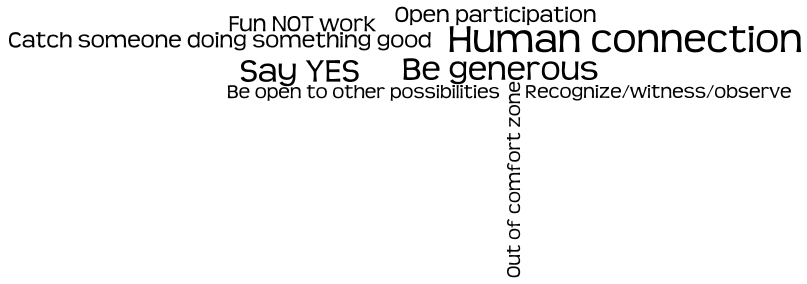
I won’t go into too much now, except to share the Wordle of the principles that we feel underpin Generosity Day, and to say that, YES we’re doing it again in 2012.

This is just a first draft.  Ideas welcome.

Dear nonprofit

[Here’s the link to yesterday’s letter: Dear (potential) donor]

Dear nonprofit,

Speak up for yourself!  Don’t play the supplicant, tin cup in hand, hoping that some change will fall from that purse (or that pocket).  Your time is precious and the playing field is level.  You offer something of great value, both to the beneficiaries of your work and to your (potential) supporters.

Believe that and start treating yourself with the respect you deserve.  Believe that and start treating your potential supporters with the respect they deserve.   Be clear what you’re talking about and why, state out loud your hopes and expectations for where this conversation is going, risk saying early on what your goals are – knowing full well that the whole thing might crash and burn because you had the nerve to say something out loud that others were thinking.

It is true that the best partnerships take time to develop, that they can meander and take surprising twists and turns, that it’s not usually a straight line from here to there.  So be open, be generous, explore and share your dreams.

But by all means act like an equal partner in the endeavor, because you have so much to offer.

Sincerely yours,

Your (potential) donor

Keith Ferrazzi on trust, vulnerability, and deliberate relationship-building

Keith Ferrazzi, author of Never Eat Alone and Who’s Got Your Back, gave a fascinating talk yesterday at The New York Forum (event livestream is here – the Forum is from June 20-21st, my panel is this afternoon).  It was a broad brush conversation about how human beings build connections with one another, and Keith gave a passionate argument in favor of being more intentional about how we build relationships.  (bonus: if you want to dig into this stuff, check out Keith’s Relationship Master’s Academy.)

Keith’s headline is that we should all have a “people plan” – a listing of the top 25 relationships that are most important to our long term success, and a commitment to investing substantially and intentionally in these relationships.  And here’s the part that I loved: Keith argued that the only way to be successful in investing in these relationships is to lead with generosity, to enter every conversation thinking about “how can I help?”  This is the polar opposite of figuring out what we can get, the opposite of thinking about how to close the sale, and (of course) the opposite of figuring out what we can GET.

The other big idea I was left with was that, as life becomes increasingly virtual and as job tenure decreases, the natural building of relationships that used to happen in business is disappearing.  For example, Keith shared a story of IBM getting rid of all of its sales offices – the expectation was that this would both decrease costs and allowing salespeople to have much more time at home and better work/life balance.  What they didn’t foresee was how much was lost – the intangible connective tissue of shared stories, the decompressing and complaining about customers or about management, the informal mentorship that used to happen at the local Bennigan’s on Thursday nights.  The result: the company scuttlebutt is that IBM, which used to stand for “I’ve Been Moved” (to the next regional office) now stands for “I’m By Myself.”

Keith’s suggestion is that, especially for the generation (mine) that didn’t grow up in a social media, online world, we have to make much more deliberate attempts to create connection, to be vulnerable, to create an environment of trust as a precursor to the “business at hand.”  Keith shared that at Cisco, a major user of Telepresence virtual conferencing, they have implemented personal/professional “check ins” in the first 5 minutes of all Telepresence meetings, because the natural swapping of personal stories that happens at the start of in-person conversations actually doesn’t happen when we have virtual conversations.

Just one example, and I’m not sure I’d follow this one to the letter.  But I love the broader idea: that if we want to innovate, if we want to have tough and real conversations about big strategic decisions, if we want to dig in to areas of uncertainty, we will be much more successful if we make deliberate investments in creating bonds of trust, no matter how far away our colleagues or our customers sit.

Every day it gets easier to skip this step: to fire off emails to people we barely know, focused on the tasks they need to complete; to hold global conference calls in which most people say almost nothing; to never, ever, pick up the phone to a key colleague sitting far away, not with an agenda, but just to talk and see how things are going.

By skipping these step, we skip investing in trust, and we relegate ourselves to exacerbating global/local tensions, where trust and rapport exists for workers in the same office and global bonds – far from being stronger, thanks to all of this technology – keep on getting weaker.

Increase global empathy

I had the chance to spend some time last week with Eric Dawson, the co-founder and CEO of Peace First.  Peace First works with kids aged 4 to 14 to teach them to engage productively with each other in peaceful ways.  Peace First is working to counteract the overwhelming barrage of violence that young kids come across every day – not just on TV and in video games, but in schools and in their role models – and teaching them and their teachers conflict resolution skills to live more productive and more peaceful lives.  They’ve already trained over 40,000 kids and trained more than 2,500 teachers.

When I asked Eric what his dream would be for a global goal for the next decade, he said he’d like to “increase global empathy.”

It’s elegant in its simplicity. It’s possible.  And it’s powerful.

I spend a lot of time thinking about generosity, so I can’t help but contemplate how Eric’s dream about increasing global empathy intersects with my quest to give people permission to be generous.  To me, generosity is a “gateway drug” to empathy: when people tell me about their own generosity experiments, inevitably their “aha moment” is the experience of real connection with another person.  Anyone engaged in a conscious practice of generosity has to stop walking by and closing the door on other peoples’ experiences.  The decision to have a practice of generosity is an a priori decision to stop, to look someone in the eye, and to connect with her.

I’ve found that the practice of generosity creates transformation on multiple levels.  Being generous makes you be more generous.  Being generous helps you to experience more empathy and, in time, become more empathetic.  And being generous is an opportunity to tap into a true sense of abundance, in one’s own life and in others’ lives.

I’m glad to know Eric and to be getting to know Peace First, and I’m curious to hear what others think about empathy, about generosity, and how to cultivate both to live a richer life.

Here’s Eric’s moving 6-minute talk from Pop!Tech in 2008 (link is here if it doesn’t embed properly):

[vodpod id=Video.7806534&w=425&h=350&fv=]

Closing the loop

In asking for help, you are often giving a gift to someone – exposing your own need and vulnerability (which can be hard), and giving them an option to shine.

You are not necessarily incurring a debt of any kind, but instead (when you ask in a genuine way for a genuine thing) are giving someone the chance to be generous.

You have the same opportunity to be generous in return.  Sure, you can thank someone.  Much better, though, is to let them know how their help helped – be very active here, very specific, and share your success, bathe them in that same warm glow.

You’ll feel better and they will too.  Otherwise, they might feel like all they’ve done is howl at the moon.

In asking for help, you are often giving a gift to someone – exposing your own need and vulnerability (which can be hard), and giving them an option to shine.

You are not necessarily incurring a debt of any kind, but instead (when you ask in a genuine way for a genuine thing) are giving someone the chance to be generous.

You should take that same opportunity.  Sure, you can thank them.  Much better, though, is to let them know how their help helped.  Share in your success.  Bathe them in that same warm glow.

You’ll feel better and they will too.

In asking for help, you are often giving a gift to someone – exposing your own need and vulnerability (which can be hard), and giving them an option to shine.

You are not necessarily incurring a debt of any kind, but instead (when you ask in a genuine way for a genuine thing) are giving someone the chance to be generous.

You should take that same opportunity.  Sure, you can thank them.  Much better, though, is to let them know how their help helped.  Share in your success.  Bathe them in that same warm glow.

You’ll feel better and they will too.  Otherwise, they might feel like all they’ve done is howl at the moon.


Otherwise, they might feel like all they’ve done is howl at the moon.


What you can’t measure

So what was the measurable impact of….?”

Of course this question matters a lot, a ton, the most maybe.

The catch is that we fail to fully appreciate three truths:

  1. You can only measure a subset of the things that matter
  2. We end up convincing ourselves that the things we are able to measure are a good approximation of the whole
  3. But they might not be

A friend was nice enough to send this Skype chat along to me the other day (names changed):

[9:53:08 PM] Felipe: for lent, i’m going to do the generosity experiment

[9:53:24 PM] Felipe: 40 days of saying yes to everything

[9:53:28 PM] Felipe: you are warned 🙂

[9:54:22 PM] Samuel: wow

[9:54:27 PM] Samuel: 40 days

[9:54:28 PM] Samuel: are you sure?

[9:54:45 PM] Felipe: lent is 40 days…i have nothing to give up

[9:54:54 PM] Samuel: ok

[9:55:09 PM] Samuel: Sasha Dichter will be happy to note this

[9:56:17 PM] Felipe: it’ll be on a smaller scale than his, for sure…but let’s see how it goes

(I’m not sure it will be on a smaller scale, really.  The most profound and lasting changes are personal.)

Folks have been asking me: “do we have to wait until February 14th, 2012 for the next Generosity Day.”  Of course not!!!  Start, go, share, inspire others…and if you have a free moment let me know how it went.

Collective Effervescence and Mass (networked) Synchronicity

Why was Generosity Day such a success?

Sure the message was “sticky”, but there’s more going on here.  I’m beginning to understand in a deeper way how people desire to participate in collective opportunities to create something positive, and our increased ability to create these opportunities.

Throughout the first day of speakers at TED2011, I’m seeing a pattern emerge in a number of talks that touch on the power of the internet to allow us engage in global, connected experiences – sometimes simultaneous in real time (like Generosity Day), and sometimes made simultaneous by the curator.

Eric Whitacre today shared a video that I found deeply touching.  Eric, who is a musician and composer, shared sheet music for a composition he’d written and asked people to record videos of themselves singing one part of the music.  185 people from around the world made usable submissions.  They were, of course, singing asynchronously, but Eric and some friends stitched everything together digitally to create a virtual choir.  What’s so amazing (in addition to the sheer beauty and wonder of the video itself) is the sense of connection the participants felt to each other and to the collective experience.  That, as much as the final product itself, is what Eric created.

Aaron Koblin is also combining mass participation in novel ways, whether through having people sketch parts of massive drawings of sheep, or having Jonny Cash fans from around the world create individual sketches that, when played at eight frames per second, create a powerful, fan-generated tribute to this musical legend.

Tony Salvador is an anthropologist who has studied and experienced numerous mass religious pilgrimages, and he’s found that as people come together, it is impossible to avoid getting caught up in the feeling of “collective effervescence” – impossible not to feel joy and connection just from being in the presence of throngs of people who are having joyous experiences.

There is an increasing power and a potential to use the web to create opportunities for collective experience and collective action, and more than ever there is an opportunity to initiate and curate these experiences in a way that taps into a deep sense of connectedness and being part of something bigger.

People are longing for this sense of connection, and maybe, just maybe, the web gives us the power to make this kind of connection happen in very real ways in the very real world.

Here’s Eric’s beautiful virtual choir.  Enjoy.

Generosity day update

What a long way we’ve traveled since Friday afternoon when we set out to reboot Valentine’s Day and kicked off Generosity Day 2011!

My heartfelt thanks to all of you for spreading the word and for pushing me every day to be better, blog better, do better.

We’ve had more than 3,000 tweets, many thousands of blog views, and some of the people I respect most in the world are spreading the word.  More important still, the #generosityday tweets and posts on www.facebook.com/generosityday are focusing on what people are DOING, which is the whole point.

The list of bloggers who have posted is getting too long to keep track of, but at a minimum you’ll want to check out Jonathan Greenblatt’s post on HuffPo, Alex Goldmark’s post on Good.is, Beth’s Blog, Philanthropy 2173, and the recent post on Time.com.

Brene Brown, who writes at Ordinary Courage has always blown me away with everything she does – and the fact that her “Generosity is my new Valentine” post has 200+ comments speaks to the amazing level of engagement she has created with her readers.  Truly a sight to behold.

Finally, if you haven’t yet, do read the great posts that helped kick this all off: Katya Andresen on The Nonprofit Marketing Blog and Ellen McGirt on FastCompany.com.

As Jonathan Greenblatt said in well in the closing of his HuffPo piece:

I deeply believe that everyone can have an impact — and that, taken together, those small acts can roll up into something truly worldchanging. As we were reminded over the past few weeks in Tahrir Square, every singe person carries the fuse of civic engagement that can ignite our common humanity. Sometimes it just takes a small spark to set it off.

This year, let’s make Generosity Day that spark. I want each of us to repair the world. Lets do it, one small act of kindness at a time.

We ARE doing it, together.  I couldn’t be more excited.