Lifetime guarantee

18 months ago I got a fancy work bag as a gift.  Within a year, the little ring holding the strap to the bag broke; a few months later the second one broke.

I finally made my way to their store in Soho in New York’s West Village to see if they’d fix or replace it.  Sure, they said.  It would take about a month to repair, and would cost me $150…to replace two little metal O-rings.

If you’re from the US you probably remember, way back when, when LL Bean was famous for taking back ANYTHING and always being willing to repair it or replace it.  This was long before the web or Facebook or social media yet, despite a lot more friction around messages spreading, that story spread – like the one about the guy who had 30-year LL Bean duck boots that finally gave out, he sent them in to LL Bean, and a brand new pair arrived, no questions asked.

This contrast got me thinking about what we see when a customer takes the time and the effort to bring back something that didn’t work or disappointed her.  Sure you could think her as a cost to be minimized.  You could make sure that the clerk she speaks to doesn’t have the authority to make a call to do something to help her, and you could definitely write a policy that’s going to minimize unwanted returns from people trying to scam you.

Or you could see her as someone who cares enough about your product to come back, someone who’s ready and willing to be wowed or disappointed right at that moment, someone who may as well be holding up a sign that says, “THIS IS YOUR BIG CHANCE: turn me into an evangelist for your extraordinary service!”

So of course you show that person the door…?

I don’t care much about the bag.  But it did get me thinking about the rare opportunities we have to really keep our promises.   It’s hard to imagine, even for folks in the nonprofit space, cases where a “lifetime moneyback guarantee” wouldn’t win you legions of loyal fans who will shout your story from the rooftops.

It’s not just the right thing to do, it also will pay off handsomely in the end.
In the know

There’s nothing better than turning your customers into insiders.  One way is to give them the sense that they’re in the know and they are sharing in a  special secret, even if it’s small and even if it’s only sort of secret.

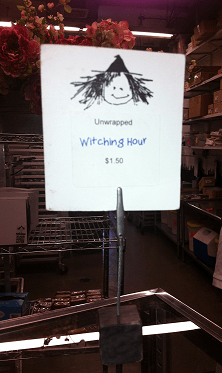
For example, you can get some of the best brownies on the planet at Fatwitch bakery in Chelsea Market.  After 5PM they put up a tiny sign:

Unwrapped brownies sell for $1.50 after 5PM – that’s half price.  Everything else in the store – wrapped brownies, brownie mix, etc. – remains full price, and you have to pay close attention to notice the little sign.  Just the other day I was in there buying a couple of half priced brownies while three tourists bought 30 wrapped mini brownies for full price.

There’s no subterfuge going on here – anyone who orders a brownie at the counter gets charged $1.50 per scrumptious brownie.  Then again, the whole thing wouldn’t work on multiple levels if they had giant letters in storefront window saying “BROWNIES HALF OFF AFTER 5PM!!!”

Just a little something small, a tiny secret that keeps loyal customers coming back.

Shhhhh!

Bump and grind

WordPress.com, of which I am a very happy user (cost = free, uptime = 100%, functionality = great and always improving) has one interesting limitation – the blog statistics one can easily access are “blog traffic,” meaning the number of site visits you get on your blog.  There’s no direct information about how many RSS subscribers you have or people subscribe to your posts by email (never mind stuff being retweeted, re-Facebooked, re-emailed).

If blogs were magazines, this would be akin to tracking how many copies you sold at the newsstand and ignoring your monthly subscriber base.

The thing is, monkey see, monkey do.  Seeing those on-site stats daily makes you care about their mostly random vacillations.  And while they do matter some – if you’re writing good content, others will link to it, repost it on social media sites, etc. so your onsite traffic will increase – they’re mostly noise compared to getting and keeping loyal readers.  For example, getting 25 new RSS subscribers is obviously more important than getting 5,000 hits on a single day (25 subscribers = ~5,000 impressions /year), but it just doesn’t feel that way.

So when something big hits that gets you visibility, there’s a natural tendency to thirst for the next big bump – the big sale, the big media hit, the big donor, the big something new.  Keeping your true fans insanely happy somehow seems like less of a victory than landing the next big customer, maybe because happy customers are often quiet, meaning there’s not as much feedback there as you’d like or need.

And so we get one big bump, one big new sale, one major new donor, and the moment things go back to normal we thirst for that next bump and the accompanying adrenaline.  It feels exciting to bring in someone new, to make that big pitch, to close the sale.  After all, isn’t big game hunting what this is all about?

Well no, actually.  This game is part hunting and part gathering, and, in the long-term, nurturing and feeding your biggest fans pays off a lot more than that next potential big win…in fact, looking off too far into the distance is a surefire way to make your most enthusiastic supporters feel like chopped liver.

That constant cultivation, the care and feeding, is the real work that makes a lasting impact.

You can deliver magic

Think about the difference between “good enough” and “magical.”

It was the difference, five years ago, between the iPod and the Microsoft Zune (or, for now at least, the iPad and everything).

It’s the difference between a Tiffany’s ring in its eggshell-blue box, and the identical ring you can get 10 blocks away in New York City’s diamond district for half the price.

It’s Zappos giving you free, next-day shipping the first time you order.

Or, back in the day, when your FedEx arrived the next morning, every time, no matter what.

“Magical” isn’t a little better than “good enough”, magical crushes the competition.

Of course, making the entire Apple experience magical is a big deal: they need to deliver, to everyone, the whole package: hardware, software, design, the Apple store, Mac Geniuses, Steve Job keynotes, even those snappy new cases on the iPad 2.

The good news is, you probably don’t need to do a fraction of this to deliver magic.  If you’re not Apple, I’m guessing that most of your success depends on a handful of customers (less than 20, I’m guessing…and even if it doesn’t just depend on such a small number, you can start small).  Curiously, delivering a magical experience to 20 people isn’t actually that hard.  Yes, you have to amaze, surprise, care for, and delight these folks, but there are only 20 of them, and I’m sure if you decide to do this you can do it right away – much more quickly and easily than you expected.

What would it take, really, to deliver magic to just the tippity-top of your top customers?  (not much).

So what’s stopping you?

Out (f-cking) care the competition

I just learned last week about Gary Vaynerchuk from Seth Godin’s Domino Project (great post, Ishita), another great example of someone who pokes the box (you mean you haven’t read Poke the Box yet?  What are you waiting for?  It’s a top 100 book on Amazon, for goodness sake, and it will help you see that you don’t need to wait for anyone’s permission.    OK fine, I’ll write a review soon).

Then just yesterday a colleague told me that Gary’s talk at last weeks’ SXSW-Interactive was one of the top three at the whole darn conference.  Besides the entertainment value of Gary’s, uh, colorful vocabulary, (2 minutes and 4 seconds without dropping the “f-bomb”) Gary’s main message was that companies are going to win and lose based on who can “out care” their customers.

Speaking of caring (and not caring), the other night I was at Magnolia Bakery, which helped start the NY cupcake craze and which shamelessly charges nearly $3 for an (admittedly delicious) cupcake.   But service is slow.  The store is set up Disney-land style (pick your cupcakes here, walk down the long counter for the chance to buy more stuff, pay at the register at the end) which might work when there’s a throng of customers but makes no sense when you’d rather just drop six bucks in a jar and walk away with two cupcakes.

I was running late for a show, so I noticed when it took me (and the other six other customers in the store) nearly 10 minutes to buy cupcakes (two cupcakes per couple, so really three customers).  Bad enough, but much worse because there were 8 Magnolia employees chatting, working, and doing everything but notice that their empty shop had a logjam.  I even asked one of them if I could just pay and go, and she said she wasn’t assigned to the register.

“Too cool for school” might be an OK customer service approach when your shop is flooded with tourists looking for a “real NY experience,” but for the rest of us chickens it’s time to think seriously about out-caring the competition.  If you don’t believe me, read the blow-by-blow Zappos story in Tony Hsieh’s Delivering Happiness, and remind yourself again and again: this is a billion dollar company with rabid fans who buy SHOES ONLINE.

While last week’s post about new humanism generated a lot of interest, some comments said that David Brooks’ arguments are old hat.  The ideas may not be new, but they’re certainly not mainstream (in business, in economics, in how we teach our kids), and I think it’s high time that changes.  It’s much more than a tweak to the old models….if you really take it seriously you have to throw the baby out with the bathwater and start afresh.

For example, the old way of thinking about customer service says that customers want the best product for the best price, and oh, yes, they want to good customer service too (read: nice-to-have, sort of like “soft skills”…can you hear the derisive sneer?).  The Zappos way of thinking says that creating an off-the-charts customer experience is the ONLY thing that matters.  For Zappos, it’s the end-all be-all.

It may be that Magnolia Bakery can ignore out-caring the competition because they serve up enough sugary, buttery goodness to anesthetize their customers (or, more seriously, because waiting forever confirms the story of cupcakes you flew across the country to try), but for the rest of us, it’s time to start out-caring the competition.

That means real relationships, every time.  It means you actually care, you don’t just act like you care.  It means you put emotional effort into everything you do.  It’s not easy to copy, which is why if you do it with abandon, you win.

Have personality

Saw this great sign yesterday morning at Fairway Supermarket in Pelham.  Fairway is the best combination of high quality and affordable food at any supermarket anywhere (they also make Zabar’s-quality lox, pickled herring, and olives, among other things).  Fairway’s original supermarket has been in business on Upper Wast Side of NY since the 1930s, and in 2007 they started an expansion blitz that has taken them to Harlem, Red Hook, even Stamford, CT.

This sign made me laugh out loud, and it reinforced the notion that it’s always better to have a personality.  Personality has a point of view.  Personality has a voice.  Personality will piss some people off but will make your rabid fans even more rabid-y and fan-y.

If you’re going to have personality, do it every time.  Every sign, every email you send out, every blog post, every quick reminder.  We’re not talking stand up comedy here, but if you write more like you talk and less like you think you’re supposed to write, you’re heading in the right direction.

Predictably Irrational

Last week I talked some about the “mental models” we carry around to simplify the world.  One of the most powerful, underlying mental models we carry around is about rationality – that people are predominately rational, and that behave (by and large) in a rational fashion.

While I’m incredibly interested in the field of behavioral economics, I must admit that I still cling to the vestiges of beliefs held earlier in my life, that people are primarily rational with a hint of irrationality thrown in every now and again.

But what if people are primarily irrational and, even more powerful, what if they’re predictably irrational?  That’s the question MIT economist Dan Ariely asks in his book Predictably Irrational: The Hidden Forces that Shape Our Decisions. What’s so fun about this book is that Prof Ariely  takes a simple, objective, experimental approach to see how people really act instead of believing in how they’re supposed to ask.  Here’s an example from early in the book that floored me (my summary, not his):

A few years ago, Dan Ariely received an email from The Economist magazine offering three subscription options:

  1. A year of access to The Economist website for $59
  2. A year of receiving the print edition of The Economist for $125
  3. A year of receiving the print edition of The Economist plus free access to the website for $125

You’ll notice immediately that options two and three both cost $125. Prof. Airely figured the clever folks at the Economist had their reasons, and he wanted to understand them.  So he tested this offer by offering it to 100 of his students.  The result? 16 of his students selected the web access and 84 selected the print + online option.  No one chose option 2 (print only).

Hard to know what to make of that result on its own; maybe option 3 really is so appealing that a rational, value-maximizing decision maker should choose it more than 4 out of 5 times.

To test this theory, Prof. Airely ran the experiment a second time, but with only two options:

  1. A year of access to The Economist website for $59
  2. A year of receiving the print edition of The Economist plus free access to the website for $125

If the students were essentially rational actors, the removal of the option that no one chose (option 2) would have no impact.  How could it matter to remove an irrelevant option?  But it mattered a lot.  68 students now chose the web-only access, and 32 chose print+web.  Removing an irrelevant option shifted the preference for web-only access from 16% to 68% of the students. That’s a powerful result.

Put simply, we’re terrible at ascertaining the absolute value of things; we only seem to be able to hone in on relative value.  So the impact of the irrelevant option was to communicate that the original 3rd option (print + web) was a “great deal.”

Depending on where you sit and what you’re hoping to accomplish, you can use this one insight in lots of different ways.  The first step is to realize that when you’re helping someone make a decision, the available options and what people don’t choose may be as or more important than what people do choose.

Tacky plastic

Some thoughts for the upcoming holiday season.

A few years ago my wife and I bought my son a beautiful, wooden, ecologically friendly, made-in-Thailand-from-recycled-materials airport set.

Guess who they’re selling that product to?  Me.

Guess who never played with it?  My son.

It took us a while to admit that our kids want the big, tacky, plastic toy with the characters they recognize.  As a parent I get to choose how much I want to try to change this, but my starting point had been getting them what I wanted them to want instead of what they wanted.

How often do we do this with our customers?  Any person who is successful at building relationships, at selling, at partnership will tell you that the key is “good listening.”  The word “listening” causes confusion because (especially to someone who’s not a good listener) it sounds like it’s talking about the literal act of what the person is saying.  To me, “good listening” means consistently hearing what the person is actually saying (irrespective of the words being said).

My kids were saying they wanted Disney or Star Wars stuff with lights and sounds.  Your customers might be saying that they want something other than what you hope they want or think they need.

What are your customers saying?

Philanthropic milkshake mistakes

Thanks to a reminder from Katya on her Nonprofit Marketing Blog, I finally went ahead and bought Clay Shirky’s most recent book, Cognitive Surplus: Creativity and Generosity and a Connected Age, which is about the digital age, the demise of TV, generosity, and the rise of interactive and user-generated content (among other things).

Clay tells an instructive story at the start of the book, one that got me thinking that most conversations about philanthropy leave out the central question – what problem does giving the gift solve for the donor?

Once upon a time, Clay recounts, McDonald’s wanted to improve sales of milkshakes, so they hired a handful of researchers.  Most of the researchers went out and asked customers what they wanted more or less of in the milkshake (sweetness, flavor, temperature, containers, etc) – which sounds like a good, customer-centric and solution-centric approach, right?  Wrong.

One of the researchers, Gerald Berstell, did something different.   Gerald “chose to ignore the shakes themselves and study the customers instead…

He sat in a McDonalds for eighteen hours one day, observing who bought milkshakes and at what time.  One surprising discovery was that many milkshakes were purchased early in the day…the buyers were always alone, they rarely bought anything besides a shake, and they never consumed the shakes in the store.

Berstell’s insight (explained in this Harvard Business Review article, by Clay Christensen, Scott Anthony, Gerald Berstell, and Denise Nitterhouse) was to ignore the milkshake as a product and instead ask, “What job is a customer hiring that milkshake to do at eight A.M.?”  And so Berstell understood the milkshake for what it really was: a portable, slow-to consume, not-too-messy breakfast – a core insight that all of the other researchers missed entirely.

When we discuss sales strategies – philanthropic or otherwise – we inevitably focus on the milkshake: is our story compelling, clear, memorable, and sticky?  Does it resonate with the worldview of our customer?  What tactics are we using for outreach, referrals, etc?

All good questions, but if we stop here we’re making a milkshake mistake.  We have to ask: what job is the customer hiring this philanthropic gift to do (in their lives)?

Being an effective philanthropic fundraiser is challenging for a host of reasons, not least of which because there’s no obvious product that’s being sold, so it’s so easy to forget about (or underplay) the fact that giving is serving a very real, very tangible purpose for the donor.

A good test to see if you’re paying enough attention to this: if you think everyone is giving for the same reason and/or if you think the reason they’re giving is because they believe in your mission then you haven’t dug deep enough.

Clay tells an instructive story at the start of the book, one that got me thinking that most conversations about philanthropy leave out the central question – what problem does giving the gift solve for the donor?

Once upon a time, Clay recounts, McDonalds wanted to improve sales of milkshakes, so they hired a handful of researchers.  Most of the researchers went out and asked customers what they wanted more or less of in the milkshake (sweetness, flavor, temperature, containers, etc) – which sounds like a good, customer-centric and solution-centric approach, right?  Wrong.

Swagger Wagon – just for fun

Mostly, this just made me laugh out loud.  A handful of you – who happen to be the exact people Toyota wants to buy the Sienna – will laugh out loud too, and the rest of you may not which is OK too (or maybe you will since the video has more than 5 million views and counting…).

Think about how well Toyota has to know who their customer is to make this.  Not just demographics but mindset and self-image and shared experiences and values. This is the perfect story that matches that worldview.

add to del.icio.us : Add to Blinkslist : add to furl : Digg it : add to ma.gnolia : Stumble It! : add to simpy : seed the vine : : : TailRank : post to facebook