Sign everything you send out

I was trading emails with a nonprofit CEO when the question of newsletters came up.  Specifically, who should his organization’s quarterly newsletter come from / be signed by since it’s not written by him?

We’re all busy, there’s a lot to get done, and really what people want is to hear what the organization is up to, right?

Well, no, actually.  That’s wrong.

The temptation not to sign and not to write your own communications is huge, but signing emails from “Us” instead of from “Me” is just a way of hiding from real work, real narrative, and real connection.  It’s an excuse to strip out all personality and tone and opinion and controversy, to iron out the bumps and smooth over the edges, because it feels safe to do so and you’ll offend no one.

How many times have you seen this one?

Dear Sasha,

Thank you so much for applying for this job/school/prize.  We received thousands of applications for this position, and while we were very impressed with your application and experiences, we will not be proceeding with your candidacy at this time.

Sincerely,

The Place You Wanna Work / Go to school / Whatever

But a person rejected your application, right?  A person made the decision not to grant the interview.

Same story with your newsletter – written by a person, and received by a person (probably an important one to your organization).

You can pretend that it’s somehow OK to impersonalize it because you’re not willing to do the hard work of standing out and speaking in your own voice.  You can pretend that people have a box in their lives called “newsletter” or “updates” and somehow by sending this out you’re checking that off for them.  But I suspect you’re doing that because on some level you’re not convinced that this thing can be really valuable – for you or for them – or because you’re afraid that it will be worse to stand out and fall on your face than it will be to blend in.

It turns out that all that smoothing out and ironing out only guarantees that you’ll fade into the dull background noise in someone’s inbox, that you’ll never create something worth sharing.

So sign everything you write with your name, with a real return email address to which you will respond (or if that’s not practical, to which another human being will respond signing his name).

I bet that simple act of owning up force you to make a cascade of good decisions.
If the only time I hear from you

If the only time I hear from you is…

…when you want me to look at something you wrote

…or to help you get something published

…or when you’re looking for an introduction to someone

…or want to promote your competition/website/product/cause

…or when you’re looking for your next gig

…or when you’re asking me for money…

…well it might work once or twice but it won’t work out in the end.  Eventually this is going to be a dead end relationships.  And there aren’t a lot of markers on that road saying “WARNING: DEAD END AHEAD.”

No, you’ll just smack into the wall and crash.

Where does your organization start and end?

Pip Coburn is a big believer in the power of the “mental models” we carry around, the approximations we make of reality to simplify the world.  The idea is that we can’t interact with reality in all of its complexities, we can only interact with our mental models of reality – and Pip’s point as I understand it is that since our mental models define our reality, walking around with the wrong model can cripple our ability to understand things and act appropriately.

Since being introduced to this phrase I’m increasingly checking in both on the conclusions I’m drawing from my mental models and on the mental models themselves to either affirm them or throw them away.

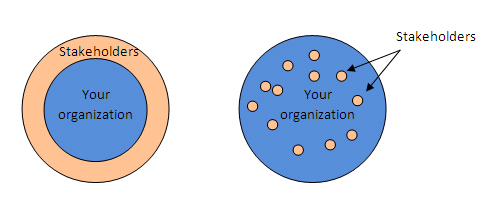
Here’s one mental model I’ve been playing with a lot lately: where does “our organization” start and end?  And where do our stakeholders (read: supporters, community members, shareholders, grantees, whatever…) sit?

For the past three years the mental model I was carrying around was the one on the left, and I’m beginning to wonder if the model I prefer is the one on the right.

If your mental model is the one on the left, as mine was, even if you care a lot about having high-quality engagement with your stakeholders, you’re inevitably carrying around a sense of divide between “us” and “them.”  “Sure we want them to be engaged and happy,” we think, “but (we say to ourselves silently) they’re not us.”

But why is this the case?  Because we’re on the payroll and they’re not?  Because we spend more hours per day doing this than they do?  There’s no magic door that we walked through that they didn’t walk through, and there’s certainly no guarantee that we are bringing more value to the table and doing more to further our mission than they are.

If they’re part of us, then our mission is a collective mission AND at the same time the standards to which we hold ourselves are equally high across the board (e.g. no coddling stakeholders just because they write big checks or shout the loudest – everyone has to bring their full selves to every conversation).

Especially as the definition of work  and jobs transform, as the social contract between employer and employee erodes, as people can work anywhere in any way to do most any thing, the idea of a firm boundary around the organization is, like the boundary itself, going to fade away.

I riffed a little on this idea in the video below, before getting to hear some of the wonderful member of the Acumen Fund community tell their own story (watch until the end to see the most incredible 9th grader you’ve come across in a long while).

Hunt for thank you opportunities

Ari reminded me of a study I’d heard about but forgotten.  Donors to nonprofits were divided into three groups:

  1. A group that was called and personally thanked
  2. A group that was called and personally thanked and invited to a subsequent event
  3. A control group

The not-surprising finding is that the first group was more likely to give in the future than the third group.  The surprising finding is that the second group (“thank you” + “would you do this other thing”) was LESS likely to give again than either group 1 or group 3.

Here’s another way to summarize these findings: people are really good at smelling a rat.  We know when you’re faking, know when the “thank you” (or, as Ari prefers and I agree, “I’m grateful”) is pro forma so you can get on to the real reason you called.

This is why I hate newsletters that sounds like boring impersonal newsletters, why form thank you notes that are for anything other than tax purposes are a no-no, and why it’s a mistake to take any shortcuts at all when thanking people (meaning: if you can choose between thanking 10 people personally and 40 en mass using some clever Outlook email trick, do the 10 real ones).

It’s also why I’m going to search even harder for opportunities to tell the people to whom I’m grateful that I’m grateful, and I’m going to fight the temptation to say “thank you AND….” with all my might.

Visual aids and crutches

Two of the best, most natural presentations I’ve given have been in the last two weeks – one of them I was coming off of 24 hours of travel and 3 weeks in India with a presentation (slides) but absolutely no real preparation; the other was a completely impromptu one hour talk with no supporting slides at all.

I think I made a mistake about a year ago in over-preparing for most of my talks – I ended up burying my personality, the spontaneous directions the talk could go, and my connection to the audience.  I couldn’t be more thankful for the friend who, about a year ago, cared about me so much that she walked straight up to me after a talk and said, “Sorry man, that just wasn’t that good.”

All of this made me think that I need to practice giving six different kinds of talks:

  • With and without slides
  • Scripted and unscripted
  • Rehearsed and unrehearsed

The food for thought part is:  if every talk you give has slides and is scripted and rehearsed, you might want to ask, “Are the slides there as visual aids, or are they a crutch?”  There are five other kinds of talks you can give.  And since nothing’s more attractive than earned confidence, why not start practicing these other kinds of talks today?

(and for those of you keeping track, yes I recognize that it’s hard to imagine a talk that is “without slides, unscripted and rehearsed” but I’m pretty sure you get my drift.  And while I’m adding postscripts, I’ll put one more reminder for me and for you: it’s never, ever better to read a script.)

<DIV ALIGN=CENTER>

<p align=”center”><a href=”http://del.icio.us/post?url=http://sashadichter.com/2010/09/30/visual-aids-and-crutches/;title=Visual aids and crutches”><img src=”http://sunburntkamel.wordpress.com/files/2006/11/delicious.gif&#8221; alt=”add to del.icio.us” title=”del.icio.us:Visual aids and crutches” /></a> : <a href=”http://www.blinklist.com/index.php?Action=Blink/addblink.php&amp;Description=&amp;Url=http://sashadichter.com/2010/09/30/visual-aids-and-crutches/;Title=Visual aids and crutches”><img src=”http://sunburntkamel.wordpress.com/files/2006/11/blinklist.gif&#8221; alt=”Add to Blinkslist” title=”blinklist:Visual aids and crutches” /></a> : <a href=”http://www.furl.net/storeIt.jsp?u=http://sashadichter.com/2010/09/30/visual-aids-and-crutches/;t=Visual aids and crutches”><img src=”http://sunburntkamel.wordpress.com/files/2006/11/furl.gif&#8221; alt=”add to furl” title=”furl:Visual aids and crutches” /></a> : <a href=”http://digg.com/submit?phase=2&amp;url=http://sashadichter.com/2010/09/30/visual-aids-and-crutches/”><img src=”http://sunburntkamel.wordpress.com/files/2006/11/digg.gif&#8221; alt=”Digg it” title=”Digg it:Visual aids and crutches” /></a> : <a href=”http://ma.gnolia.com/bookmarklet/add?url=http://sashadichter.com/2010/09/30/visual-aids-and-crutches/;title=Visual aids and crutches”><img src=”http://sunburntkamel.wordpress.com/files/2006/11/magnolia.gif&#8221; alt=”add to ma.gnolia” title=”ma.gnolia:Visual aids and crutches” /></a> : <a href=”http://www.stumbleupon.com/submit?url=http://sashadichter.com/2010/09/30/visual-aids-and-crutches/&amp;title=Visual aids and crutches”><img src=”http://sunburntkamel.wordpress.com/files/2006/11/stumbleit.gif&#8221; alt=”Stumble It!” title=”Stumble it:Visual aids and crutches” /></a> : <a href=”http://www.simpy.com/simpy/LinkAdd.do?url=http://sashadichter.com/2010/09/30/visual-aids-and-crutches/;title=Visual aids and crutches”><img src=”http://sunburntkamel.wordpress.com/files/2006/11/simpy.png&#8221; alt=”add to simpy” title=”simpy:Visual aids and crutches” /></a> : <a href=”http://www.newsvine.com/_tools/seed&amp;save?url=http://sashadichter.com/2010/09/30/visual-aids-and-crutches/;title=Visual aids and crutches”><img src=”http://sunburntkamel.wordpress.com/files/2006/11/newsvine.gif&#8221; alt=”seed the vine” title=”newsvine:Visual aids and crutches” /></a> : <a href=”http://reddit.com/submit?url=http://sashadichter.com/2010/09/30/visual-aids-and-crutches/;title=Visual aids and crutches”><img src=”http://sunburntkamel.wordpress.com/files/2006/11/reddit.gif&#8221; title=”reddit:Visual aids and crutches” /></a> : <a href=”http://cgi.fark.com/cgi/fark/edit.pl?new_url=http://sashadichter.com/2010/09/30/visual-aids-and-crutches/;new_comment=Visual aids and crutches”><img src=”http://sunburntkamel.wordpress.com/files/2006/11/fark.png&#8221; title=”fark:Visual aids and crutches” /></a> : <a href=”http://tailrank.com/share/?text=&amp;link_href=http://sashadichter.com/2010/09/30/visual-aids-and-crutches/&amp;title=Visual aids and crutches” title=”TailRank”><img src=”http://sunburntkamel.wordpress.com/files/2006/11/tailrank.gif&#8221; alt=”TailRank”></a> : <a href=”http://www.facebook.com/sharer.php?u=http://sashadichter.com/2010/09/30/visual-aids-and-crutches/&t=Visual aids and crutches”><img src=”http://sunburntkamel.wordpress.com/files/2008/02/facebookcom.gif&#8221; alt=”post to facebook” title=”facebook:Visual aids and crutches” /></a></p>

</DIV>

Circles of humanity

Want to persuade, make a connection, motivate someone to DO something?

Dive as deep towards the center of your humanity as possible, and share that.

Like so many other things, this is the opposite of what we’re taught in professional schools (business, law, policy) and their professional counterparts (McKinsey), where they drum into us how to get good at staying in the outer two circles.

At a minimum, tell stories. But change happens when you share your dreams and your love.

They call it “HEARTS and minds” for a reason.

add to del.icio.us : Add to Blinkslist : add 

to furl : Digg 

it : add to ma.gnolia : Stumble It! : add 

to simpy :

seed the vine : : : TailRank : post to facebook

Return to Sender

It’s a mathematical fact that you can never be 100% sure an email has arrived.  Never.  It’s a heady concept, but the proof stems from the fact that there’s always a nonzero chance that one of the following doesn’t arrive: the email that was sent, the confirmation, the confirmation of the confirmation…and so on.

Practically speaking, emails do tend to arrive, but that lack of certainty is a good analogy for how we can over-rely on email. All too often, conversations unfold like this:

“Hey, did you manage to set up that meeting you were hoping to line up.” [you know, the one you’ve been saying for the past three months you really want to make happen].

“Nah, I haven’t heard back yet.”

This is a lazy, backward-leaning response that comes either from fear or lack of commitment or both.  It’s not the way you act if you care more about the result than you do about going through the motions.

Here’s the counterexample: today I got a phone call from Germany from a guy I’ve never met, following up on an email I hadn’t read.  He’s offering (for free) an interesting training software that at first blush doesn’t seem too relevant to me.  And it may not be.  But the guy called, and in the 5 minutes we spent on the phone, I got a sense of him, of his enthusiasm, and I heard his pitch of the idea.  And I’ve now got the demo software in my inbox, which I’m about a million times more likely to download than I had been if I’d just received his email.

Bully for him – he’s doing his job.

The asynchronicity of email is a blessing and a curse.  Often – especially with newer, less well-established relationships – it can be a crutch.  “I emailed and I didn’t hear back” let’s you pretend that you tried hard enough, which you didn’t.

Plus since everyone is over-relying on email these days, it’s made it a hundred times easier to stand out by just picking up the darn telephone.

Go ahead.  It still works. And I bet you get a human being on the other end, not an Inbox, and wasn’t that the point in the first place?

add to del.icio.us : Add to Blinkslist : add to furl : Digg it : add to ma.gnolia : Stumble It! : add to simpy : seed the vine : : : TailRank : post to facebook

Permeability

Yesterday’s post got me thinking about the question of permeability and the virtual organization.  A few years ago Niko Canner shared with me and my Acumen buddies the idea of a “virtual organization.” In Niko’s words, loosely paraphrased (and potentially butchered in the process) there are many concentric circles of people surrounding any organization who do all sorts of valuable work (Board, advisors, donors, friends, mentors, etc. for nonprofits; but also suppliers and lawyers and bankers for just about everyone).  The virtual organization is this collection of people, and it is, especially for nonprofits, potentially more far-reaching, powerful, and impactful than the people who are actually on the payroll.

This brings up the question of permeability.  When we, who represent the organization, talk to people outside the organization about bringing their financial resources to bear to help us do our work, how permeable are we?  How bright are the lines we draw between “us” (the organization) and “them” (the donors, the advisors, the helpers, the friends)?  And how much, ideally, is the act of creating permeability something that we, external standard bearers of the organization, do in an ad hoc fashion, and how much should it be built in to the fabric of the organization?

Permeability only works where there is trust.  And while you can build trust with shared time, conversation, and exploration, what kicks things into high gear is shared action.  As we take action, we experiment – how do you and I act together, how do we treat each other, is this an us/them situation or can we leave that baggage behind?

So how are things, typically, different inside and outside the organization? When I problem-solve with someone on my team, I would never dream of leading with apologies or caveats; nor would I ever write an email asking for help that starts or end with “if you’re not too busy.”  By definition my teammates and I have signed up to the same goals so we dream together and riff together; we shoot ideas down and build them up and kick them around until they have enough fortitude to stand on their own.

We can’t act any differently when we move outside, to the virtual organization.  Yet because of the imagined, created (constructed?) impermeability between the organization and the virtual organization we convince ourselves that we have to ask for permission every time we “bother” someone who has said that they’re in and they’re signed up to help – which just serves to reinforce that we’re not all in this together.

And often I think that we – those of us inside the organization – are the main culprits here.  And if that’s right it’s good news because it means that we are in a position to make a change.

add to del.icio.us : Add to Blinkslist : add to furl : Digg it : add to ma.gnolia : Stumble It! : add to simpy : seed the vine : : : TailRank : post to facebook

Abundance

Here’s something I hear all too often: “Oh, we can’t ask her to donate (buy) to this new project (product), she already gives (buys) so much.”

Which way does the value flow again?

Remember, remember, remember, people don’t give (buy) and get nothing in return. They didn’t give because they were temporarily hoodwinked, cajoled, tricked, or otherwise pushed unaware over some invisible line. They gave to accomplish something, to express something, to be more of the person they want to be.  And that’s true whether they give $50 or $50 million.

OK, so that’s easy to say and it sounds so sensible.

But if it’s sensible then the right thing to say when you’re creating something new, something exciting, something powerful, is, “Wow we’d better make sure we take this idea to the people who are our biggest supporters.  They’d be so bummed if they missed out on this opportunity.”

There’s a world of difference between “Please would you give to this?” and “This idea is so exciting, you don’t want to miss out on it.”  A bigger difference still when “you don’t want to miss out” is so real, is something you feel in your bones, because then it’s true and you and the person you’re talking to feel and know that truth.

And yes, this is just as true when you’re selling a project, selling a gig, selling a software solution as it is in philanthropy.

The conversation you want to have, the conversation you can have right now, starts with, “Imagine this amazing, exciting thing.  Wouldn’t it be cool if we could make this happen together?”

Not a zero sum game.  Abundance.

add to del.icio.us : Add to Blinkslist : add to furl : Digg it : add to ma.gnolia : Stumble It! : add to simpy : seed the vine : : : TailRank : post to facebook

Medium is the message

When you’re talking to your top partners, your top customers, your top donors, how do you talk to them?

Not, “what do you say?” but “what medium and language do you use?”

You certainly don’t send the people closest to you formal letters or emails starting with“Dear So-and-so” and followed by “just thought I’d drop you a line…” with three full paragraphs of supposedly off-the-cuff exposition.

For those closest to you – friends, colleagues – there’s a way you talk, right?  There’s a rhythm and a cadence and a certain ease in the communications – direct and informal and personal, and a little humor is OK.  The people closest to you usually get short emails along with text messages and phone calls and voicemails, whatever’s easiest because that person is top of mind, their contact information is at your fingertips, and you’ve got an open channel of communication.

Formal and professional is fine too, it’s just not how you communicate with a partner in crime.  And we all need more partners in crime.

add to del.icio.us : Add to Blinkslist : add to furl : Digg it : add to ma.gnolia : Stumble It! : add to simpy : seed the vine : : : TailRank : post to facebook