Neglected, then out the door

I was a DIRECTV subscriber for about six years, until I wasn’t.  Meaning, over time the ~$65/month (once it was all said and done) started to sting more and more, and while I was generally happy with the service, the volume of alluring communication I got from everyone else pushing me to switch was in marked contrast to the bill and nothing else I’d get from DIRECTV month after month.

In the TV and telecom businesses, customer “churn” is one of the most important metrics to manage.  This is because customer acquisition and setup costs are high: the costs of giving someone a subsidized phone, or of sending a technician to physically install a costly satellite dish in each new customer’s home, are layered on top of all the regular sales and marketing costs everyone takes on.  That makes it especially important to keep customers from leaving once you’ve gotten them on board.

The challenge for DIRECTV and its ilk is that they have no information at all about how happy I am.  As long as I’m paying, I’m paying – until the day I leave, ending what could have been a 10 or 20 year relationship (which, at $65/month is somewhere between $7,800 and $15,600 in lifetime revenues).

The irony in the TV business is that the marginal cost of surprising or delighting a current customer is so low compared to the value that walks out the door when she leaves.  A free month of HBO for every year I’ve been a customer, or getting NFL Sunday Ticket for free one season if you’ve been a customer for five years (just hypothetically, of course!), could pay off in spades.

Because metrics (customer acquisition costs, churn, etc.) are so much harder to come by in nonprofit fundraising, and because each “customer” is so different in terms of how much they pay/give (DIRECTV’s customers might pay $30 or $200 a month, but that’s about as big as the range gets; a donor could give $500 or $5,000,000), we rarely do the math on customer acquisition costs or churn.  And so we hunt for the next donors at the expense of tending to the donors we already have.  It’s so easy to forget to delight those who are already with us – to give our true believers tools to evangelize on our behalf, and to make those who are happy feel proud, delighted, and occasionally surprised at the little gifts we give them to say “thank you.”  (And by “gifts” I don’t mean trinkets, though those are nice too.  I mean helping them see what they have helped accomplish, and showing them true and honest gratitude.)

We all have lurkers in our midst who are about to leave but we don’t know it.  Of course some folks will leave no matter what, and some will be too expensive to retain.  But let’s at least make that a conscious choice.

It’s a shame and a loss when someone who has been supportive, someone who has been a loyal and important customer, walks out of the door for no better reason than low-level neglect.

How generosity touched you

Not long ago, a group of senior executives asked me to speak to them about generosity.  So I started the conversation by asking each of them to share what generosity meant to them.

Perhaps I shouldn’t have been surprised, but what I heard back were examples of niceties – I volunteered a bit here, I helped someone with something there.  It was probably my mistake to open a conversation with a new group and expect that folks would take the opportunity to be vulnerable.  I should have laid the groundwork first.  Nevertheless, it was telling.

At times I’ve been surprised with negative reactions to talk of generosity and Generosity Day.  That day – hearing example after example of nice, kind, but mostly peripheral acts of generosity from a group that I knew had much deeper stories to tell – helped me understand what was going on in a new light.

I’ve been purposely exploring generosity for nearly five years now, and while I humbly admit that my own practice of generosity is still very much a work in process, my points of reference when hearing the word “generosity” are profound, textured, nuanced, and potentially very deep.  Generosity and giving are cornerstones of cultural practices dating back thousands of years; they are bedrocks of all the major religions; generosity is one of the five yamas in the eight-limbed path of yoga!

That’s the opposite of small, the antithesis of trite.

Nevertheless, just because that is my experience of generosity does not mean that is what others hear.  If someone’s conscious engagement with generosity is limited, when they hear talk of “generosity” their minds can naturally avoid things that are deep, grounded, or profound.

If I could restart the conversation I had with that group of executives, I would ask a different question.  Not “what does generosity mean to you?” which somehow got people to talk about when they had been generous, but “when has someone else’s generosity made a difference in your life?”  I’ve been amazed with how consistently I hear poignant stories of generosity when people are freed to answer this question.  People see others’ better angels.  Small, fleeting acts from decades ago are revealed to be seminal milestones in peoples’ lives.

I just heard about an effort to raise $60,000 on Indigogo to produce a movie called The Perfection of Giving.  I thought the trailer looked good and that you might want to check it out.

If I have one wish for the project, it would be that it move beyond the more obvious focus – how a practice of generosity transforms the giver – and delve deeper into how acts of generosity changed the lives of recipients (and, equally interesting, to uncover the countless acts of generosity practiced daily by people who do not, by external appearance, seem to have a lot to give).  I know all good stories need a protagonist, I just think the message is most powerful when we can share others’ stories, rather than describe our own experience of transformation.

So: when has generosity touched you?

Perfection of Giving

The Overhead Myth

The founders of the three largest charity watchdogs in the US have penned a letter and started a campaign to debunk the overhead myth.  Between Dan Pallotta’s outstanding TED talk this year – with nearly 2 million views and counting – and this move by Art Taylor (BBB Wise Giving Alliance), Jacob Harold (GuideStar), and Ken Berger (Charity Navigator), we might just be at the beginning of the end of the tyranny of “low overheads = well-run charity.”

Quoting from the new website, http://overheadmyth.com:

The letter, signed by all three organization’s CEOs, marks the beginning of a campaign to correct the common misconception that the percentage of charity’s expenses that go to administrative and fundraising costs—commonly referred to as “overhead”—is, on its own, an appropriate metric to evaluate when assessing a charity’s worthiness and efficiency. The nonprofit sector, which all three organizations provide information to and about, has too often erroneously focused on overhead over the past few decades, which has starved nonprofits from investing in themselves as enterprises and created what the Stanford Social Innovation Review calls, “The Nonprofit Starvation Cycle.”

I don’t yet know the details of the aforementioned campaign, but it’s high time we had one.  My hope is that the campaign provides donors and funders rules that are as simple as the “low overhead” mantra has been, because we won’t debunk one simple, easy-to-follow orthodoxy unless we replace it with another.

The challenge, of course, is that solving big problems is hard, complex, and nuanced.  Nevertheless, my bet is that the most successful version of this campaign will result in simple mantras and a few short checklists, as well as focused advocacy with the big foundations, institutional donors, and signatories of the Giving Pledge.

I’m excited to see this unfold, and to support the effort.  As a start, here’s the full text of their letter, which you can endorse here.

To the Donors of America:

We write to correct a misconception about what matters when deciding which charity to support.

The percent of charity expenses that go to administrative and fundraising costs—commonly referred to as “overhead”—is a poor measure of a charity’s performance.

We ask you to pay attention to other factors of nonprofit performance:  transparency, governance, leadership, and results.  For years, each of our organizations has been working to increase the depth and breadth of the information we provide to donors in these areas so as to provide a much fuller picture of a charity’s performance.

That is not to say that overhead has no role in ensuring charity accountability. At the extremes the overhead ratio can offer insight: it can be a valid data point for rooting out fraud and poor financial management.  In most cases, however, focusing on overhead without considering other critical dimensions of a charity’s financial and organizational performance can do more damage than good.

In fact, many charities should spend more on overhead.  Overhead costs include important investments charities make to improve their work: investments in training, planning, evaluation, and internal systems—as well as their efforts to raise money so they can operate their programs.  These expenses allow a charity to sustain itself (the way a family has to pay the electric bill) or to improve itself (the way a family might invest in college tuition).

When we focus solely or predominantly on overhead, we can create what the Stanford Social Innovation Review has called “The Nonprofit Starvation Cycle.”  We starve charities of the freedom they need to best serve the people and communities they are trying to serve.

If you don’t believe us—America’s three leading sources of information about charities, each used by millions of donors every year—see the back of this letter for research from other experts including Indiana University, the Urban Institute, and others that proves the point.

So when you are making your charitable giving decisions, please consider the whole picture.  The people and communities served by charities don’t need low overhead, they need high performance.

Thank you,

Art Taylor
President & CEO, BBB Wise Giving Alliance

Jacob Harold
President & CEO, GuideStar

Ken Berger
President & CEO, Charity Navigator

Below market

We have a major language problem in impact investing, one that speaks to how nascent we are in really understanding and segmenting our marketplace.

The two main classification systems we have adopted are:

  1. “Finance-first” and “impact first,” formally coined by the Monitor Institute in 2009
  2. “At market” and “below market” rates of return

Of course, in order to talk about “at market” or “below market” rates of return, one must have a reference point in mind. One can only be “at” or “below” a market if a market exists.

So what is that market? In the way we’re using language today, things feel quite loose, with the unstated assumption that the “market” of reference is developing world private equity investing. If that’s the implication, it feels equivalent to conceding that “impact investing” is nothing more than old wine in new bottles, which would vastly understate its potential. To put a more positive spin on things, we’ll know that impact investing is at a different place – and not simply looking outside the sector for its benchmarks – when the fact that a fund is “impact-” or “finance-first” doesn’t ipso facto tell you what targeted financial returns should be. To figure that out, you’d need to dig much deeper into investment strategy, including segmentation by sector or geography or customer base.

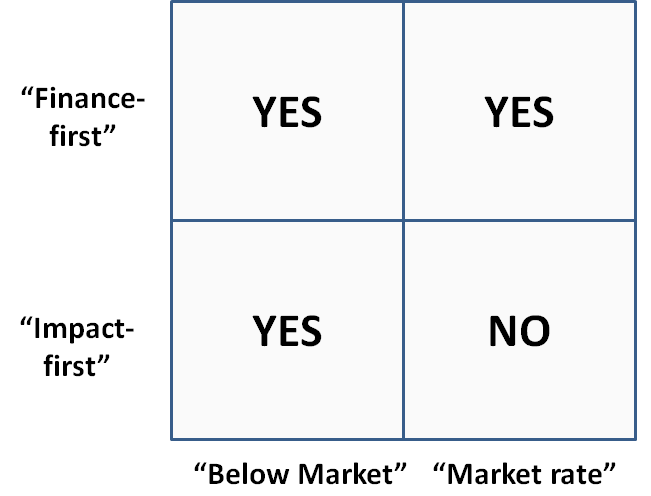
To clarify, let’s boil this down to a simple 2×2, with “impact” or “finance-first” on one axis and “at market” or “below” market on the other.

Which Markets Exist?

Finance impact first


The way we are using language, I’d posit that we have an empty box (the “NO” below) in “market rate” “impact first” investing. We’re acting as if there is literally no such thing as “at market” with an impact-first orientation. This in turn implies that there is no market for impact-first investing. Troubling indeed.

I of all people am a huge fan of simple language, but I think we’ve settled on the wrong terms in pursuit of simplicity. What we’re really trying to say is that the level of financial return that would adequately compensate an investor for the risk she is taking in a pioneering impact-first investment would have to be astronomically high – 30%, 40%, even 50% IRRs – to compensate for the risk of investing in new, untested business models. In fact, if you think about it, since most impact-first investments are in areas that are unproven (and, therefore, much riskier), one would have to deliver even higher financial returns for “impact first” investments to adequately compensate investors for the risks they are taking.

Unless…

Unless social return has real value. Unless that value can be clearly quantified and communicated. Unless we can start segmenting the marketplace to say that “here and here and here and here we are building a market, and that takes time and money, so for now the expected financial returns are low.”

“Low,” but not “below market.”

Grit, Agency and Mastery

Angela Duckworth defines grit as “passion and perseverance for long term goals.”

She also has found grit to be the single best determinant of long-term success.  The single one.  And, she tells us, we know very little about it – little about how to instill it in our kids or in ourselves.

But perhaps the definition itself, in its simple economy, gives us some insight about the way forward.

Passion: meaning that you have to care.

Perseverance: meaning that you have to push through, that this won’t be easy, that there are going to be many hard days (weeks, months), many times when things aren’t looking good.  This is going to test you.

Long-term: as in years, in most cases.

Goals: you need to have an objective, somewhere you’re trying to go, a point on the horizon or, at least, a north star.

It strikes me that we get tripped up on the “passion” bit.  Enough people have found a way to be part of something that they care passionately about.  Yet even if the big Mission with a capital “M” is motivating, the day-to-day also needs to hang together for years on end.

And what if you’re not actively working towards something that moves you?  What if you don’t even know what moves you?  Here is where people get and overwhelmed by the notion of “finding their passion.”

Two suggestions.  First, that mindset may be starting at the wrong end of the sentence.  If we’re working on grit then we can start with “perseverance,” “long-term” and “goals” and devote ourselves fully to doing great work and getting our ego out of the way.  Second, I don’t think we need to start with “Passion” with a capital “P.”  We can be passionate about small things (figuring out pivot tables once and for all) or about pieces of our work (coaching others) even in situations where the whole is leaving us flat.

The shift comes when we realize two things: that we do have the ability to decide where to apply our energies (agency); and that through applying ourselves we grow in amazing ways over long periods of time (mastery).

I find that – whether as a husband, a professional, a father, a squash player, a blogger, a speaker, a boss, whatever – I’m always aiming to improve, and the only thing that works is focusing on one thing at a time in each area of my life (as in, in squash I’ve been working on my drop shot for about a year now).  Each thing I’m passionate about changing is part of a longer term goal, and through the process of focus and dedicated work, that change happens – slowly, one thing at a time.  Each change takes months or sometimes years.  But, mostly, I progress.  And knowing that’s possible changes everything.

Angela’s 6-minute TED talk on grit just might change your whole perspective. It certainly pulled a lot of threads together for me.

You, Me, We

Some of the best advice I’ve heard on how to give feedback involves the simple switch from “you” phrases to “I” phrases, meaning switching from, “You weren’t as clear as you could have been today in making that point” to “I was confused by the points that you made today, and I didn’t feel like your message got across.”  It’s a small shift in language that helps create connection and a sense of shared ownership, instead of a feeling of judgment and separation.

Lately, I’ve found myself pining for a parallel shift of language in big meetings.

In meetings, among polite company, I challenge you to find a lot of “you” statements or a lot of “I” statements.  Safe meetings are the world of “we,” as in “we need to think about such-and-such” and “it’s important that we take action to correct this problem.”

Unfortunately “we” as a standalone doesn’t get us very far.  “We” abdicates responsibility and ownership and follow-though unless it is followed by “I,” as in, “We haven’t prioritized this important project, and what I’m prepared to do to help is….”

In feedback sessions gone awry, the conversation is all about the other person and how he needs to change.  In meetings gone awry, the group and the organization transform to a collective “we” separate from the people having the meeting.  We use safe language to create the illusion that “we” is anything other than a collection of “I”s who either will or won’t take steps – starting now, starting today – to make something else happen, something new happen, something hard and important happen.

There’s no “we” but you and me.

Magical

I’ve been known to be a stickler about slides.  Ask anyone I work with, they’ll agree (too quickly).

For a few years when I was a kid, I got interested in magic.  I’d walk up the flight of stairs to Tannen’s Magic Shop in New York City – always dark in there – and be wowed by the guys behind the counter.  I’d go home with a few new tricks to practice and a handful of simple props to master.

I never had the discipline to get good at it, but I stuck with it long enough to learn that you could have a giant red plastic thumb on your hand that a person two feet away from you wouldn’t notice; that getting someone to pick the card you want them to take really isn’t that hard; and that what you say, the eye contact you make, and how you engage with your audience are more important than what you physically do with the cards or the props.

Many years later, I’ve come to believe that the best presentations are like magic.  They engage, they captivate, they engross.  Included in that is just a bit of illusion: attention to detail, the occasional moment of, “Hey, how did she do that?”, and never letting them see the man behind the curtain.

Of course the slides shouldn’t be the “wow,” you should.

But anything that pulls people away,  anything that makes it harder for people to understand the story you’re telling or the points you want them to walk away with, breaks the spell.  That’s why we sweat the small stuff, in our slides, in our words, in the stories we tell.

Without magic, you’re just standing up there presenting, just like everyone else.

Just you

A number of years ago I bumped into an old family friend, a senior partner at a law firm, on the 7:30am Delta Shuttle from New York to DC.  For me, catching that flight was always a discombobulated mad morning dash of stuff and stumbling through security (shoes, belt, bag, computer…) and grabbing a few newspapers for the flight.

As we were going down the aisle in the plane I noticed he had nothing with him – no briefcase, no suitcase, nothing.  I asked him about it and he said, “They asked me to come down to DC for the day, so I’m going.  What they asked for is me and that’s what they’re getting.  Nothing else.”

It was said tongue-in-cheek, with a smile, but I liked the point he was making.

At some point you need to strip it all away, the busyness and the stuff, the laptops and the schedules and everything unnecessary, and realize that in the end it’s just you, laid bare.  What you have to offer, the clarity of your insights, what you, unadorned, bring to the table.

Clean, simple, no additional baggage.

Skills for this century

The deadline for applying for Seth Godin’s summer internship is tomorrow, May 31st.  And the last 15 applications will be discarded, so today is effectively the last day to apply.  It’s a two-week internship from July 22nd to August 2nd.  All the details are here.

I thought the skills Seth is looking for were pretty indicative of must-have skills for the next century, no matter what line of business you think you’re in.  Everyone doesn’t need all of them (though why wouldn’t you learn all of them at at least a minimal level, since today you can, easily)?

Still, it’s impossible to argue that anyone is allowed, any more, to have none of them.

Seth_internship skills

Basically, the list boils down to:

  • Coding
  • Design
  • Writing good copy
  • Coming up with ideas
  • Selling stuff
  • Managing projects
  • Hustle

(I, too, give bonus points for Monty Python trivia but I’ll admit that feels a bit arbitrary.)

Not a bad list, though, sadly, it compares terribly to what we’re teaching in our schools (including business schools).

On this last point, if you have kids or you care about education, you really must watch Seth’s “Stop Stealing Dreams” talk at TEDxYouth.   And once the video inspires you, read and share Seth’s full manuscript with the parents and educators in your life.

Are you a fundraiser?

There’s an old line that parents swap, and it goes something like:

People who aren’t parents think that there’s not a chasm between people who are and are not parents.  People who are parents know that there is one.

It’s not better or worse to be a parent, it’s just a different worldview and state of mind, a line that you cross and can never go back.

I think fundraisers experience something similar.  A good fundraiser is just as smart and savvy and capable and strategic as non-fundraisers – indeed much of what motivated me to start this blog was how frustrated I was to see that the nonprofit world sidelined fundraisers and fundraising and then wondered why it was so hard to scale things that work.

But there is something different about being a (good) fundraiser.  It means that at any day, at any moment, on some level you’re thinking about that revenue line, thinking about where you are in the year, how much time you have left, and what it’s going to take to get there.

This, too, isn’t good or bad, it just is.  It’s something you feel in your bones and in your gut.  And living with that feeling and that stress does take some getting used to.  I think the challenge of living with that discomfort is where lots of the burnout for fundraisers comes from.

My hope is that if we acknowledge it, if we say it out loud, if we share that this is something we are all holding, the weight that we are bearing gets just a bit lighter.