It’s not personal (and that’s the problem)

OK, I know you’re busy, we all are.

And you have a lot of people you want to connect with.  We all do.

And yes, it’s true, sometimes you copy and paste stuff into more than one email, because the meat of the update might be pretty similar from person to person, right?

But here’s the decision you get to make: how much value do you place on making the person on the other end feel like the note was written just for them, every time?

Outlook has a whiz-bang feature that allows you to create a text email that is, in fact, a mass mailing.  It’s tempting isn’t it?  Think how efficient it would be!!

Except.

Except you have to decide if relationship-building is a mass-market undertaking.  You have to decide if scale comes from going broad or going deep.  You have to decide which tradeoff you’re willing to make, because halfway there is no man’s land.

Sure, you’ll be careful most of the time.  But the moment a giant block of text in your email is in another color, or another font, or another size, the illusion is shattered. The moment you email the same thank you note to five different people, the wires appear to the whole audience, and the magic of your flying act goes *poof*.

And the thing is, the moment someone discovers that they’re the kind of person who gets impersonal notes from you…well, there’s really no way to recover from that.


How are you doing? How are you doing? How are you doing?

Last week I went to my 20-year high school reunion – which was neither as dreadful nor as exciting as the hype would lead one to believe.

Over the course of a few hours, a group of people (most of whom live in the same city even when not reunion-ing) who once knew each other well assemble to engage in a speed-dating type dance, trading 2-5 minute updates on the last 10-20 years of their lives.  Mostly I found it positive to hear how people have grown, the paths they are walking, how they are making their way through the world.

What’s unique about a reunion is that it combines long-lost friendship (trust, openness) with the expectation that you’ll give shorthand update on a few decades of your life.  There’s an intimacy that’s absent from cocktail party conversations, which I found breeds honesty and directness if you actually stand up and listen.

Perhaps most interesting was the simple answer to the question, “How are you doing?” asked repeatedly.  In the context of a high school reunion, this innocent phrase carries some real weight.  Peoples’ short answers to this question revealed joy, excitement, the desire to impress, openness, closedness, happiness, disappointment…the whole gamut, if you listened closely.

Hearing 30 people answer this same question in 60 minutes certainly made me think about how quickly first impressions are made.  And then I thought: wait a minute, maybe high school reunions aren’t any different at all in terms of what you can learn from how folks (how you, how I) answer this question.

I think with my brain, but…

I spent some time today talking with a great filmmaker and TV producer.  Her mantra for everything she creates is to what she called the “micro story:” that one, personal narrative that captures the whole.

We know this, but we don’t practice it.

We throw up statistics.  We create mash-up stories profiling a series of good projects and forget that the end result of the glossy portrayals is so much less than the sum of the parts.  We have conversations about giving to our organization that lead with programmatic jargon, budgets, abbreviations and ratios.

I think we’re afraid that telling real, honest stories will somehow be insulting to someone’s intelligence.  We know that “people respond to stories” but the woman across the table from you is so smart and so accomplished that of course she “really wants to dig in.”

What if we imagine our audience wearing block-lettered, tacky t-shirts (like the caps that Frank from 30 Rock wears) that shout out:

I THINK WITH MY BRAIN

BUT I ACT FROM MY HEART

I bet we’d act differently, we’d inspire more often, we’d create genuine connection and a sense of hope.

Hello!

Try this: the next time you have lunch planned with a friend, have him meet you at your office.  Put him on your calendar.  But don’t tell anyone who he is or why he’s there.

Then, when you sit down with him, ask him what it felt like to be a new visitor to your place of work.

How long does he wait at reception?  Does the receptionist pass him to another person before getting to talk to you?  Is he attended to quickly or does he wait for a while?  Did people say hello to him?  Was he brought to your desk or to a conference room?  Did the experience make him feel welcomed, excited, intimidated, put off?  Does your office feel active and buzzing or empty and quiet?

How was he left feeling before your “meeting” even started?  And how does this compare to how you’d like someone to feel before / during / after a meeting?

Here’s how this often works:

  • You arrive and say who you’re there to meet
  • A receptionist call an assistant
  • You wait a bit
  • The assistant comes to greet you and takes you to an empty room
  • You’re offered something to drink
  • You wait a bit
  • The drink arrives
  • You wait a bit
  • The meeting starts
  • (elapsed time: 5-10 minutes if all goes smoothly)

This particular sequence of events might be fine if you want to make a very specific impression (namely, we’re big and established).  But if the impression you’re after is “nimble, cutting edge organization” consider re-imagining the whole shebang.

Maybe something along the lines of: person arrives, they’re walked straight to your desk.

The advantage you have against the big guys is that you’re NOT them.  In which case acting just like them (because that’s how they do it) is a huge miss.

Have personality

Saw this great sign yesterday morning at Fairway Supermarket in Pelham.  Fairway is the best combination of high quality and affordable food at any supermarket anywhere (they also make Zabar’s-quality lox, pickled herring, and olives, among other things).  Fairway’s original supermarket has been in business on Upper Wast Side of NY since the 1930s, and in 2007 they started an expansion blitz that has taken them to Harlem, Red Hook, even Stamford, CT.

This sign made me laugh out loud, and it reinforced the notion that it’s always better to have a personality.  Personality has a point of view.  Personality has a voice.  Personality will piss some people off but will make your rabid fans even more rabid-y and fan-y.

If you’re going to have personality, do it every time.  Every sign, every email you send out, every blog post, every quick reminder.  We’re not talking stand up comedy here, but if you write more like you talk and less like you think you’re supposed to write, you’re heading in the right direction.

Where does your organization start and end?

Pip Coburn is a big believer in the power of the “mental models” we carry around, the approximations we make of reality to simplify the world.  The idea is that we can’t interact with reality in all of its complexities, we can only interact with our mental models of reality – and Pip’s point as I understand it is that since our mental models define our reality, walking around with the wrong model can cripple our ability to understand things and act appropriately.

Since being introduced to this phrase I’m increasingly checking in both on the conclusions I’m drawing from my mental models and on the mental models themselves to either affirm them or throw them away.

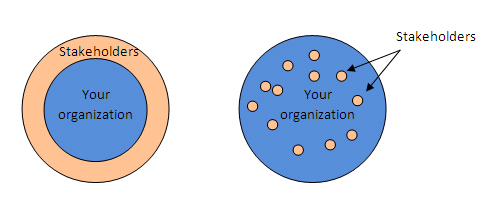
Here’s one mental model I’ve been playing with a lot lately: where does “our organization” start and end?  And where do our stakeholders (read: supporters, community members, shareholders, grantees, whatever…) sit?

For the past three years the mental model I was carrying around was the one on the left, and I’m beginning to wonder if the model I prefer is the one on the right.

If your mental model is the one on the left, as mine was, even if you care a lot about having high-quality engagement with your stakeholders, you’re inevitably carrying around a sense of divide between “us” and “them.”  “Sure we want them to be engaged and happy,” we think, “but (we say to ourselves silently) they’re not us.”

But why is this the case?  Because we’re on the payroll and they’re not?  Because we spend more hours per day doing this than they do?  There’s no magic door that we walked through that they didn’t walk through, and there’s certainly no guarantee that we are bringing more value to the table and doing more to further our mission than they are.

If they’re part of us, then our mission is a collective mission AND at the same time the standards to which we hold ourselves are equally high across the board (e.g. no coddling stakeholders just because they write big checks or shout the loudest – everyone has to bring their full selves to every conversation).

Especially as the definition of work  and jobs transform, as the social contract between employer and employee erodes, as people can work anywhere in any way to do most any thing, the idea of a firm boundary around the organization is, like the boundary itself, going to fade away.

I riffed a little on this idea in the video below, before getting to hear some of the wonderful member of the Acumen Fund community tell their own story (watch until the end to see the most incredible 9th grader you’ve come across in a long while).

Visual aids and crutches

Two of the best, most natural presentations I’ve given have been in the last two weeks – one of them I was coming off of 24 hours of travel and 3 weeks in India with a presentation (slides) but absolutely no real preparation; the other was a completely impromptu one hour talk with no supporting slides at all.

I think I made a mistake about a year ago in over-preparing for most of my talks – I ended up burying my personality, the spontaneous directions the talk could go, and my connection to the audience.  I couldn’t be more thankful for the friend who, about a year ago, cared about me so much that she walked straight up to me after a talk and said, “Sorry man, that just wasn’t that good.”

All of this made me think that I need to practice giving six different kinds of talks:

  • With and without slides
  • Scripted and unscripted
  • Rehearsed and unrehearsed

The food for thought part is:  if every talk you give has slides and is scripted and rehearsed, you might want to ask, “Are the slides there as visual aids, or are they a crutch?”  There are five other kinds of talks you can give.  And since nothing’s more attractive than earned confidence, why not start practicing these other kinds of talks today?

(and for those of you keeping track, yes I recognize that it’s hard to imagine a talk that is “without slides, unscripted and rehearsed” but I’m pretty sure you get my drift.  And while I’m adding postscripts, I’ll put one more reminder for me and for you: it’s never, ever better to read a script.)

<DIV ALIGN=CENTER>

<p align=”center”><a href=”http://del.icio.us/post?url=http://sashadichter.com/2010/09/30/visual-aids-and-crutches/;title=Visual aids and crutches”><img src=”http://sunburntkamel.wordpress.com/files/2006/11/delicious.gif&#8221; alt=”add to del.icio.us” title=”del.icio.us:Visual aids and crutches” /></a> : <a href=”http://www.blinklist.com/index.php?Action=Blink/addblink.php&amp;Description=&amp;Url=http://sashadichter.com/2010/09/30/visual-aids-and-crutches/;Title=Visual aids and crutches”><img src=”http://sunburntkamel.wordpress.com/files/2006/11/blinklist.gif&#8221; alt=”Add to Blinkslist” title=”blinklist:Visual aids and crutches” /></a> : <a href=”http://www.furl.net/storeIt.jsp?u=http://sashadichter.com/2010/09/30/visual-aids-and-crutches/;t=Visual aids and crutches”><img src=”http://sunburntkamel.wordpress.com/files/2006/11/furl.gif&#8221; alt=”add to furl” title=”furl:Visual aids and crutches” /></a> : <a href=”http://digg.com/submit?phase=2&amp;url=http://sashadichter.com/2010/09/30/visual-aids-and-crutches/”><img src=”http://sunburntkamel.wordpress.com/files/2006/11/digg.gif&#8221; alt=”Digg it” title=”Digg it:Visual aids and crutches” /></a> : <a href=”http://ma.gnolia.com/bookmarklet/add?url=http://sashadichter.com/2010/09/30/visual-aids-and-crutches/;title=Visual aids and crutches”><img src=”http://sunburntkamel.wordpress.com/files/2006/11/magnolia.gif&#8221; alt=”add to ma.gnolia” title=”ma.gnolia:Visual aids and crutches” /></a> : <a href=”http://www.stumbleupon.com/submit?url=http://sashadichter.com/2010/09/30/visual-aids-and-crutches/&amp;title=Visual aids and crutches”><img src=”http://sunburntkamel.wordpress.com/files/2006/11/stumbleit.gif&#8221; alt=”Stumble It!” title=”Stumble it:Visual aids and crutches” /></a> : <a href=”http://www.simpy.com/simpy/LinkAdd.do?url=http://sashadichter.com/2010/09/30/visual-aids-and-crutches/;title=Visual aids and crutches”><img src=”http://sunburntkamel.wordpress.com/files/2006/11/simpy.png&#8221; alt=”add to simpy” title=”simpy:Visual aids and crutches” /></a> : <a href=”http://www.newsvine.com/_tools/seed&amp;save?url=http://sashadichter.com/2010/09/30/visual-aids-and-crutches/;title=Visual aids and crutches”><img src=”http://sunburntkamel.wordpress.com/files/2006/11/newsvine.gif&#8221; alt=”seed the vine” title=”newsvine:Visual aids and crutches” /></a> : <a href=”http://reddit.com/submit?url=http://sashadichter.com/2010/09/30/visual-aids-and-crutches/;title=Visual aids and crutches”><img src=”http://sunburntkamel.wordpress.com/files/2006/11/reddit.gif&#8221; title=”reddit:Visual aids and crutches” /></a> : <a href=”http://cgi.fark.com/cgi/fark/edit.pl?new_url=http://sashadichter.com/2010/09/30/visual-aids-and-crutches/;new_comment=Visual aids and crutches”><img src=”http://sunburntkamel.wordpress.com/files/2006/11/fark.png&#8221; title=”fark:Visual aids and crutches” /></a> : <a href=”http://tailrank.com/share/?text=&amp;link_href=http://sashadichter.com/2010/09/30/visual-aids-and-crutches/&amp;title=Visual aids and crutches” title=”TailRank”><img src=”http://sunburntkamel.wordpress.com/files/2006/11/tailrank.gif&#8221; alt=”TailRank”></a> : <a href=”http://www.facebook.com/sharer.php?u=http://sashadichter.com/2010/09/30/visual-aids-and-crutches/&t=Visual aids and crutches”><img src=”http://sunburntkamel.wordpress.com/files/2008/02/facebookcom.gif&#8221; alt=”post to facebook” title=”facebook:Visual aids and crutches” /></a></p>

</DIV>

Circles of humanity

Want to persuade, make a connection, motivate someone to DO something?

Dive as deep towards the center of your humanity as possible, and share that.

Like so many other things, this is the opposite of what we’re taught in professional schools (business, law, policy) and their professional counterparts (McKinsey), where they drum into us how to get good at staying in the outer two circles.

At a minimum, tell stories. But change happens when you share your dreams and your love.

They call it “HEARTS and minds” for a reason.

add to del.icio.us : Add to Blinkslist : add 

to furl : Digg 

it : add to ma.gnolia : Stumble It! : add 

to simpy :

seed the vine : : : TailRank : post to facebook

The Butcher and the Baker

On my daily commute to work, I walk from to and from the train station.  It’s not that far – about a half a mile – and I feel lucky not to have to step in a car every day.  Many people, though, drive to the train, even a few who live right near me.

A few Fridays ago, a guy who I know a bit (a wave, a nod, pleasantries exchanged every now and again) was driving home from the train.  I was in a rush to get home to see my kids, and at that moment on a hot day, “hey do you want a ride?” would have been a welcome overture.  He didn’t offer, and while he was driving off I got to thinking about the distance between us, the oh-so-sacrosanct space of aloneness that we create when driving our cars, when sitting in front of our computers, when shopping online, when plopped in front of our HDTVs, and how through all the progress we’ve made, we’ve traded in the crush and human connection of the sawdust-floored marketplace, of common spaces, and of all the unexpected, simple happenstance that comes from living our lives stumbling and tripping over one another.

In the late 90s I lived in Madrid, Spain, in an airy one-bedroom apartment that opened onto a quiet, bright courtyard.  It was the second time I’d lived in Spain and it took this second take to unlearn my frustration at the “inefficiencies” of Spanish life: on Sundays, everything – and I mean everything – was closed except for churches, coffee shops and a few restaurants, and since the internet wasn’t yet so ubiquitous, my (now) wife and I developed a cherished ritual of going to a local coffee shop with the newspaper and spending hours wiling away the day, talking, and working on the crossword puzzle.

When we left Spain, as part of our goodbyes, we went door-to-door to the fruit shop, the butcher, the baker, and the cheese shop to say goodbye to the shopkeepers who had become part of our lives, who had advised us on dishes and taught us the words for pastries and cuts of meat and the best local cheeses.  Yes, going to a shrink-wrapped supermarket is more efficient, but shopping for food wasn’t a chore when it was filled with conversation and questions about how last week’s dinner came out.

I worry that with all the efficiencies we’re creating, we’re also facilitating a habit that’s averse to basic human contact.  It’s easier to smile and look away, easier to walk into your car than to offer someone a ride, easier to click and compare than get to know a salesman or a store owner or a neighbor.

The irony is that people crave genuine human connection.  We’re just getting woefully out of the habit.

Just crack open the door a little for someone and you’ll see the light flood in.

add to del.icio.us : Add to Blinkslist : add to furl : Digg it : add to ma.gnolia : Stumble It! : add to simpy : seed the vine : : : TailRank : post to facebook