Seeing the Problem Clearly

We waste a lot of time because we misunderstand the problem.

Our poor diagnosis leads to the wrong mental models. We then waste energy focused on addressing things that aren’t really a priority.

Worse, we incorrectly assume that “correct diagnosis” is binary: either we see things the wrong way or the right way.

In reality, we don’t flip from not seeing to seeing.

Rather, we have a first glimpse of true understanding, and we sharpen what we see over time.

If, tomorrow, you finally figure out what the problem is, in your enthusiasm you might rush to turn that eureka moment into a plan for action.

Let me suggest, instead, spending some time sitting with your new understanding.

Keep doing things the way you’ve been doing, while all the while keeping your hypothesis about what needs to change in the back of your mind.

Letting this gap persist—the gap between today’s practice and your (new) view of what things should look like tomorrow—will automatically force your diagnosis to sharpen. As your understanding deepens, you will have:

  1. A more complete understanding of what you need to do differently
  2. Much more conviction behind starting down that new path

The clarity of understanding will itself be hugely valuable.

The strength of your conviction will make it much more likely that you’ll successfully lead those around you to rally around the changes you want to make.

Open Mondays, Open Fridays

18 months ago, I made a structural change to my calendar that I love: leaving Mondays and Fridays (nearly) free of meetings, so that each week has a No Meeting Monday and a No Meeting Friday.

These days are dedicated to ‘doing’ rather than to talking or reacting. What’s valuable is not simply the number of hours available, it’s the large blocks of time every week: enough time to create, and the requirement to face a blank page.

How to Make it Happen

Most of my meetings are external, so I’ve set up my Calendly to only show free time on Tuesdays, Wednesdays, and Thursdays. Beyond that, it’s up to me to stay disciplined when someone asks me if I can meet on Monday at noon. (“No!”)

(Though, in truth, a short meeting here or there doesn’t materially impact my flow, since I do need some breaks.)

The Flow of the Week

On Mondays, I’m setting up for the week and laying the foundation for things that I need to move forward. This allows me to maintain some control over my (and the company’s) direction of travel rather than constantly being in responsive/reactive mode.

Fridays are for closing everything that came up during the week, including ensuring I’ve properly followed up on the many (many) external conversations I had on Tuesday, Wednesday and Thursday.

In addition, to make things really hum I also:

  • Us the end of the day on Friday to make a short list of Monday morning priorities. This helps me ensure I don’t lose any threads from the previous week.
  • Find time on Sunday to clean out my Inbox / Slack from the weekend. This way I don’t lose my Monday morning to responding to inbound traffic (but this is a balancing act because it’s also important for me to keep my weekends free…).

The Great (and Hard) Parts

The obvious challenge of this schedule is the hyper-full Tuesdays, Wednesdays and Thursday that can feel overwhelming.

I have pretty good endurance but there’s a limit to how many productive hours of conversations I can have (my max is 5). And even 3 or 4 hours of meetings is too much without great notes. I use Notion, with clear next steps documented at the end of every meeting. Otherwise, by 3pm I’ve forgotten what I agreed to do in my 9am meeting.

The more important, and subtle, challenge is starting the week off with blank space.

If I’ve caught up on Friday (and, when needed, over the weekend), then Monday morning is all mine. Forcing myself, nearly every week, to face that down and decide for myself what’s most important for me to do, feels a lot like staring at a blank page and needing to write a blog post: humbling, often intimidating, even spilling over into a bit of soul-searching….

What is my job when I’m not frantically responding to the things that everyone else needs me to do for them?

It’s a good question that we all need to ask ourselves regularly.

And I’ve found that without this sort of structure in my days, I can go weeks, and even months, without asking myself this question.

The fact is, it’s a question we all need to answer for ourselves, regardless of how ‘senior’ we are in the organization.

We all have unique talents and a unique perspective. We all, therefore, need to have our own agenda: the work we do when it’s our time and not someone else’s.

How to Write Good Annual Goals

Nearly every organization has you write out your goals for the year in some form.

And, in nearly every organization I’ve been a part of, doing so has felt like an exercise for someone else.

That’s not how it should be.

So, if you have to write professional goals for 2022, or (even better) if you don’t but you want to write them for you, here’s a better approach.

First, write for you.

Write a first draft in whatever format is most comfortable to you, and write it for you. Make it informal, write it in a notepad, on a blank piece of paper. Do some drawings. Make it creative.

The point is to recognize how constraining it can be to write your Formal Professional Goals for your Boss.

When you do that, you’re already doing a bunch of editing. You’re crafting a story for what you think they want to see rather than writing, in a non-judgmental way, what’s meaningful to you.

So, take a moment to quietly ask yourself:

What would make this year be successful for me?

What set of accomplishments would make me proud?

What new skills would I like to learn / strengthen?

Think of this as a journaling exercise first, so you can honestly explore what would feel like success.

Then, edit this rough draft plan in whatever way you find helpful. See if you can boil it down to a few salient points to summarize your priorities for the year.

Second, write for your supervisor.

Now that you have your own rough draft, open up whatever formal document your company / organization uses and draft your official 2022 goals for the year.

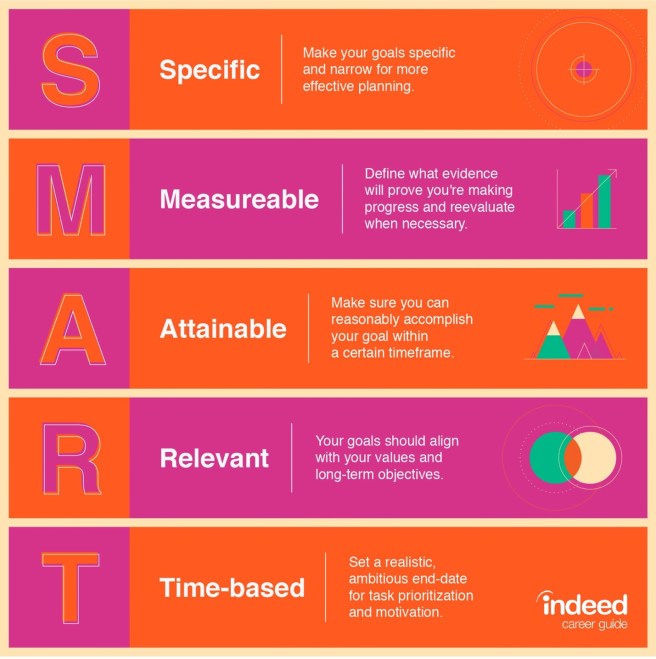
After you have your first draft, review what you’ve written and see if you’ve done a good-enough job of writing SMART goals.

Per this nice graphic from the Indeed website, a SMART goal is one that is Specific, Measurable, Attainable, Relevant, and Time-Based.

The shortcut I use when reading goals is to ask myself, “if it were the end of the year, could I easily and objectively judge whether this goal was achieved?”

For example, you might write a goal along the lines of “improve my analytical skills.” This is a great place to start, but it’s hard to judge what “improved” really means.

Whereas a goal that reads “improve my analytical skills so that fewer than 10% of my projects require re-work of my analysis by” is a much “SMARTer” goal.

Some parting thoughts on accountability.

I believe we should write goals for ourselves so we start out unconstrained. But there’s something more important going on: I find goals to be the most motivating when they are promises I’m making to myself.

In addition, there’s value in stating out loud what you think you can accomplish over the course of a quarter, six months, or a year.

First, by setting an intention I believe we are more likely to make that intention come to pass.

And, the act of goal-setting is also a sort of prediction: a statement of what you believe is possible to do in the next year, both in terms of delivery and in terms of professional development.

When you get to the end of the year and look back at your goals, remember that they were your best guess at what you could and wanted to accomplish in 2022. Use that reflection to calibrate your goal-setting abilities.

Getting better at predicting what we can accomplish is itself an important skill.

Your Speed, Client Speed

If you’re running a fast-paced, high growth organization, your speed frequently outstrips your clients’ speed.

It’s natural, then, that your pace rarely matches your clients’ pace Indeed, sometimes they slow down, or nearly stop, only to reappear ready to move once again.

What to do then?

So much has happened since you last spoke. So many new things have come to the fore. So many new priorities on your plate. So many other clients have moved more quickly than this one.

It. Doesn’t. Matter.

Your job, always, is to be like a soccer player: from stand-still to full-speed faster than the next guy.

This isn’t the time to mirror them.

This is the time for fast acceleration, every time.

Terror/Freedom, Calm/Structure

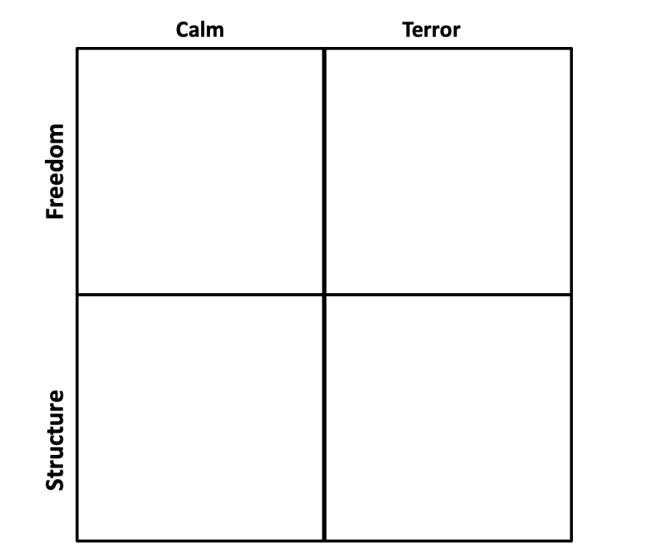
I was talking with a colleague about what makes us most productive, and we came up with this fun 2-by-2.

We were discussing whether he was, in fact, most productive in the top-right corner: namely, when he’s got as much Freedom as possible, and has massive, important goals that are so big that they’re Terror-inducing.

We had a chuckle about this—it’s a caricature, to be sure—but it did get me thinking that this simple 2×2 might be a great shortcut for getting to know each others’ work styles.

For example, I’m also at peak productivity (though not sustainably) when I’m somewhere in the middle of the ‘Terror’ quadrant. A bit of fear leads me to crank out a ton of good work, whereas if things are too calm for too long they feel flat to me.

That said, Terror for too long does wear me down. What’s best for me is hanging out somewhere between Calm and Terror, with enough Calm for predictability and self-care and enough Terror to keep me motivated.

Similarly, I’m comfortable with, and like, a strong foundation of structure; and I find too much structure stifling. I need to be in the middle of that axis to thrive: structure as a jumping-off point for the freedom to dream about and create new things.

I find this 2×2 diagnostically helpful. For example, when I think about work groups that have trouble, the four that jump out are:

  • (Usually) One high-Structure person and one high-Freedom person. The exception is if this high-structure person is an awesome, self-aware supervisor who knows how to give their freedom-seeking team member tons of white space and motivation, while not constraining her too much. Conversely, a high-freedom person managing a high-structure person seems particularly hard to pull off. The high-structure junior person often ends up confused, stressed out or frustrated.
  • (Always) One strongly Structure/Calm person with another strongly Freedom/Terror person unless both are super-self-aware. These two environments are so different that these pairs struggle to find common ground.
  • Too many high-freedom people working together without someone to create structure. Also known as “chaos.”
  • High-freedom people who have been forced into high-structure roles. This is a tricky one because we naturally associate seniority with more management responsibility. That’s why we give management job to successful high-Freedom folks, and then get confused when they (and their teams) struggle.
  • Finally, I wonder if the High Structure / High Terror profile exists and, if it does, what makes that person thrive.

A parting thought, lest we lose the nuance here: maximum productivity does not equate to maximum well-being.

I expect everyone wilts eventually when they feel too much terror for too long. However, I do believe there are folks who have higher ‘terror’ thresholds and who find low-to-medium levels of terror exhilarating rather than off-putting.

We all surely inhabit parts of the framework in different settings and moments. The useful point for introspection is to explore our emotional reaction to each of the four quadrants, and unpack how that reaction impacts our energy levels, our focus, and our productivity.

To Be More Productive, Limit Your Time

There’s a lot of talk about shorter work weeks. This is a natural outgrowth of the acceleration of remote work over the last two years.

The thesis, as I understand it, has two parts:

  1. Most/all employees can get the same amount done in 32 hours that they can get done in 40 hours.
  2. Doing so leads to an overall increase in well-being for everyone

I have no idea what the long-term data are/will be on the first point, but my first reactions are:

  • I’m sure most people waste a ton of time at most jobs. This  means there’s a lot of slack built in. So it’s believable that some people can work 20% fewer hours and get the same amount done.
  • I am curious about whether this impact is temporary or permanent.
  • And, more fundamentally, I wonder what happens in people’s heads when they feel they only have 4 days in which to get 5 days’ worth of work done.

Does our time being (or feeling) constrained lead us to be more productive?

I think this is entirely possible. When our boss, at 10am, tells us we’re working until 10pm today, most of us will find space for a longer lunch and a few other distractions.

Conversely, I’ve found (particularly during the pandemic) that knowing that I have a set of end-of-day obligations at home (driving the kids somewhere, cooking dinner) keeps me hyper-focused on getting everything I need to get done in the (shortened) available time and I am more productive.

You might experiment with juicing your output by, counterintuitively, constraining your time. Create your own strict deadlines for projects—“I’ll get this done by 5pm” rather than “by tomorrow”—and see if it creates a positive cascading effect in the hours leading up to that deadline.

The fact is, we all have moments when our energy lags throughout the day. The question is: what do we do in those moments, how do we manage them?

Do we consciously take productive breaks (getting some fresh air, walking around a bit, getting a glass of water and sitting quietly without our phones)?

Or do we dither and get pulled into (online) things that can spiral and that sap our energy?

For most of us, in the last 60 minutes before a deadline, we’re hyper-focused and spending 0% of our time doomscrolling.

The trick is to harness a sustainable version of this feeling over the course of a day, so we have a sustained sense of focus and urgency and, as a result, are much more efficient.

And, lest we forget, whenever we hit our own early deadline, we have to remember Jerry Seinfeld’s advice to give ourselves a (figurative) cookie. The reward for 4, 5 or 6 hours of super-productive, focused work has to be…rewarding! And that probably isn’t jumping immediately to the next task.

The bonus is that, not only does this behavior make us more productive, efficient and happier, it’s also an opportunity to practice being accountable to ourselves (and not just to other people).

The muscle of self-accountability is a blog post for another day, but the short version is this: the better we get good a keeping the promises we make to ourselves (along with, not instead of, the promises we make to others) the more chance that we’ll use our newly-found free time for projects that really matter.


Good Decision-Making

Ultimately, our job as leaders boils down to a few things. Having a vision and strategy that is shared, understood, motivating and that inspires action. Creating a great culture. Hiring and supporting great people. And, maybe less obvious, creating an organization that’s good at making decisions.

It turns out that there’s a very high correlation between organizational effectiveness and the quality of organizational decision-making. And the best, most actionable article I’ve found on understanding the quality of an organization’s decision-making says it’s function of:

  • Speed: how fast do you decide?
  • Effort: how much work goes in to making decisions?
  • Quality: how good are the decisions?
  • Yield: how well do you turn decisions into actions?

As someone who’s transitioned from the non-profit to the for-profit sector, my experience is that non-profit organizations typically decide more slowly and with more effort, all without resulting in consistently high(er) quality / higher yield decisions.

I think this is a function of the more multi-faceted accountability in the non-profit world (multiple criteria for success, multiple stakeholders). This in turn leads to slow(er), high(er)-effort decision-making which begets a culture that accepts slower, higher-effort decision-making, even when it’s not always needed.

This is not to say that faster is always better: speed is not useful if we make lots of quick, poor decisions.

Indeed, one of our jobs as leaders is to consistently walk the line of always moving quickly while managing to get the right input from the right people, so that decisions are (mostly) high quality.

The nuance is that how we decide develops into a cultural norm: people watch how decisions get made, learn that behavior by osmosis, and replicate whatever your decision-making culture is.

For example, is it OK in your organization to:

  • Make decisions without formal authority?
  • Change a decision after it’s been made? After the deadline?
  • Leave a decision-making meeting without a decision getting made?
  • Have a more junior person be the decision-making in a meeting with someone more senior?
  • Make a decision that is not documented?
  • Make a decision that doesn’t turn into action?
  • Be unclear who the decision-maker is on a given topic?
  • Have one decision-maker?
  • Have many decision-makers?

While there’s no right answer to any of these questions, my view is that organizational growth creates complexity, and complexity slows things down and allows people to hide.

That’s why most of the time, most organizations would benefit from faster decisions being made by fewer people who take more ownership around being “the decider.”

One helpful way to jumpstart these conversations is by starting to frame decisions as either Type 1 (irreversible, make them very deliberately) or Type 2 (reversible, prioritize speed). You’ll quickly discover that most decisions are Type 2, and that just might give you the freedom to move faster on them.

One final thought: one of the easiest ways to lead, no matter where you sit in an organization, is by choosing, today, to make more decisions without triple-checking if it’s OK. The worst thing that will happen is that you’ll discover that deciding really isn’t allowed (which is important information). The best thing is that more people will start turning to you to decide more things, because you had the courage to step up in the first place.

Stop / Start / Keep

I was first introduced to the concept of After Action Reviews by Colonel Patrick Tierney, a retired U.S. Army officer who I got to know in my time at Acumen.

An After Action Review (AAR) is a review of a completed operation, typically run by the commanding officer and with all members of the operation present.

In an AAR, your job is to answer four questions:

  • What was expected to happen?
  • What actually occurred?
  • What went well and why?
  • What can be improved and how?

My sense, from talking to Col. Tierney, is that there’s a level of (harsh) objectivity in an AAR that serves two purposes: surfacing the truths about what happened and building a culture of transparent accountability. Col. Tierney would describe going into an AAR as, “you have to strap on your thick skin before heading into that room.” The feeling was that any and all critiques would come out in the AAR, and then, afterwards, you were done and would put the AAR behind you.

While there’s a full AAR process that is itself very powerful, at a practical level I’ve often found our teams boiling AAR’s down to a simple start / stop / keep rubric: What do we need to start doing? What should we stop doing? What should we keep doing?

To operationalize this, create a table in a Google Doc and have all team members spend the first 5-10 minutes of the meeting filling in the document (or, better, do this before the meeting). In addition to writing, anyone can also +1 another team member’s entry to show they agree with it. For example:

Start Stop Keep
Sharing all spec details at the start of the project ++++
More clear pushback to the client when requests are out of scope +++++
Adding requirements late in the process +++++
Parallel conversations ++
Having daily standups ++++
Clear decision-making +
Raising hands to support each other +++

As I head into 2022, I’ve found myself switching gears more slowly than in the past, likely the result of the Groundhog Day that it we’re living through: cancelled trips, postponed back-to-office plans, tons of emails from schools about new protocols and Zoom options, and global uncertainty.

That said, I know the beginning of the year is an invaluable time for reflection, planning and intention-setting, one that we shouldn’t miss.

With that in mind, I’m planning to start my year with both a personal and an organizational start / stop / keep list.

On the personal front, the list will focus on how I manage my time and my energy, the structure of my days, and any adjustments I might make to keep myself more grounded while still getting everything that I need to get done done.

And, for our company, I’ll use this as a conversation-starter across multiple teams and geographies, a chance for everyone to share what we need more of, less of, and the things that went really well in 2021 that we need to keep.

You might want to try it too.

Happy new year, and here’s to a great start to 2022.

My Favorite Books of 2021

A number of you reached out asking for my 2021 book recommendations (including fantasy fiction). I have to say, I had more misses than hits in what I read this year, but there are a few books that really stood out.

Here are my top five books of 2021, along with 9 other good books I read this year.

My Top Five Picks of 2021

The Overstory by Richard Powers: (2019 Pulitzer Prize winner) this book was magical. It is, ostensibly, about trees and our relationship to them. It follows a seemingly-unconnected group of characters across multiple decades. I found myself transported to another world and I loved inhabiting it. The book made me look at trees, and our relationship to nature, in a new way. This was definitely the best work of fiction I read all year – though it did take me about 100 pages to get into it.

The Warmth of Other Suns by Isabel Wilkerson: this book is the story of the Great Migration in the United States, the exodus, spanning more than five decades, of more than six million Blacks from the South. Isabel Wilkerson spent more than a decade researching the book and she tells the story through three protagonists: Ida Mae Gladney, a former sharecropper who left Mississippi for Chicago in 1937; George Starling, who left Florida for Harlem in 1945; and Robert Foster who left Louisiana in 1953 to become a doctor in LA, and who became, among other things, Ray Charles’ physician. The book has such narrative beauty that it reads like a work of fiction. And, from an educational perspective, I’m embarrassed to say how little I knew about the Great Migration and more surprised still that I had such a narrow understanding of the lived Black experience in the U.S. in the decades leading up to the Civil Rights movement: not only the day to day realities of Jim Crow but also the amazing hardship and bravery of pulling up roots and setting them down again in new, often hostile parts of the U.S.

Maybe You Should Talk to Someone by Lori Gottlieb: this memoir was breathtaking in its honesty, its poignance and its humanity. Lori is a psychotherapist who, at the start of the memoir, is dumped by her boyfriend. She starts seeing a therapist named Wendell for “a few sessions” to work through her grief, but finds herself digging much deeper into her own emotional life. Gottlieb shares her own struggles while also telling the story of four of her own patients. This book was equal parts surprising and beautiful.

Between the World and Me by Ta Nehisi Coates: Coates frames this book as a letter to his 15-year old son, describing the experience of being Black in the United States. Coates describe the systemic and institutionalized racism in the United States, drawing powerfully on his own experience and perspective while paying homage to  the work of James Baldwin. Shortly after finishing this I also read Coates’ We Were Eight Years in Power which I recommend just as highly.

Such a Fun Age by Kiley Reid: (2020 Booker Prize Nominee) Emira is a 25-year-old Black girl who is hired by a white blogger and public speaker, named Alix, as a babysitter. At the start of the novel, Emira is detained by a security guard in an upscale supermarket when she’s “caught” dancing with three-year-old Briar, Alix’s daughter. The incident is recorded by a white bystander, Kelly Copeland. Emira is a powerful narrator and first-time author Kiley Reid has an exceptionally deft touch in exploring the complexities of the relationships between an ensemble of leading characters and the different worlds they inhabit. She also has a wicked sense of humor.

Nine Other Good Books I Read in 2021

In case you’re looking for a longer list, here are some more that didn’t crack the “best” for me but were still good reads.

The Night Circus Erin Morgenstern: this one nearly cracks the “top” list, it’s a novel about Les Cirque du Reves, a magical circus that only opens from sundown to sunrise. It is escapist and magical and just plain fun.


Hamnet by Maggie O’Farrell: a beautiful novel about “Hamnet,” the young twin boy and son of William Shakespeare who died of the plague at age 11 in rural Stratford-upon-Avon in 1596. The names “Hamnet” and “Hamlet” were interchangeable, and this story centers around Hamnet himself, life in rural 16th century England, and his mother Anne’s experience of grief and loss. The book is a moving piece of historical fiction and is a wonderful read.

How the Word is Passed: A Reckoning With the History of Slavery Across America by Clint Smith: this is a powerful work of nonfiction that explains the centrality of slavery to American history through Smith’s personal experiences with various landmarks across the U.S.: Monticello, the Whitney Plantation, Angola (a maximum security prison near New Orleans), and Blandford Cemetery (the final resting place for tens of thousands of Confederate soldiers). Smith writes beautifully and he invites you to see these places through his eyes. In so doing, he shares a new perspective on slavery, on race, on American history, and he makes so much that is invisible visible.

The Shadow of the Wind Carlos Ruiz Zafon: a friend said this was one of his favorite books, and it’s sold more than 15 million copies worldwide, so perhaps my expectations were a bit too high. The book is set in 1930s Barcelona and is a fun, escapist thriller about a boy, Daniel Sempere, who sets out to find the lost novels of the author Julian Carax. Many of the characters were great and I loved the historical setting, I just felt like the book never really came together for me as much as I’d hoped.

The Invisible Life of Addie Larue by V.E. Schwab: another fun fantasy fiction novel, this one about Addie Larue, a girl who, by mistake, makes a deal with the Devil and who never ages. We follower her life from 1714 to 2020, and it’s fun to watch her through the centuries. At times, though, the novel felt a bit too Groundhog-day ish for me—not only does Addie never age, but how she shows up and engages with the world is also a bit repetitive. Still, it was enjoyable enough.

Rodham and American Wife by Curtis Sittenfeld: each book is a fictionalized account, one of Hilary Clinton and one of Laura Bush. Rodham is the better book, and it imagines a world in which Hilary Clinton never married Bill Clinton and in which she wins the Presidency in 2016. I enjoyed both books, though I had a bit more trouble following how fictionalized or not ‘American Wife’ was and its purpose seemed less clear than that of ‘Rodham.’ Still, they were interesting and original.

The Midnight Library by Matt Haig: this book was a NYTimes bestseller and on lots of ‘best of’ 2020 lists. It’s the story of Nora Seed, an unhappy woman who has the chance to visit a place between life and death—the Midnight Library—and explore the many lives she didn’t live. I enjoyed many parts of the book, and the various paths Nora explored…it just didn’t ever become more than the sum of its parts for me.


The Inner Game of Tennis by W. Timothy Gallaway: this book is a classic, published in 1972. It explores the psychology of tennis—and, really, of any sport—and, more specifically, how the mind and body interact when we compete. The simple, big idea that I took away is that, for sports we’ve played for a long time, our bodies actually know how to do all the things we want them to do, so our minds’ job is to focus on what we want to do—for example by watching the tennis ball and deciding where we want it to go—and not spending any mental energy thinking about the minutiae of technique. After I read this book, my squash game improved immediately and significantly, and mostly that was because I spent a month just trying to see the two yellow dots on a flying squash ball (which is nearly impossible).


As you can see, I had a good year of reading though I was let down a bit by my various attempts at escapist fantasy fiction (in fact, I just finished reading the three part Wildwood Chronicles which, after 1,000+ pages, was mostly a disappointment). Fortunately, I’ve also gotten to read all seven Harry Potter books again, more than once, at bedtime with my 10 year old daughter—this time the beautiful, large-format ones illustrated by Jim Kay—and I love them each and every time.

I hope this list sets you up for some good reading in 2022, and if there are books that I’ve missed that you love, please let me know!


No Backstop

In teams, in organizations, in families, there are certain roles that are played.

“Are played,” which is different from “roles that we play,” because the roles exist independently of their players. They exist to be filled, whether by the person filling them today or by somebody else.

Roles like:

The one played by the person who makes sure we keep moving forward fast enough.

The one played by the person who keeps us safe.

The one played by the person who expressed doubt, asks questions, makes sure we look at things from all angles.

The one played by the person who speaks up.

The one played by the person who lurks on the sidelines.

And the one played by the person who acts as a backstop.

The backstop role is essential: it’s the role of making sure everything is good enough to ship. This isn’t just about dotting i’s and crossing t’s. It’s things like making sure the story hangs together, that it connects to the big picture, that it’s on brand and that whole is more than the sum of the parts.

Sometimes, the person playing the backstop role really does have more experience, context and knowledge than the person who handed her the “almost finished” product. She’s been here before and can see and do things that others cannot.

But, just as often, the backstop person is just playing that role, because somebody’s got to do it and we’ve gotten used to being able to count on her.

While it’s a great relief to be able to rely on that kind of person, it also presents a risk. The risk is getting used to that role being played by someone else. The risk is teaching ourselves that someone else is going to put themselves on the line, to sit in the client’s shoes and always ask “is this good enough to represent us?”

And then, by definition, we’re not on the line, we’re not the arbiter of good enough, we’re not making the tough calls.

Behaving as if it’s OK to fall, because we have a net, is one way to teach ourselves that falling is OK. And then, day by day, almost imperceptibly, we start to become a person who falls.

The solution, of course, is to act as if there’s no backstop, to practice as if there’s no net.

Nets are essential if you’re on a literal high wire. But since, for most of us, our day-to-day work is rarely life or death, we’re much better off acting as if we didn’t have one, so we practice to putting ourselves on the line.