The inefficient nonprofit marketplace

A friend who’s doing a lot of work to improve giving practices and flows of capital in the nonprofit marketplace asked me the other day: “do you think capital is allocated efficiently in the nonprofit sector?”

“Of course,” is what I was supposed to say, but instead I asked, “Compared to what?”

Here’s another version of these questions, played back with a little more detail:

Question 1: Is there a significant gap between the way capital optimally would be allocated in the nonprofit sector and how it is allocated (where optimal = the best, most high impact ideas / organizations get the most funding; the worst get the least)?”

Answer: Yes.

But before we stop there and dive headlong into the steps we can take to “optimize” how capital is allocated – with better rating systems and more transparency and standards – I’d like us to ask and answer this question too:

Question 2: Is the nonprofit sector any worse than any other sector in how it allocates capital?

Answer:  I haven’t seen any data that helps me answer this question.  So for now, I have to say I don’t know.

Or, more simply:

Might we be a mess? Sure.
Are we any more of a mess than anyone else? Dunno.

For example, let’s compare the nonprofit sector to the mutual fund industry (since both involve individuals and institutions allocating their capital in pretty significant ways).  Mutual fund clients have the clearest incentive to allocate their capital efficiently and to avoid paying for things (like high management fees or stock-picking managers that say they’re going to beat the market) that are proven to be inefficient.  Plus, tons of time and effort has gone in to creating standards and disclosure requirements to protect individual investors and provide them with clear, easy-to-understand information.

And….?  And investors make all sorts of screwy decisions about what to do with their money, pouring billions of dollars into funds that cost 10, 20, 30 times the cheapest and most efficient option.  (And in further proof that we keep on getting halfway to the wall, just three weeks ago the mutual fund industry had another call to action about how disclosure and transparency need to be radically improved.)  In the meantime, high fees persist, people put money into underperforming funds, and investors ignore reams of data that says it’s impossible to beat market returns in the long term, especially with high-fee mutual fund managers.  On average, we buy high and sell low most of the time.

So what about another, simpler point of reference, like, say, just about any consumer product on the market?  Because while mutual fund fees may be obtuse and hard to understand (so arguably a great point of reference for the nonprofit sector), people also routinely spend, say $250 for 1.7 ounce facial moisturizer when its non-comodogenic cousin costs $10.99 for a 20 ounce container (about a 300:1 price difference).

$150/ounce or $0.50/ounce?

The point is not that the nonprofit marketplace doesn’t need better disclosure, more transparency, more accountability – it does. But we need a mental model of what we hope our sector will look like when we’re successful if we’re ever going to get there.  And “better than where we are now” isn’t much of a rallying cry.

Is the model publicly traded companies (with GAAP and ratings agencies…which failed us spectacularly in the latest economic meltdown)?  Is it the mutual fund business?  Consumer credit?   The point is obvious: lots of markets more “advanced” than ours fall short the same ways we do.

Since it’s so hard to find examples of markets that are “working” in the sense that capital is allocated in the “right” way, I would advocate starting by understanding how we’re the same (we’re interacting with consumers who, with limited time and attention, are allocating capital) and how we’re different (nonprofits tend to die slower deaths than their for-profit brethren), and then be clear about what these differences and similarities  mean and, from that, describe the gap we hope to close from where we are to where we hope to be.

In the meantime it feels like there’s a lot of railing about what’s wrong (“it’s not all about overhead ratios!” “Donors just respond to stories and sad pictures instead of digging in and understanding who is most effective!”), and a lot of effort to improve on what we have (by the nonprofits “rating” agencies and work to improve online giving marketplaces) which is all probably productive, but if we don’t know where we’re ultimately trying to go I have trouble seeing how we’re going to get there.

So my closing question is, “What does a highly functioning nonprofit marketplace look like, one filled with real actors who act like real human beings when deciding how to allocate their capital?”  And from that statement, let’s figure out what it will take to get there.

add to del.icio.us : Add to Blinkslist : add to furl : Digg it : add to ma.gnolia : Stumble It! : add to simpy : seed the vine : : : TailRank : post to facebook

Abundance

Here’s something I hear all too often: “Oh, we can’t ask her to donate (buy) to this new project (product), she already gives (buys) so much.”

Which way does the value flow again?

Remember, remember, remember, people don’t give (buy) and get nothing in return. They didn’t give because they were temporarily hoodwinked, cajoled, tricked, or otherwise pushed unaware over some invisible line. They gave to accomplish something, to express something, to be more of the person they want to be.  And that’s true whether they give $50 or $50 million.

OK, so that’s easy to say and it sounds so sensible.

But if it’s sensible then the right thing to say when you’re creating something new, something exciting, something powerful, is, “Wow we’d better make sure we take this idea to the people who are our biggest supporters.  They’d be so bummed if they missed out on this opportunity.”

There’s a world of difference between “Please would you give to this?” and “This idea is so exciting, you don’t want to miss out on it.”  A bigger difference still when “you don’t want to miss out” is so real, is something you feel in your bones, because then it’s true and you and the person you’re talking to feel and know that truth.

And yes, this is just as true when you’re selling a project, selling a gig, selling a software solution as it is in philanthropy.

The conversation you want to have, the conversation you can have right now, starts with, “Imagine this amazing, exciting thing.  Wouldn’t it be cool if we could make this happen together?”

Not a zero sum game.  Abundance.

add to del.icio.us : Add to Blinkslist : add to furl : Digg it : add to ma.gnolia : Stumble It! : add to simpy : seed the vine : : : TailRank : post to facebook

Do philanthropy bloggers care about donors?

Sean Stannard-Stockton and Nathaniel Whittemore point us to a recently-released UK report that shows that only 40% donors are interested in creating a new national charity rating scheme and 68% said such a rating scheme would not change their giving decisions.

Reflecting on these facts, Sean writes a post titled Do Donors Care Whether Nonprofits are Any Good?

And Nathanial’s title is Do Donors Care About Impact? Not Really

Nathanial’s conclusion from the aforementioned statistics: “Uh oh. That’s some pretty damning evidence that donors don’t care.”

The other way to look at these numbers is to conclude that donors don’t believe that a rating scheme is going to work; that they don’t believe that such an approach is going to effectively inform them about how to make charitable decisions. (I happen to agree that it won’t, though that’s a post for another day.)  If that’s what’s really going on, then the right headline – much less catchy, and much less likely to be retweeted – would be: “Do donors believe that rating agencies are any good at their jobs?  No.”

There’s a lot of good stuff in both Sean’s and Nathanial’s posts, especially Sean’s point that we need to put as much effort into spreading ideas as we put into assessing impact.  But I also think we have to be careful.  I don’t think we advance the field of philanthropy and champion the cause of effective philanthropy by making and tearing down caricatures of philanthropists, and I think the blog post titles do just this.

It’s fun to be provocative to grab attention, but not when it cuts directly against what I know Sean and Nathanial and all of us hope to be part of – an ever-improving, ever-more-dynamic field of philanthropy that brings about large-scale, positive social change.

add to del.icio.us : Add to Blinkslist : add to furl : Digg it : add to ma.gnolia : Stumble It! : add to simpy : seed the vine : : : TailRank : post to facebook

The third pocket

The next wave in the social investing space is to create a market of socially-oriented investment funds that are neither purely philanthropic nor purely market-based in their return expectations.

Put more simply – there’s a belief and an assertion that somewhere between pure philanthropy and pure investing, there’s a class of capital that’s willing to get a lower expected economic return for a higher expected social return.  The most common term for this is “impact investing” and it’s applied quite loosely – but it implies a level of proactive care for social impact that’s a generation beyond the screened investment funds of the 1990s that invested in various flavors of “vice-free” stocks.

There’s no doubt that there’s a middle ground here, that it’s important that we find it, describe it, and understand it, because by doing so we will, over time, find much more capital and much more savvy investors willing to occupy that space.

That said, it’s not as easy as it sounds.  There’s a pervasive myth out there that there are enormous piles of investor money poised to be “unlocked” if we create the right product and investment opportunity.

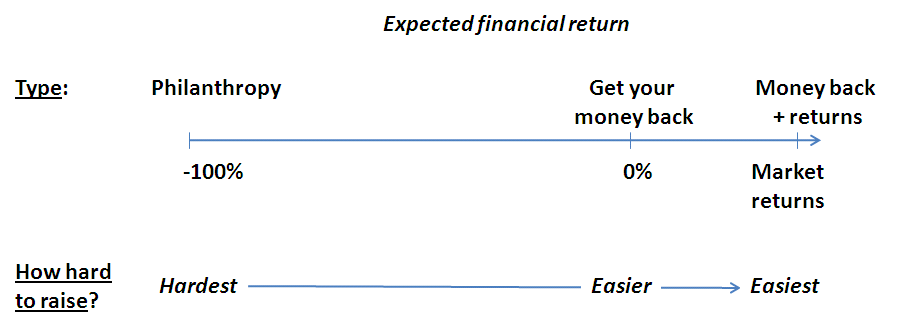
Having raised both philanthropic and sub-market return capital, I would describe the mental model people hold of how this will work as:

That is, people typically expect the holders of capital to look at a spectrum of expected financial return and implicitly find every opportunity further to the right (closer to a positive return) more attractive than every opportunity further to the left.

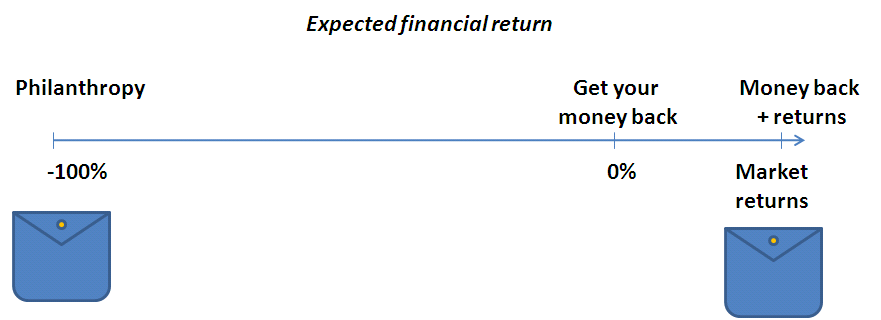
The reality, I’ve found, is different, with a picture that looks like this (yes, those are pockets).

Namely, the potential individual philanthropist / investor has two pockets, two types of capital that they’re used to deploying.  The first pocket is for their investing, and it’s where most of their money goes and where they think about financial return.  The second pocket is for philanthropy, which is also a defined practice with its own decision-making process – whatever that process may be.

Asking someone to make an impact investment isn’t a move along a rational economic scale, with each step proving marginally more attractive.  It’s asking someone to do two things instead of one:

  1. Create a new pocket
  2. Invest out of that pocket with us

There’s nothing wrong or right about this, it’s just two sales you have to make instead of one; two decisions instead of one – at least if you’re talking to anyone who hasn’t developed that pocket on their own.

Doing this is important – it is, in fact, how markets are created, and the more that this becomes accepted practice (written about, talked about, understood and supported by financial advisers and investment professional, etc), the more that third pocket gets created for everyone, not just for the pioneering impact investors.

It’s important work, but it’s hard work, and until we understand it as such people will continue to throw around numbers blithely, implying that trillions of dollars are waiting on the sidelines, ready to be deployed in pursuit of social change.

Not yet.  At least not until we all, together, create that third pocket.

add to del.icio.us : Add to Blinkslist : add to furl : Digg it : add to ma.gnolia : Stumble It! : add to simpy : seed the vine : : : TailRank : post to facebook

A new tool

I participated an interesting conversation tonight of about 30 people all interested in the “impact investing” space which, broadly defined, is focused on taking an investment-based, market-based approach to solving major social problems.  Acumen Fund, where I work, is one of the pioneers of this space, and we’re excited to see the growth of the sector, especially in the last few years.

Tonight’s conversation started with a question – “what are the limits of philanthropy?”  And while I thought this was an interesting question to kick off discussion, I thought it was a misleading starting point for a conversation about how to use patient investment capital for social change.

It’s not about what’s wrong with philanthropy.  Rather, we opened our tool box one day a few years ago and discovered a strange new tool – using the markets and an investing mindset to make social change.  What we’re all in the process of trying to figure out is, “What’s this tool for? Where can it best be used?”  I don’t know if philanthropy is a hammer or a screwdriver or an awl, but I do know that we can waste a lot of energy trying to figure out all the things that other tool cannot do, energy that would be much better spent holding this new tool in our hands, playing with it, trying it out in different situations, and honestly looking at the fruits of our labor.

Where does this tool work?  Where does it do a fabulous job?  And where does it prove to be awkward or misshaped or just plain inappropriate?

This new tool alone isn’t going to solve all our problems just like philanthropy doesn’t and the markets don’t either (nor does microfinance; nor does infrastructure; nor do projects for women and girls).  But those who spend their time mastering this new tool, apprenticing and toiling and honestly assessing what they have worked to build – these people will show us the way forward.

add to del.icio.us : Add to Blinkslist : add to furl : Digg it : add to ma.gnolia : Stumble It! : add to simpy : seed the vine : : : TailRank : post to facebook

Giving is as fun as sex

Apparently it’s true. From Nick Kristoff’s recent op-Ed:

Brain scans by neuroscientists confirm that altruism carries its own rewards. A team including Dr. Jorge Moll of the National Institutes of Health found that when a research subject was encouraged to think of giving money to a charity, parts of the brain lit up that are normally associated with selfish pleasures like eating or sex.

A young colleague of mine set out over the weekend to raise money to support Haiti.  She and a small group of friends walked the length of Manhattan (15 miles) with the goal of raising $500.  So far they’ve raised $7,500 and counting.

Why has she raised more than 15 times her goal?  It’s because her “ask” (“sponsor my walk in support of Haiti”) was really two gifts to her friends and network, since they:

  1. Are looking for a way meaningfully to support those affected in Haiti
  2. Appreciate and want to support her personally, for the work that she does and the person that she is.

One of the most powerful things you can do is to reframe what it means to ask someone to give, to remember that as much as they are supporting you, that you are giving them a gift.  You are providing them with a solution.  Better yet, you may be helping them become the person they want to be.

And, hey, it may just be as fun as sex.

add to del.icio.us : Add to Blinkslist : add to furl : Digg it : add to ma.gnolia : Stumble It! : add to simpy : seed the vine : : : TailRank : post to facebook

Generosity experiment revisited

A few weeks ago I started a generosity experiment.  The idea, sparked by a homeless man to whom I did not give, was to spend a period of time saying ‘yes’ to all requests to give – whether a person on the street, a donation request from a nonprofit, whatever.

Some people, like Jeff, really hated the idea at first (“AHH! NOO! STOP!” was his initial reaction); others shared my sense that the practice of being generous itself was inherently valuable.

A month later, I’m glad for the experiment.  I gave more than I normally do and I gave more often.  And it felt good and right, especially during the holidays, a time when presents of all sorts were flying in all directions.

And while I won’t continue giving to virtually everyone who asks, I will give more and more often.  The practice of being generous instead of critical (discerning?) is, I have found, important for at least two reasons:  first, we are how we act, so if I can habitually act more generous, I will be and become a more generous person.  Second, the experiment served as a deeper exploration of how much giving is an act of self-expression, rather than (or in addition to) a “purchase” of a social outcome.

The people who didn’t like my experiment all said something like, “If I pass a person on the street asking for money, I don’t give because I know it makes more sense to give to a homeless shelter.”  Put another way, one could better purchase social change for a homeless person by giving to a shelter or a food bank.   Objectively, that’s probably true (though one doesn’t know for sure).  However, it also misses something: first, because whether or not you give a dollar or two to a person on the street really doesn’t affect the larger donation you’ll hopefully make to the homeless shelter or the food bank; second, because the act of saying ‘no’ over and over again is reinforcing something in you and in me.

I’m not saying give every time, I’m asking us to be honest about why we do and don’t give, and to recognize the effect it has on us.

Let’s take an extreme example: suppose that over the course of the year I’m asked to give 200 times – maybe 100 times directly and 100 times by various nonprofits in various ways.  And let’s say I have a limited amount of money to give, which I do.  Isn’t the practice of saying ‘no’ 195 times and ‘yes’ 5 times reinforcing a mindset and habit that I’m the kind of person who says no when people ask for help?  And couldn’t there be a way to say “yes” 15 or 50 or 100 times that would reinforce something else entirely?

I don’t want to take this too far – to the conclusion that all philanthropists should spread their funding widely so that they can practice saying ‘yes.’  That’s not right either.

But I do want to push myself and others to ask whether it is healthy to think of every giving decision from the head rather than from the heart.  Can’t the argument that “this isn’t the best use of my money” be paralyzing or, worse, an excuse never to part with any money, because nothing is ever good enough?

Maybe a request for a gift isn’t always chance to analyze what is or isn’t the “best” use of my money.  Instead, maybe a request for a gift is an opportunity to practice being the person that I want to be – someone whose first response is to be open and generous.

And maybe, with practice, I will be transformed in a way that is powerful for me and for the world.


add to del.icio.us : Add to Blinkslist : add to furl : Digg it : add to ma.gnolia : Stumble It! : add to simpy : seed the vine : : : TailRank : post to facebook

The junk drawer experiment

My house has a junk drawer, somewhere for keys and phone chargers and pens and post-its…and whatever other random things seem like they should be around but don’t have an obvious home.

For the last two years, it’s been almost impossible to close the drawer.

For a while I’d grudgingly clean it every few months, painstakingly sorting through what should stay and what I wanted to throw out.  Invariably, two weeks later it would be overflowing again.

Three months ago I tried something different with the drawer.  I took a plastic bag and dropped everything I didn’t absolutely need from the drawer into the bag.  But I didn’t throw the bag out – I just put it aside.  This way I was comfortable putting a lot more stuff in the bag, instead of leaving things in the drawer that I wasn’t ready to throw out.  I was curious to see how long it took for me to look for something in that bag.

Surprise, surprise: I’m at three months and counting, and I have yet to go look for the bag.  Pretty soon, I’m going to have to admit that I’m ready to throw it and the former contents of the drawer out.

I wonder if there’s any application here to philanthropy – to help us all as givers in our own practice of aparigraha, or non-hoarding? (which is something I talked more about here).  Could you create a vehicle for people (everyday people, not just ultra-high net worth individuals who for lots of reasons create private foundations) to set aside money to see how it feels to live without the money for a while?  Some sort of escrow account that’s practice for giving more, where people could put the money aside with a plan to give but the option to get it back?

How would you structure it?  What would the mechanics be?  Who would you want to have involved – financial institutions, 401(k) providers, non-profits, online giving marketplaces? What would you name it?  How would you spread the word?

add to del.icio.us : Add to Blinkslist : add to furl : Digg it : add to ma.gnolia : Stumble It! : add to simpy : seed the vine : : : TailRank : post to facebook

Kiva Customers Don’t Receive the Loans you Give

If I wanted to get your attention, that’s the headline I’d write.  Strictly speaking, it’s true.  And when you only have a minute to grab someone’s attention, isn’t it your job to grab their attention?

That in essence is what’s at the core of the conversation that’s swelled up over the last two weeks about Kiva.  David Roodman’s “Kiva Is Not Quite What It Seems” post kicked things off; Tim Ogden took things further in his post on the Philanthropy Action blog, and Sean Stannard-Stockton provided the definitive summary of the conversation, with his take on it, on the Tactical Philanthropy blog in a post titled “Is Kiva Misleading the Publc?

Here’s the low-down: you can log on to Kiva, find a microfinance client in the developing world who needs a loan, and fund that person.  The catch is that that person has already received their loan.   In fact all the clients on the Kiva website have already received their loans.  The microfinance organizations that gets money from Kiva does receive those funds, but the funds don’t go to that individual client.   The GiveWell blog provides the picture that’s worth a thousand words by showing what the Kiva donor is told (graphically) and what the microfinance organization is told.

The thing is, what Kiva’s doing is nothing new.  Heifer International raises tens of millions of dollars a year by sending out millions of catalogs that are every bit as sophisticated as the LL Bean or J Crew catalogs, only instead of buying rugby shirts you buy a chicken or a cow for a family in the developing world.  But you’re not really buying that chicken or that cow.  On the bottom of every page for every cow or chicken or trio of rabbits you “give” to someone, there’s a small-print disclaimer:

Gifts made through this catalog represent a gift to the entire mission. To help the most number of families move toward self-reliance, Heifer does not use its limited resources to track gift animals from donation to distribution. We use your gifts where they can do the most good by pooling them with the gifts of others to help transform entire communities. And, because you are helping Heifer fight hunger and poverty, your gift is tax deductible.

So the gift of a cow isn’t buying a cow, just like the Kiva loan isn’t going to that actual Kiva borrower.

Before we get on our philanthropic high horse, let’s be clear about what is and isn’t true here.  To keep it as simple as possible, imagine you run a nonprofit that provides food aid to people struck by natural disaster.  The simplest story goes:

  1. People are suffering as a result of this natural disaster
  2. One can buy food for one person who is hungry for one week for $10
  3. We’re in the business of buying this food
  4. So give us $10 and we’ll buy the food.

And when you’re writing a catchy headline to get a high open rate for your emails, you’ll lead with “A $10 gift will buy someone food for a week.”  This is, strictly speaking, true.

So the question here isn’t really about truth, it’s about how big a sin of omission each nonprofit can and should commit as they play this game.  Is it the responsibility of the nonprofit sector and donors alike to break down the myth that each gift does or doesn’t buy a specific thing?  And will those who take the high road ever win out in the marketplace of ideas?  It’s an empirical fact that people give more to help one person than to help many (check out this excerpt from Made to Stick for the startling experimental data), and this is wired deep into our brains, it’s not something that was created by the nonprofit sector.

Which is why I think Nathanial Whitttemore has it right when he says that this “problem” is here to stay, namely that nonprofits will, by and large, tell almost-truths to their donors – focusing on a specific connection between their dollars and a given outcome – and that a major shift for the majority of the giving population won’t happen any time soon (if ever), even though as professionals our aspiration might be to change the narrative to investing in nonprofit organizations, as Sean suggests.  It’s a good aspiration, and we should keep at it, but it will never be the bread and butter for most nonprofits or for most donors.

It is true that philanthropists who makes major giving decisions and give considerable time and energy to these decisions have the opportunity to break this cycle; and the supporting infrastructure of philanthropic advising has an opportunity to push this conversation forward, aided by nonprofits who are willing and able to tell a different story.  But let’s not pretend that we will someday divide the world into two, with the masses being duped into emotional decisions that get them to dig into their wallets while major donors dig in deep analytically and primarily make educated, highly rational, institutional-building investments.  If it doesn’t happen in the stock market, why will it happen here?

All givers are essentially the same, essentially human, making rational and emotional decision based on the information they have and the amount of time they have to give to their giving decisions.  The emotional connection is the starting (and often ending) point for everyone, and what matters is the ability of every individual donor (whether they give $20 or $20 million) to insert themselves into the narrative of a particular nonprofit organization, the problem they’re addressing, and the role that the philanthropist and their gift have in addressing that problem.

The “your money buys this” message isn’t going anywhere soon. If anything, what Kiva and Charity:Water and DonorsChoose have shown is that there’s a way to take this approach and adapt it to 21st century tools – so that you can see an online photo of the microloan recipient or the well that was dug or the classroom that was helped — if not directly by your money, at least by that same amount of money as the amount you gave.  It’s interesting that making this association more visible and tangible is calling into question the veracity of these claims (no one’s writing about Heifer, right?), when in fact all Kiva et al are doing is strengthening a tried-and-true narrative.  The mechanics of gift -> organization -> recipient haven’t changed one bit.

If you think about it, it’s nearly impossible to change these mechanics and run an efficient, global nonprofit.  So why are we all acting so surprised?

add to del.icio.us : Add to Blinkslist : add to furl : Digg it : add to ma.gnolia : Stumble It! : add to simpy : seed the vine : : : TailRank : post to facebook

Real giving conversations

I had a fascinating, far-ranging conversation today with a friend about philanthropy, touching on giving, donor accountability, what an individual gift means in the context of larger pools of money, how people really make philanthropic decisions…the works. Out of the blue, he says, “this is highly emotional, this business of giving.”

In another conversation today, another friend told me that his giving is “an expression of who I am in the world.”

Pretty heady stuff.

People can write analytical papers until they are blue in the face about the efficient allocation of philanthropic capital, but unless they spend some time on the front lines, I worry that all the real substance around how and why people give – for expressive, emotional, personal, sometimes selfish, always human reasons – is and will continue to be lost. This is part of the reason I wrote a manifesto a while back, because I think the business of giving – how and why it’s done; but also how important it is to raise money in the right way – is often fundamentally misunderstood.

People bring their whole selves to their giving decisions, and if you are going to engage with them at that level, you have to be prepared to bring your whole self to the conversation. This starts with knowing who you are and knowing why you’re there, talking to someone, and asking her to give.

add to del.icio.us : Add to Blinkslist : add to furl : Digg it : add to ma.gnolia : Stumble It! : add to simpy : seed the vine : : : TailRank : post to facebook