
The next wave in the social investing space is to create a market of socially-oriented investment funds that are neither purely philanthropic nor purely market-based in their return expectations.
Put more simply – there’s a belief and an assertion that somewhere between pure philanthropy and pure investing, there’s a class of capital that’s willing to get a lower expected economic return for a higher expected social return. The most common term for this is “impact investing” and it’s applied quite loosely – but it implies a level of proactive care for social impact that’s a generation beyond the screened investment funds of the 1990s that invested in various flavors of “vice-free” stocks.
There’s no doubt that there’s a middle ground here, that it’s important that we find it, describe it, and understand it, because by doing so we will, over time, find much more capital and much more savvy investors willing to occupy that space.
That said, it’s not as easy as it sounds. There’s a pervasive myth out there that there are enormous piles of investor money poised to be “unlocked” if we create the right product and investment opportunity.
Having raised both philanthropic and sub-market return capital, I would describe the mental model people hold of how this will work as:
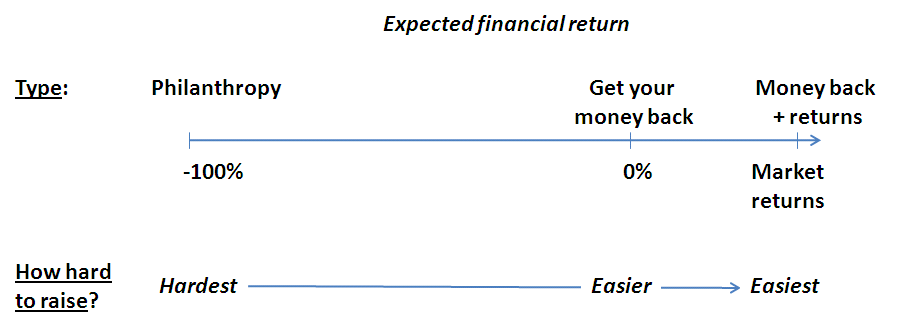
That is, people typically expect the holders of capital to look at a spectrum of expected financial return and implicitly find every opportunity further to the right (closer to a positive return) more attractive than every opportunity further to the left.
The reality, I’ve found, is different, with a picture that looks like this (yes, those are pockets).
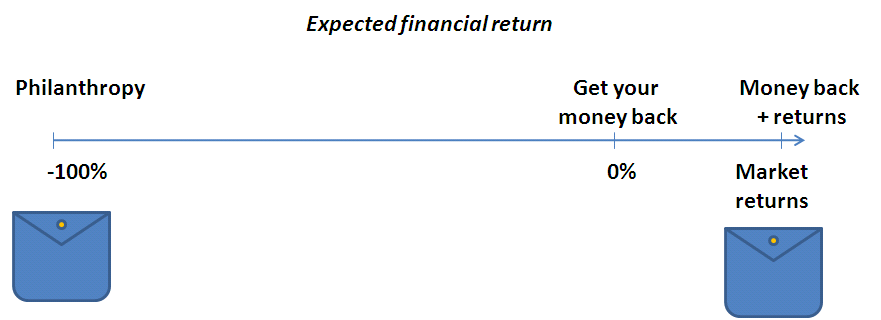
Namely, the potential individual philanthropist / investor has two pockets, two types of capital that they’re used to deploying. The first pocket is for their investing, and it’s where most of their money goes and where they think about financial return. The second pocket is for philanthropy, which is also a defined practice with its own decision-making process – whatever that process may be.
Asking someone to make an impact investment isn’t a move along a rational economic scale, with each step proving marginally more attractive. It’s asking someone to do two things instead of one:
- Create a new pocket
- Invest out of that pocket with us
There’s nothing wrong or right about this, it’s just two sales you have to make instead of one; two decisions instead of one – at least if you’re talking to anyone who hasn’t developed that pocket on their own.
Doing this is important – it is, in fact, how markets are created, and the more that this becomes accepted practice (written about, talked about, understood and supported by financial advisers and investment professional, etc), the more that third pocket gets created for everyone, not just for the pioneering impact investors.
It’s important work, but it’s hard work, and until we understand it as such people will continue to throw around numbers blithely, implying that trillions of dollars are waiting on the sidelines, ready to be deployed in pursuit of social change.
Not yet. At least not until we all, together, create that third pocket.
 :
:  :
:  :
:  :
:  :
:  :
:  :
:  :
:  :
:  :
:  :
: 