Following up on my follow up

I no longer try to reply immediately to every email. It’s not only impossible, it leaves me reactive, tired, and less productive (though very busy). I still try to be very responsive most of the time, and even this only works if I’m pithy while also being predictable and clear when it will take me longer to reply.

Everyone has their own approach to managing their communication flow, and part of the trick is to get my flow and someone else’s flow in sync. This boils down to is a series of pairings: my communication has a tone, a style, and a cadence; and, when a communication flow is working well, that evolves into a nice groove of clear mutual expectations (again, in terms of tone, style and cadence) with the people I’m in touch with regularly.

Where things get dicey is in higher stakes, infrequent communications – and these are the ones that we want to be getting right: reconnecting with a (potential) donor; reaching out to invite someone to speak at your conference; asking for advice from someone I don’t know.

The unspoken reality is that, in the absence of a strong existing relationship, the person doing the cold call (email) is taking advantage of the email medium to interrupt someone and borrow some of their attention. The only way this works is either by being exceptionally brief and clear in these sorts of notes (which seems to happen almost never), or by writing a note that itself adds value in exchange for that interruption (by being interesting or useful to the recipient, not to the sender).

Lately I’ve been noticing a lot of bad email etiquette that wrongly supposes that no one will notice or care about being interrupted and asked for something. This feels like the unintended consequence of an unstated but widely-followed norm that personal emails merit a personal reply, even when they don’t.  The result is more and more people asking for things without stopping to think about how to complete the circle of the ask they are making.

Hints that this is going wrong are phrases like: “I know we haven’t been in touch for a while, but…” “I realize I’m emailing out of the blue, but…” “Things got busy on my end, but I’d like to continue the conversation we started…” and, the worst, “You don’t know me but…” Essentially, any first sentence with a “but” in it is a problem.

(Even worse is any chain that contains any of the above phrases and is followed, one day later, by some version of “Hey, why haven’t you replied to my out of the blue email that I wrote on my timeline in the hopes of getting your attention?”)

Email can be quick and immediate, but relationships are not, and trust is earned or unearned each and every day. Don’t be confused by the medium (quick, easy, immediate) and the expectations of the people who are reading your notes.  The technology has evolved very quickly, but our expectations march to a different drummer.
Subway Portrait

“Excuse me, m’am, may I draw your picture?” he says, white pad on his lap, fingers stained with charcoal.

“Pardon me?” says the woman sitting across from him on the subway, looking confused and a bit taken aback.

“Your picture…is it alright with you if I draw your picture?” he reiterates.

“Uh…sure.”

And then, as his hands glide across the page, his patter begins, not interrupting the drawing, which has to be complete in the two minutes before the last stop.

“This is what I do,” he says, “I draw pictures of people. Portraits. Been doing this for years, I’ve drawn 800 portraits of New Yorkers so far.”

She takes the bait: “All in one day?” she asks. Her guard is dropping just a little bit.

“No m’am, that would be impossible. Anyone who tells you they’ve drawn 800 portraits in one day, they’re lying to you. No, I’ve drawn 800 portraits since I started, and that’s why I can draw them so fast, because I’ve done it so many times. I’m an artist, you see, an artist. Don’t you like how that looks?” (he holds up the already – amazingly – half-finished sketch, which has gone from a few lines to, instantly, a pair of eyes, an outline of a mouth, a bit of expression, in about one minute).

She smiles, recognizing her likeness, the shape of her face, the crinkles around the outside of her almond-shaped eyes.

“See I knew that would make you smile! Now I can get that smile in the picture… Now I’m gonna give this portrait to you, that’s what I do, I’m gonna give it to you either way….Lots of people like these portraits, they hang them up, in their offices usually…And a lot of them pay me for them, even though I give them to ‘em either way, a lot of people pay me $10, or sometimes even $20…

(almost to himself) “Yeah, I try to get 10 people in a day to pay me $10 each, that’s what I try to do. Last guy I did this for he handed me a $10 bill, yes he did. And don’t tell me I’m not an artist, see? Artists make people smile and that’s what I’m doing here, I’m making something that will make people smile.”

Just a few more seconds for the finishing touches, and:

“So here you go, beautiful, here’s your portrait I hope you like it.” he says, handing it to her.

And she does.

And she pays $10.


In review: to create a situation where someone gives or buys, you must first create joy, a story, connection, a thing of beauty.

And in situations, like philanthropy, or busking, where it’s not clear what something is worth, it’s your job to tell them, to frame it for them, to say: this is what people who are happy and feeling a sense of connection in this moment typically pay. This is what the last 10 people did.

“I’m going to give this to you either way, but you gotta know that everyone else before you who liked their portrait gave $10 or $20 and hung the portrait in their office.”

Sure, she could decide not to pay, but if she does pay, you can bet it’s not going to be $1, which is what most people on the subway get when they ask for money.

His starting point was a $1 portrait. The story about the portrait, and the story about what people who like portraits pay, that’s what’s worth the other $9.

Bhava Yoga, then and now

Over the holidays, I went with my family up to Okemo, Vermont for four days of skiing. It was a little icy for the first few days, but we had a great trip.

As an experiment in family travel management, we decided to break up the drive with a quick overnight stop in Brattleboro, VT. One of our great parenting discoveries is that any hotel with a pool and free waffles for breakfast is, according to the kids, “totally awesome,” so we stay at a lot of Hampton Inns on family vacations.

Weeks after we’d made this plan, my wife reminded me that Peter Rizzo, a master yoga teacher whose classes we used to take on the Lower East Side of New York City, had moved his studio to Brattleboro a number of years ago. Could we arrange things so that one or both of us could take a class with Peter during our 18 hours in Brattleboro?

Somehow, it worked out. Last Sunday we left New York around 1:30pm and managed to pull into Brattleboro at 4:50pm, ten minutes before Peter’s 5pm class. My wife spilled out of the car and went up to Peter’s two-hour class while I took the kids to the (tiny, cold) pool at the Hampton Inn. That class was so great that I then took Peter’s 9am class the next morning.

Peter is an exceptional yoga teacher on a number of levels. Yes, he’s technically amazing, but what really matters is that he keeps you calm and helps you get to a non-striving place, with great reminders like (after putting you into a crazy poze) “just by looking at how far you do or don’t get into hanumanasana (full split) I could tell nothing at all about how advanced your yoga practice is. In fact, I can tell you from my personal experience that there’s no relationship between how close my head gets to my shin and how enlightened I am.”

Indeed.

Time works in funny ways, and when my wife and I spoke to Peter that Sunday evening after the 5pm class, he remembered that we used to go to Bhava Yoga when it was on East 13th street. We said it was “a while ago,” and he said, “Yes, that was 11 years ago.” Where did the time go?

Though our interaction with Peter was fleeting, there was something special in that moment of reconnection. Peter gave each of us the gift of a deep, grounding, inspiring yoga class, and a glimpse of the community he has created. There was also something pensive and reflective – and perhaps even a flicker of pride – in Peter’s eyes as he contemplated the 11 years since we’d last seen him, the logistics we must have managed to make the class happen (the drive, the kids). What I hope he understood was that, even though we’d taken no more than 30 classes with him so many years ago, he was a part of our lives and he had made a lasting impact on us. I hope that, in seeing us, we helped him realize how many other people there are out there in the world, some of whom he hasn’t seen for a decade or more, who he’s also impacted in profound ways.

I think this is how it is for all of us: we hear back only a fraction of the ways that we have touched people, moved them, inspired them, and lifted them up when they were down. But that impact is out there, it is real, and it is our living legacy.

One of the easiest gifts to give is to find the opportunities to remind people how important they have been to us, and to thank them for it.

Here’s wishing you a great start to your year in 2015.

Individual and Institutional Fundraising

Over the past six months, a greater proportion of the fundraising I’ve been doing has been institutional rather than individual. By “institutional” I mean fundraising from people who have been charged with donating somebody else’s money – whether or not it’s a formal, recognized institution (e.g. a large private foundation, a corporation, etc.).

In both individual and institutional fundraising, there’s a strategic element and a people element. The strategic conversations are around goals and outcomes and what success looks like. The people element is around what motivates a person to take action – the story and the emotional elements that move people to act, as well as the interpersonal dynamics that are always at play.

The one thing that is missing from these institutional conversations, which easy to miss if you’ve not experienced it directly, is a deep, personal element. In my experience, real, substantive conversations about real, substantive philanthropy nearly always get personal: they touch on motivations, hopes and fears, aspirations, and legacy.

These conversations require something different from the person doing the fundraising: a comfort getting into that murky space where they, too, are more open, honest, and vulnerable than would ever be expected in a purely professional context.

My hunch is that the reason most people don’t wade deep into individual, big-ticket fundraising is either because they don’t understand how deeply personal these conversations have to be, or they are unwilling or unsuccessful at going there. This means that if you have the courage to take that leap, along with openness to do the real work that this leap requires – to learn about yourself, to understand your own motivations for doing this work, to help people talk about their own purpose – you’ll soon be part of a very small group of people willing to take it to another level. This path is a heavy lift, a long walk that requires emotional labor and has the potential for a serious personal and professional payoff.

Of course your other option is to sit safely at a desk replying to yet another formal request for proposal, hoping that your program will be the one out of 1,000 that’s picked out of the pile.

This is one of the greatest blend-in or stand-out opportunities in the nonprofit sector.

Word Economy

Most emails are too long. And most emails, long or short, are either emotional deserts or they transmit the wrong emotional content.

Short is the only solution to email overload, and radical email shorthand is employed by nearly all the successful busy people I know. But it only works if you pick words that transmit feeling too.

One word shorthand for…

Friendly: Hey, hi, please, help, okay, great

Informal: yeah, yup, nah, sure, yo, …,

Aggressive: just (“it’s just that”), never mind, forget it

Dismissive: whatever (…you want), fine, c’mon

Connection: thank you, truly, warmly, visit (with), sorry

Encouraging: go for it!, absolutely, fabulous, super, yes!

“Just the facts” is a nice idea. But like it or not we’re communicating emotions, even in six words or less.

I love New York

Why do I like Citibike so much (when it works)? True, it helps me cut my long commute (a bit), and it’s a rare innovation in transportation in a country that, thanks to our love affair with cars, radically underinvests in transportation infrastructure. It’s got some geeky software and data tie ins too, which I like, and it also serves as commentary on modern “public services” that, due to the need to show financial sustainability, aren’t as public as they used to be – hence the concentration in Manhattan south of 59th street.

But there’s something bigger and much more personal going on.

As a native New Yorker, I’ve watched my city change a lot in the last 40 years. It used to be a grimy, dangerous place, where you never took the subway if you could avoid it, where most of Central Park was dirt and dust, not lush, fenced-in fields. When I was a kid I watched bodegas and locksmiths on the Upper West Side turn into ristorantes and, eventually, high end, bobo-fied chains. I saw Times Square morph from the underbelly of the city, where 3-card monte players would set up on cardboard boxes to fleece tourists and locals alike, to a place that you could almost drop into Disney Land.

And yet, through all the facelifts and gentrification, New York City is still New York City – even if it’s become a kinder, gentler, more upper class version of itself.

My new, daily, Citibike-powered, two-and-a-half mile ride through the heart of Manhattan is a chance to see all the things that haven’t changed about New York City. It’s a daily glimpse of the kaleidoscope that still is this city if you just scratch the surface. It’s a reminder that, despite all the changes, New York City is still a crush of people and cultures and races mixing together, mostly, without much trouble.

New York is my experience on each and every afternoon ride. It is Sikhs driving Lincoln Navigators, edging into the bike lane. It is smokers with white earbuds, scowling; Japanese tourists with H&M bags; tourists of all stripes looking up and not forward; businessmen in a rush, looking down at their BlackBerrys.

New York is, still, bleary-eyed med students in scrubs, blinking in the afternoon light; watch repairmen, falafel-makers, computer repair hideouts. It is Yankees fans in pinstripes, Rangers fans on an open bus, barreling towards Madison Square Garden, bike messengers with Beats headphones and giant canvas bags, drummers in Hawaiian surfer shirts spinning their sticks and dreaming of their next gig. New York is Bangladeshi kids in strollers talking to moms wearing shawls; it is tourists snapping pictures in front of minor landmarks and yellow mobs of taxis vying for a fare. It is throngs and throngs and throngs of jay-walkers in high heels and high hair, sweating on an early summer afternoon

I (still) Love New York.

Why we read you

We read you because you are you. Because you sound like you, talk like you.

You are identifiable, clear, and you have a point of view. Whether that is polished or rough, grammatical or not…whether you use ellipses and start your sentences with “and” are all part of what make you you.

We read you because you teach us, or challenge us, or make us laugh.

You give us a feeling we’ve come to expect most of the time, and a feeling that surprises us some of the time.

By reading you we tell ourselves a little something about who we are. When we share what you’ve written with others, we are sharing what you’ve said and, also, shared a glimpse of what makes us us.

We can’t read “you” (an identifiable someone) if we can’t identify you, if you don’t sound like something.

If you’ve read this far and are still nodding, you’ve got no choice but to conclude that your organization’s voice isn’t supposed to sound like nothing and no one. If you’re nothing and no one, we won’t miss you when you’re gone.


THE SAME SUBJECT LINE

Every time you send an email you’re asking someone to make a decision.

Open this now or later.

Prioritize it or put in the “I’ll get to it later” pile.  (And later never comes.)

When you write your spouse, your best friend, your boss, you write a subject line that will help them understand why you are writing, help them understand how important the message is (or isn’t), help communicate something.  The subject line is the second thing they see when your email arrives (the first thing they see is that you sent it).

If it goes without saying that you would never, ever, send one person an email with the same subject line each and every time, how can it be that I still get newsletters whose subject is the name of the newsletter, conference invites whose subject is the name of the conference, offers from companies with the company name as the subject in big capital letters?

As in: NONPROFIT NEWSLETTER VOL 3

Or

SOLAR INDUSTRY CONFERENCE SPECTACULAR

Why oh why?

Just because you are writing something for an institution doesn’t mean you’re supposed to sound like an institution.  Please, sound like you.


Personal, with an element of surprise

As I sat down at my desk at work to start the new year, I found two envelopes on my chair.

The first one was a big envelope, 11 x 14.  I opened it up to find a report with a full-color photo on the front, followed by more than 100 pages of text.  I immediately threw it in the trash.

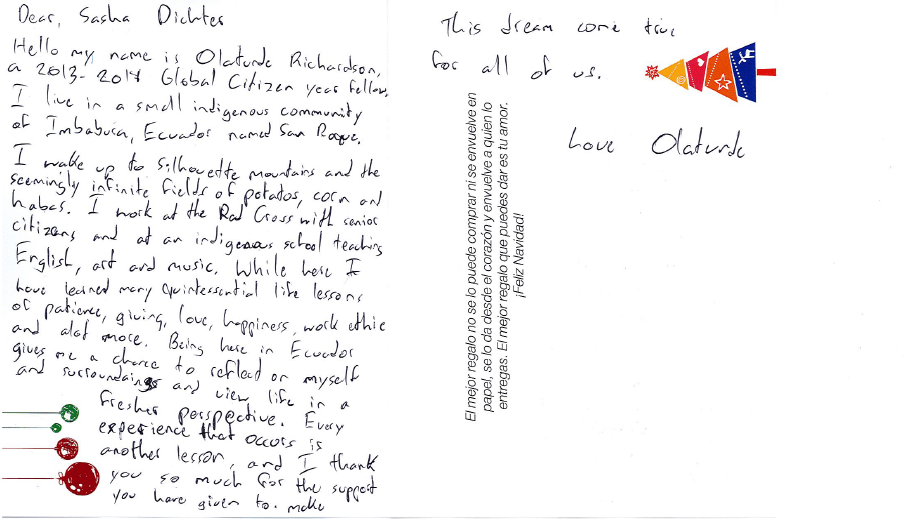
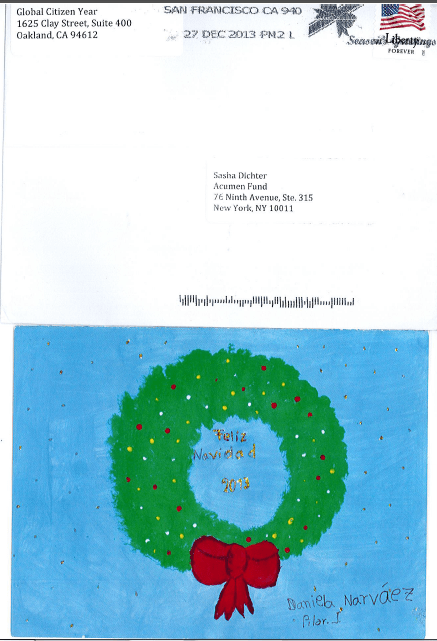
The second one was a thin envelope with a Christmas card.  It looked like a lot of other “Season’s Greetings” cards I receive from nonprofits.  And then I opened it up and found a handwritten note from Olatunde Richardson, who just graduated from high school and is spending the year in Ecuador as a Global Citizen Year Fellow.  Olatunde works at the local Red Cross, he teaches English, art and music (he’s a budding musician), and his note definitely isn’t going into the trash.

Now, if I were part of the inner circle of the first nonprofit, the one that sent me the big report, the report might help me understand their work in more detail, might equip me to tell their story better…assuming I’m already 100% sold on them, 100% passionate about their work, 100% cerebral, and 100% willing to do the work of distilling all of that down into a story I can tell.

Unfortunately I’m none of those things and I suspect few are.

But something as remarkable as a kid taking the time to write me a personal note from Ecuador?  That’s just enough to tip the scales, to give me something worth sharing because it is personal and it totally surprised me.  So it invites me in.

The handwritten note works because it isn’t trying to do everything, it isn’t trying to answer every question I might have about Global Citizen Year (because it couldn’t, and nothing could).  It is trying to say thank you in a personal, memorable way, and it succeeds.

I know, I know – you have too many people you need to connect with, you could never do this for every single one.

Except if you could.  What if it wasn’t you writing the notes but instead the 50 people who care most about your organization, telling a personal story?

Nice to meet you, Olatunde.

GCY_envelope

GCY_note


To Whom Am I Speaking

If I’m stuck when developing a talk or a presentation, it helps me tremendously to remind myself of two fundamental questions:

  1. To whom am I speaking?
  2. What do I want them to walk away with from this talk?

Now, in practice, there are times when I feel inspired and the words (and accompanying slides) just come out.  Often those are the easiest talks to write.

But when I don’t have a bout of inspiration, it helps me a lot to take the deliberate step of thinking through the blanks in this sentence:

At the end of this talk, I want people to walk away understanding ______,  having learned ________, and feeling _______.

That’s a good starting point.  (And please, don’t forget the “feeling” bit.”)

The next big sticking point in that sentence is the word “people.”  Which people, exactly?

Rather than think about types or groups of people, increasingly I try to think of a specific person (or, at most, two) who I feel represents the most important audience-member to whom I want to speak.  That person doesn’t need to be physically present for the talk (though that helps), she just needs to be someone I know well enough to allow me to look at what I’m planning to say and ask myself, “would she find this engaging?  How should I say this in a way that connects with her worldview and where she is coming from?  What points would I make, and how would I make them, in a way that would resonate with and move her?”

Without this, I’m just writing for me, and, problematically, I find most of what I’m interested in interesting.