New Year’s Resolution

When I take time off in December and don’t travel I inevitably find my way back to the piano.  I played classical piano very seriously for about 20 years, so it’s part of me and part of who I am, even if I don’t make the time to practice most days.

If I had ever wanted to be a professional pianist, one of the things I would have had to have gotten better at was learning new pieces of music faster.  I never was much of a sight reader, and I allowed that summary of one of my weaknesses to define how I learned new music (slowly).

The advantage of returning to something intermittently is seeing it with fresh eyes.  This year, sitting down at the piano to learn one of my favorite pieces, Shubert’s Piano Sonata in B-flat, D.960, I realized that while I’m not a great sight-reader, there’s also a next step where I’m falling down for no good reason: I let sections, measures, tricky bits, sit in a limbo of “I don’t quite play this right” for way too long, when a little bit of focused attention upfront would be the difference between taking 20 and 40 hours at the piano to learn a new piece.

So often our new year’s resolutions are about big new things that we are going to start: exercising again, cutting out sugar, sleeping more.  And sometimes those can create major shifts in our lives.

But more often than not I find it’s the minor shifts that end up sticking: if I say I want to sleep 7 ½ hours every night and keep it at that, I’ll fail miserably.  Life’s too busy, I have too many other obligations, and the binary nature of do/do not (“there is no try”) makes it too easy to write something off quickly as a failure.  But if I notice, say, how long it takes me to get from planning to get to sleep to sleeping, and then, by paying attention to that one new bit of information, if I make small tweaks where I can in my nightly routine, this might just be enough to have lasting impact.

When it comes to the shifts I want to make in my life, I haven’t had much luck with big sweeping changes, because the power, logic and momentum of the way I do things today doesn’t give way easily.  At the same time, like water to a stone, noticing old behaviors in new ways and then making small shifts has the power to reshape everything.

Happy New Year.

7 words to increase your productivity

“What would help me the most is…”

Whether to a peer, a boss, a Board member, someone you are fundraising from or a friend, the act of clearly and specifically asking for help is transformative.

Of course it is easier to sit on the sidelines bemoaning the one thing that someone didn’t do.  This gives you a person to blame and it keeps you off the hook for taking the next step.

Or, you can take the much more powerful step of (figuring out and) asking for that one thing that would really make a difference.

And then you can get on with the important work of make the changes that only you can make.

Personal, with an element of surprise

As I sat down at my desk at work to start the new year, I found two envelopes on my chair.

The first one was a big envelope, 11 x 14.  I opened it up to find a report with a full-color photo on the front, followed by more than 100 pages of text.  I immediately threw it in the trash.

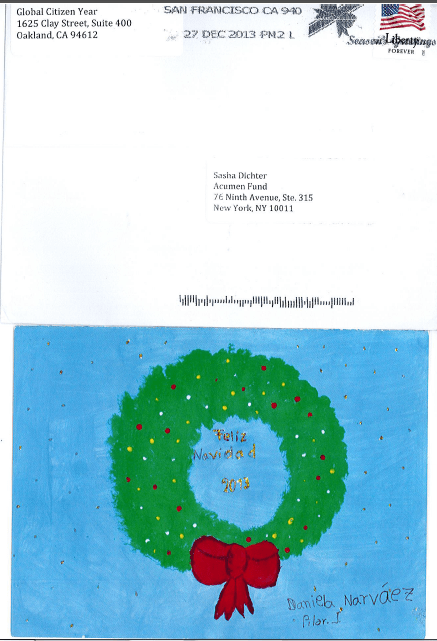
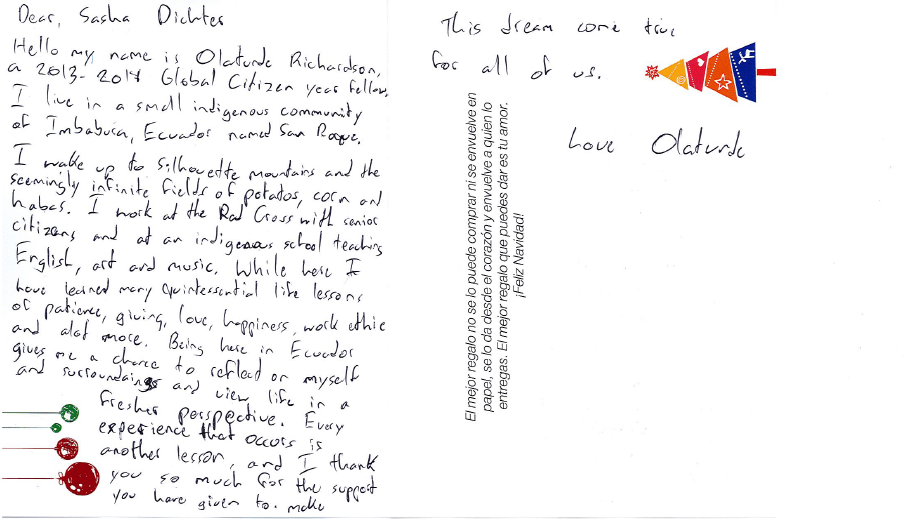
The second one was a thin envelope with a Christmas card.  It looked like a lot of other “Season’s Greetings” cards I receive from nonprofits.  And then I opened it up and found a handwritten note from Olatunde Richardson, who just graduated from high school and is spending the year in Ecuador as a Global Citizen Year Fellow.  Olatunde works at the local Red Cross, he teaches English, art and music (he’s a budding musician), and his note definitely isn’t going into the trash.

Now, if I were part of the inner circle of the first nonprofit, the one that sent me the big report, the report might help me understand their work in more detail, might equip me to tell their story better…assuming I’m already 100% sold on them, 100% passionate about their work, 100% cerebral, and 100% willing to do the work of distilling all of that down into a story I can tell.

Unfortunately I’m none of those things and I suspect few are.

But something as remarkable as a kid taking the time to write me a personal note from Ecuador?  That’s just enough to tip the scales, to give me something worth sharing because it is personal and it totally surprised me.  So it invites me in.

The handwritten note works because it isn’t trying to do everything, it isn’t trying to answer every question I might have about Global Citizen Year (because it couldn’t, and nothing could).  It is trying to say thank you in a personal, memorable way, and it succeeds.

I know, I know – you have too many people you need to connect with, you could never do this for every single one.

Except if you could.  What if it wasn’t you writing the notes but instead the 50 people who care most about your organization, telling a personal story?

Nice to meet you, Olatunde.

GCY_envelope

GCY_note


Mega Millions Jackpot Hits $586 Million

And 70 percent of the hundreds of millions of possible number combinations will be purchased.

Did you ever need more proof that what you’re selling is hope and possibility and not facts and figures?

Where the Magic Happens

I’m a big believer in people’s capacity to change.

In fact, I think that one of the most powerful levers we have in life is recognizing that we can change.  This can be around mental plasticity – realizing our ability to learn big, new things.  Or we can go deeper, reconfiguring our habits, our outlook, even our emotional responses – how we are wired.

It all starts with knowing that we are not static beings.  And with recognizing that the way we act and the person we are aren’t one and the same thing.

We also have to give ourselves permission: the space to see that it took us decades to learn to act the way we act today, so it no doubt will take years, not months, before our new behaviors and orientation grow deep roots and feel natural.

Last week I had the opportunity to speak at the first Lean Impact Summit organized by Leah Neaderthal and Leanne Pittsford.  It was an energizing, entrepreneurial event based on the premise that we will create faster, more powerful change if we learn to embed Lean Startup principles into social change work (you can too!).

I got a huge positive reaction (judging from the Twitter pics) to the last slide of my presentation, an image drawn by Jessica Hagy – whose new book How to be Interesting has lots more great stuff.

Where the magic happens_Lean Impact Summit

Jessica’s right, of course, the magic does mostly happen outside of our comfort zones.  That’s where we change and grow.

No, it’s not too much trouble to measure impact

As impact investing goes more mainstream, there is a growing chorus suggesting that impact measurement might be the providence of academics and idealists.

(as in, “…we have spent too much time and too many resources discussing impact measurement and trying to measure outcomes. Is an individual who needs eyeglasses better off if she has access to them? If you are wearing a pair while reading this article, you know the answer. There are myriad basic products and services such as eyeglasses to which the majority of the world’s population does not have access and which, if they did, would allow them to live significantly improved lives. So let’s move on and not overburden those initiatives focused on underserved communities with academic questions. They already face plenty of challenges trying to deliver what they promise.”)

Now, the argument goes, the real investors have arrived, so we can do away with all of that impact measurement mumbo-jumbo.  If companies succeed and grow, if capital is getting deployed and returned, and if more capital is coming in, then we know that we are succeeding.  The rest is just noise.

That argument would make sense if impact measurement is undertaken as an academic, ex post process  in which those on the periphery of the system peer into its beating heart, extract data, and attempt to define whether or not those at the center are creating sufficient impact.   Who are they to judge?

Indeed, let’s avoid a scenario like that at all costs.  In fact let’s avoid any measurement system in which the main goal is to produce data that isn’t, at its core, useful to operating companies in their interactions with end customers.

However, let us also avoid quick, easy caricatures about what measurement is and could be.

To walk through an example, let’s begin with the assertion that any company that qualifies as an impact investment is creating some sort of direct benefit for end customers or other key stakeholders (e.g. creating jobs).

So, we might ask, who wants to know if this hypothetical company is creating impact?

Sure, a wonky social scientist would love to know.  She’d hope to understand if someone who buys a solar light or who hooks up to a mini-grid stops spending money on dirty, dangerous, expensive kerosene.  If she doesn’t, then there’s less impact than one would hope.

The good news is that while the academic would love to have answers to these questions, we wouldn’t and shouldn’t answer these questions primarily for her.  Because the same questions she has are core questions driving the success of the business.  Any company that has an iota of sales and marketing DNA will need to understand answers to a basic set of questions:

  • Are customers buying solar lights as a replacement to kerosene or as a supplement?
  • How much less do customers spend on kerosene as a result of having a new source of light?
  • Are lights are used primarily late at night in homes, for kids to study, or out in the fields?
  • And on and on….

Similarly, a company selling drip irrigation kits has no choice but to find out whether end customers achieve the 2 to 3x yields that the company gets on demonstration plots.  A company selling drinking water needs to understand if customers are contaminating the water before they consume it (which means that a marketing message around better health ultimately won’t deliver).  And of course a company offering vocational training and job placement will definitely need to know how many graduates they place, how graduates’ incomes compare with the money they made before the program, and which training programs have the highest yield on job placement rates and salaries.

All of which is to say that understanding impact is a key driver of business success for any company selling a new product or service to an underserved market.  And the companies that are first to realize this will be best positioned to meet the needs of their customers and deliver products that create the most value.

Put another way, understanding impact starts with questions like:

  • Who are we serving?
  • Why are these customers buying this product? (what problem does it solve for them)
  • How are they using the product?
  • How does this product compare with what they did before?
  • What benefits do they hope to realize when using this product?
  • Are they realizing those benefits?
  • Why or why not?
  • Etc.

If we recognize that conversations about impact start and end with the end customer, we will sort out the way forward.  Whereas we will continue to stumble out of the gate if they we miscast these efforts as pitting investors’ priorities against those of companies.  Companies will increasingly need this data, and, recognizing that this data must and will be collected, we as a sector will miss an opportunity if we don’t agree at the outset to use a common set of standards – so that as the data is collected, it can be aggregated in ways that allow for easy comparison.

The idea that we have the option to opt out of understanding impact is akin to arguing that we can build large-scale, successful new enterprises without understanding our end customers in any real way.   It’s absurd.  Our opportunity is to understand, in a much deeper way, the intersection of a company, its products, and a customers’ well-being.  The better the customers are served, the better the company will do, and the flywheel will start turning.  If we lack data on impact, we’ll never start walking that path.

The perfect toy

Last week we got my son what he called “maybe the best present ever.”  It’s a Structures 200 Plank Set.Structures 200

Before buying it my wife and I kept on reading over the description to see if we were missing anything.  It is described as “200 identical wooden planks.”  Each of them is a three-inch long little pine rectangle.  No notches, no nothing, no different sizes.  The product description says: “No glue connectors required, simply stack wood planks to create buildings, monuments and geometric forms.”  200 identical little pieces of wood, along with “ideas for over 40 structures?”  Yup, 200 identical little pieces of wood, plus the clever idea to put them all together in a box and sell them for $49.99.

Really?  Yes, really.

And the truth is, it’s wonderful.  You can build bridges, staircases and vortexes.  The pieces are light enough and have enough friction that they don’t collapse.  It’s a blank canvas in a world where everything (especially toys) is over-engineered with too many instructions to follow.  It’s what Lego used to be before they figured out that if you sell a bunch of nondescript bricks each kid will max out at a thousand pieces, but if you sell them the Death Star and Ewok Village and an X-Wing Fighter and the Republic Attack Cruiser, you can keep on selling, well, forever.

So Legos as they are today win.  And Legos as they used to be (Structures 200) wins too, albeit at a smaller scale.  Why?  It’s because we can deliver one of two kinds of experiences to our customers.

At one extreme we have what Lego has become: each individual story perfectly constructed, honed down to the last piece, and that one special character that you can’t get anywhere else.  The edges have been smoothed off, you can have what everyone else has and talk about it with your friends.  You know exactly what you’re getting and it delivers.  All you have to do is buy it and follow the instructions.  (This is the big, institutionalized nonprofit, where any gift can be broken down into a small, digestible story and you can shop for product like you shop on Amazon.  Crank those babies out on the assembly line and sell ‘em like hotcakes.)

At the other end is the pure, blank canvas: create your own story, tell it in your own way.  You, the customer, are the creator and curator and artist, and we are the vehicle for your self-expression.  This is the startup, the dream, the “let’s build this thing together and we will change the world.”

Where things fall down is in between, where the story is neither crisp and clean enough to make a simple promise and deliver on it, nor is there an exciting blank canvas where big thinkers and first movers can make their mark.  Stuck in the middle is disappointing to everyone, and you have no customer whose problem you’re completely solving.

(By the way, blank canvases and products that deliver on their promises can co-exist within one organization, you just have to realize which is which and never forget that each of those gets sold to a different customer.)

Blank canvas

Giving Tuesday 2013

Ten days ago I had the chance to meet with Henry Timms, the Interim Director of the 92nd Street Y.  Henry posed a question that I’ve been turning over ever since: “if you had to build a community organization (like the Y) in the 21st Century, what would it look like?”

This question is hard because it gets to the core of what we mean by “community.”  In the next century, will our community remain those who are physically nearby?   Meaning, despite all of our online connectivity, will we remain fundamentally and predominantly rooted in the places we send our kids to school, the common spaces we use, the places we shop, and the chance encounters we have that cause us to stop, pick our heads up from our smartphones and our calendars, and have a good 10 minute chat?

Or will borderless communities of common (weird) interests become what define us?  Will our identities, our values, what we care about, and ultimately our sense of community increasingly transcend location?

Or is it both?

And if you ran an organization like the Y, how would you have these two streams interact?

Henry did something surprising and beautiful to start to answer this question.  Of course the core work of the 92nd Street Y is the outstanding arts programming, teaching, preschool, sports and community events.  But why couldn’t the Y, as a community organization, help build a virtual community of shared values, and give space to expression of those values in the real world?

It could, of course.

So Henry, along with a small group of troublemakers (most notably the UN Foundation), created #givingtuesday, a day devoted to generosity of all stripes.  Giving Tuesday serves as the other bookend to Thanksgiving, so that we can start our long weekend with a day of giving thanks, run around like maniacs to shop for bargains on Black Friday and Cyber Monday, and then return to the roots of giving and generosity on Giving Tuesday.  What a great idea.

As Henry and I began discussing Giving Tuesday it became clear that a lot could be gained by bringing together the collective energies of the Generosity Day and Giving Tuesday movements.  To kick that off, I’m excited to have the Generosity Day crew lend its collective energies to Giving Tuesday this year.  We’re joining the likes of Melinda Gates, Bill GatesMatthew Bishop, Adam Grant, the Case Foundation,  the UN Foundation and more than 6,000 other nonprofits that are committed to making Giving Tuesday a huge success.

If you’re excited to get involved in Giving Tuesday, the best thing you can do is to make today a day of giving and to spread the word to others.

And, if you’re game, join the likes of Sec of State John Kerry by taking an “unselfie” and posting it to your Twitter/Facebook/Instagram/tumblr/etc. feed.  Here’s mine.

 givingtuesday_unselfie_generosity

To take it further still, become a Giving Tuesday social media ambassador and help spread the word!

Happy Giving Tuesday.

Anatomy of a thank you note

We are all emailing and messaging each other a zillion times a day, yet people seem to be writing fewer thank you notes than ever.  In a professional setting, there’s no good reason not to write a short, substantive email* thank you note within 24 hours of an important meeting.

I suspect that people don’t send these for two reasons:

  1. Lack of discipline in choosing to write the note every time; and
  2. Lack of confidence than one can write a note that will productively add to the relationship.

On the discipline point, well, that’s up to you.  But I’d suggest that not writing the note is akin to skipping an at-bat in a baseball game, intentionally double faulting once in a tight tennis match, or taking one fewer penalty shots at the end of a tied soccer game.

On the content of the note, writing a great note is an art, and like all art it takes years of work and lots of practice to master your craft.  But writing a good note is not hard.  A good note goes something like:

Dear Samantha,

Thank you for meeting with me.  I left our meeting feeling [ADVERB] because [SOMETHING POSITIVE THAT HAPPENED IN THE MEETING.]  In fact, our discussion of [SPECIFIC THING WE DISCUSSED] really made me think about [SUBSTANTIVE NEW THOUGHT OR REFLECTION YOU’VE HAD SINCE THE MEETING.]  As a result, I really hope that we can [DESCRIPTION OF WHAT THE FUTURE MIGHT HOLD IN THE CONTEXT OF THIS RELATIONSHIPS.]

Moving forward, I’m hoping that we can [1-2 NEXT STEPS AGREED UPON IN THE MEETING].  I’m also going to [SOMETHING SPECIFIC YOU ARE DOING TO SUPPORT THE OTHER PERSON/ADD TO THE RELATIONSHIP.]

Thank you again for your time, and I look forward to hearing from you soon.

Sincerely,

Emily

On the one hand, this looks like a MAD LIBs, paint-by-numbers undertaking.  But of course it isn’t because first you have to distill:

  • The emotional content of the meeting
  • One specific highlight that is meaningful to both participants
  • How the meeting affected your thinking
  • What you are hoping to build together
  • Agreed-upon next steps
  • What you will do to contribute to the relationship, with no expectation of specific return

The heavy lift is this level of reflection.  It’s the work that illustrates that you want to build something beyond a simple transaction.  Reflecting in this way gives you and your counterpart a glimpse of what you could build together and, in doing so, you go way beyond gratitude.

The note itself, though, is short and sweet, and there’s no excuse for not writing it.  Indeed, the faster you build towards fifty pounds of clay here the better.


* I have recently come off the fence on my internal debate email versus handwritten notes.  For personal invitations (dinner parties, gifts, etc.) handwritten is still the way to go, but in a professional setting, time passes too fast these days to wait three or four days for a handwritten note to be delivered.

The sprint at the end

The sprint at the end of a project does get you there.  It focuses your and your team’s energy, keeps the pressure on, and is an occasion for heroic efforts.  It can work.

Except.

Except it only really works when you guess right about where that finish line is.  It only really works when you time everything just right, so that you cross the finish line just at the moment when your and your team’s energy is about to run out.

Meaning that, once you hit maximum velocity you’ve closed yourself off to discovery, closed yourself off to noticing, a good ways down the path, that you need to make a turn, you need to double down, you need to shore up for a longer haul.

That tortoise was on to something.