On Behalf of Me

With just a week to go until the New Year, now is the time to reflect on 2014 and to thank those around us for all the help and support they have brought to us and to others.

It is also a big time for online donations. For reasons that have something to do with the tax deadline but more to do with ritual and habit, the week between Christmas and New Year’s, and especially December 30th and 31st, are the biggest days all year for online donations. Naturally, our inboxes are flooded with some combination of “thank you’s” and “it’s your last chance to give.”

I am happy to receive the subset of these emails that are from people I actually know or from people who are thanking me for things I actually did.

What drives me bonkers are the emails from organizations, emails that have no name attached to them and where I cannot reply and get to an actual, identifiable human being on the other end. I don’t want to be thanked by an organization, asked for anything from an organization, or wished happy holidays on behalf of anyone but a real, living, breathing person.

It may feel overwhelming to imagine the logistics of hearing back from, and then having to reply to, the too-many people who might respond to your email. But then it’s time to ask whether it makes sense to send that email in the first place. Any correspondence you initiate in which getting a response from the recipient will be a problem and not an opportunity….well, that isn’t a correspondence, it’s spam.

To get tactical for a second, there are four places where your name can (or cannot) show up in the emails you send:

  1. The “From” name that appears in someone’s email client
  2. The associated email address
  3. The name that is signed at the bottom of the email
  4. The email address that comes up when someone hits reply to your note (not always the same as #2)

At least three of these four should be names of living, breathing, human beings.  And I should never, ever hit “reply” and have the To: field read anything like us3-a22c2dfe-1779e987@conversation01.mailchimpapp.com

On behalf of me, and only me, happy holidays.

Individual and Institutional Fundraising

Over the past six months, a greater proportion of the fundraising I’ve been doing has been institutional rather than individual. By “institutional” I mean fundraising from people who have been charged with donating somebody else’s money – whether or not it’s a formal, recognized institution (e.g. a large private foundation, a corporation, etc.).

In both individual and institutional fundraising, there’s a strategic element and a people element. The strategic conversations are around goals and outcomes and what success looks like. The people element is around what motivates a person to take action – the story and the emotional elements that move people to act, as well as the interpersonal dynamics that are always at play.

The one thing that is missing from these institutional conversations, which easy to miss if you’ve not experienced it directly, is a deep, personal element. In my experience, real, substantive conversations about real, substantive philanthropy nearly always get personal: they touch on motivations, hopes and fears, aspirations, and legacy.

These conversations require something different from the person doing the fundraising: a comfort getting into that murky space where they, too, are more open, honest, and vulnerable than would ever be expected in a purely professional context.

My hunch is that the reason most people don’t wade deep into individual, big-ticket fundraising is either because they don’t understand how deeply personal these conversations have to be, or they are unwilling or unsuccessful at going there. This means that if you have the courage to take that leap, along with openness to do the real work that this leap requires – to learn about yourself, to understand your own motivations for doing this work, to help people talk about their own purpose – you’ll soon be part of a very small group of people willing to take it to another level. This path is a heavy lift, a long walk that requires emotional labor and has the potential for a serious personal and professional payoff.

Of course your other option is to sit safely at a desk replying to yet another formal request for proposal, hoping that your program will be the one out of 1,000 that’s picked out of the pile.

This is one of the greatest blend-in or stand-out opportunities in the nonprofit sector.

Most of your meetings will be better if you…

Have a purpose.

State a purpose.

Execute on that purpose.


This means you know what success looks like for you, and you actually say it out loud to the person you’re meeting with. For example:

“I want to make sure we cover these three topics.”

“I wanted to connect because I really want to understand ________ from your perspective.”

“I’m hoping that by the end of this meeting we will finalize the partnership we’ve been discussing for the past six weeks, and that your company will commit to $1M of funding towards that partnership.”

I’m surprised how rare it is to hear people actually articulate their goals for a meeting.  Especially fundraisers.  Doing so doesn’t make you pushy, it makes you clear and effective.


Personal, with an element of surprise

As I sat down at my desk at work to start the new year, I found two envelopes on my chair.

The first one was a big envelope, 11 x 14.  I opened it up to find a report with a full-color photo on the front, followed by more than 100 pages of text.  I immediately threw it in the trash.

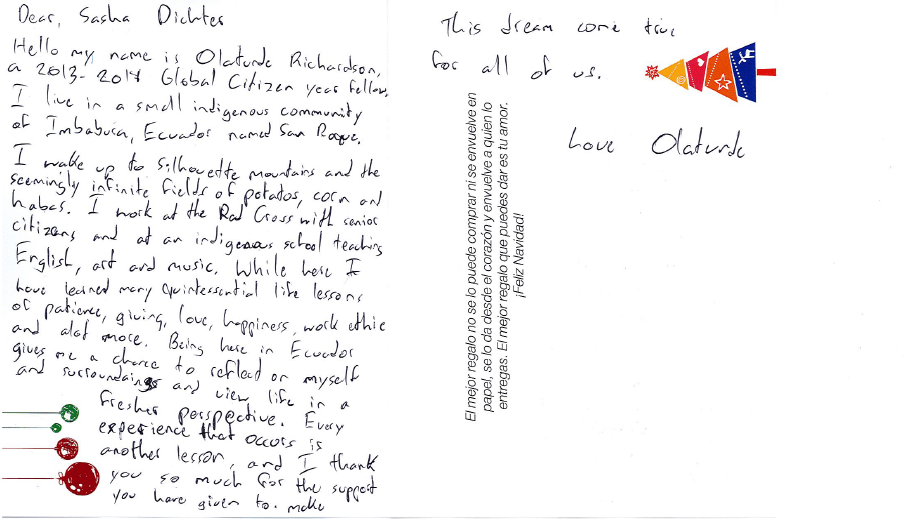
The second one was a thin envelope with a Christmas card.  It looked like a lot of other “Season’s Greetings” cards I receive from nonprofits.  And then I opened it up and found a handwritten note from Olatunde Richardson, who just graduated from high school and is spending the year in Ecuador as a Global Citizen Year Fellow.  Olatunde works at the local Red Cross, he teaches English, art and music (he’s a budding musician), and his note definitely isn’t going into the trash.

Now, if I were part of the inner circle of the first nonprofit, the one that sent me the big report, the report might help me understand their work in more detail, might equip me to tell their story better…assuming I’m already 100% sold on them, 100% passionate about their work, 100% cerebral, and 100% willing to do the work of distilling all of that down into a story I can tell.

Unfortunately I’m none of those things and I suspect few are.

But something as remarkable as a kid taking the time to write me a personal note from Ecuador?  That’s just enough to tip the scales, to give me something worth sharing because it is personal and it totally surprised me.  So it invites me in.

The handwritten note works because it isn’t trying to do everything, it isn’t trying to answer every question I might have about Global Citizen Year (because it couldn’t, and nothing could).  It is trying to say thank you in a personal, memorable way, and it succeeds.

I know, I know – you have too many people you need to connect with, you could never do this for every single one.

Except if you could.  What if it wasn’t you writing the notes but instead the 50 people who care most about your organization, telling a personal story?

Nice to meet you, Olatunde.

GCY_envelope

GCY_note


So, you looking?

Not long ago I bumped into a headhunter at a cocktail party, a woman I hadn’t seen in nearly a decade.  Her second sentence (second!), after, “How are you?” was, “So, are you looking for a job?”

Wow.

The easy questions in fundraising are around tactics, as in, “when is the right time to make an ask?”  There’s nothing wrong with “three-meeting before making an ask” and other rules of thumb, but questions like this one essentially miss the point.

(By the way, my take on this particular rule of thumb is that it is better to ask sooner than you’d like and better to and ask for more than you feel comfortable asking for.  This is primarily about getting through our own fears about asking – we usually take too long – and about recognizing that we are giving the person across the table an opportunity to do something important, and we should help them do something big, not small.)

No matter what approach you take, you’re never going to get out of the starting blocks until you’ve done the internal, personal work of getting out of that space where you see the person across from you as a transaction, as simple dollar signs.  No matter how you dress up your language, if you see your “prospect” as a means to and end then she’ll feel that way.  Whereas if you treat her as a person with whom you are building a real and substantive relationship, you can (counter-intuitively) talk comfortably, early on and directly about money.

It starts with you and how you see the world.  Are you building something, or just taking?

Don’t take it personally

Jonathan Lewis’ recent blog post and accompanying video on fundraising hits the nail on the head: “The best fundraisers don’t fundraise.  Instead, they teach people to take realistic – and unrealistic!  – risks in the service of a better world. “

“Teaching” and “risk-taking” in service of a better world.

Maybe if we used that language more often we would have more great people getting into fundraising, more people in fundraising with the right mindset and orientation, and more funders taking risk.

I’m with Jonathan all the way until the closing paragraph, where he says, “Infuriating indeed is the patronizing ‘don’t take it personally’…If you believe in your mission and if you are giving it your all, then it’s always personal.  Every committed social entrepreneur takes organizational rejection personally!”

As I told Jonathan, I don’t think this is quite right.  Of course I feel it personally when I am rejected, when someone doesn’t share my passion or, worse, when my explanation of what we are trying to do at Acumen fails to capture the imagination of someone who I know is aligned with my passion and vision (in which case, shame on me).  I don’t think I would be human if I didn’t feel it; indeed, if the day comes when I stop feeling it I’d have to question my own passion and sense of commitment.

But when I let the rejection feel personal, and when I see other fundraisers do the same thing, I think that’s a big mistake.

The person I’m meeting with came into the meeting with a worldview, with ideas, with momentum in a certain direction…and so did I.  I feel like my job is to listen, explore, connect, tease out alignment, and then to inspire action (aside: the “inspire action” bit is really important and not easy to get right.)

But when that alignment isn’t there and I end up feeling personally rejected then I believe I’m misdiagnosing what just went on in that meeting.

When someone says no, it could be an execution error on my part: maybe I handled the meeting poorly, didn’t listen enough, was off my game, didn’t have a real and compelling ask, didn’t tell compelling stories, or didn’t articulate how Acumen could help the funder realize their vision.  Hopefully, after fundraising for nearly seven years I make fewer and fewer of those mistakes, but I’m sure I do make them plenty.  When this is what’s gone wrong,  I need to use a rejection to figure out how I can get better, how I can hone my craft, how I can turn “no’s” into “not now’s.”  Taking these sorts of rejections personally places blame in the wrong place: I didn’t do my job well, plain and simple.

And when what I’m fundraising for doesn’t inspire a funder or align with their vision, then something entirely different is at play.  That’s a question of worldview, a question of where they are in their journey.  It’s about lack of alignment of vision and values and aspiration.  What they’re looking for is not what I’m selling.

(Note that it’s easy to see, when I’m selling database software or consumer copiers, the difference between being turned down because the person isn’t buying anything right now, buys from my competitor, or decides to buy productivity software and a high-end color printers instead.  In philanthropy what we mostly see is the person giving or not giving to us, so everything gets much more muddled).

Almost always, it’s not personal.  I have not been rejected.  The moment I take rejection too personally is the moment I lose forward momentum, the moment I begin to question myself at a more fundamental level, the moment I forget that real long-term partnerships happen because of a deep sense of alignment, not because someone chose to buy what I’m selling.

Everyone a fundraiser

A colleague of mine – someone who has never been a formal part of Acumen’s fundraising team but who has done a good deal of fundraising  – said that a series of recent meetings with new donors reminded her of what it means to raise money.  She said:

The act of fundraising changes you, it changes your perspective.  When you sit there and look someone in the eye, it forces you to do two things.  First, you have to have your story straight: what are we doing and why, what are the details, how do all of the pieces hold together?  More important, though, is the sense of accountability you have to that donor when you’ve had that conversation.  You’ve made a promise to them, and knowing that changes you and makes you want to work harder than ever to deliver for them.

Exactly.

There’s something real about face-to-face, personal fundraising that I don’t experience anywhere else – not online or with social media or crowdfunding platforms, not in institutional fundraising or grant-writing (even in situations where you have strong personal relationships).  When someone gives their personal money, when someone sits down and writes a personal check to your organization, it creates a deep connection.  If you choose to see it and experience it, that sense of accountability can be internalized – first for you and, over time, into your organization.  In that personal connection and experience, you have the chance, long after that meeting, to transform yourself into an agent for that donor – not literally to do everything they would do (because they’ve given to you because of what you do and know, because of the perspective and professional judgment you bring to the table) but to give them a seat at the table, an important spot in your mind and in your heart.

Our opportunity is to have everyone who does this work be a fundraiser.  Not their full-time job. But why would we pass up the opportunity to get at least a glimpse of the sense of ownership, discipline, and, yes, obligation it creates?

Neglected, then out the door

I was a DIRECTV subscriber for about six years, until I wasn’t.  Meaning, over time the ~$65/month (once it was all said and done) started to sting more and more, and while I was generally happy with the service, the volume of alluring communication I got from everyone else pushing me to switch was in marked contrast to the bill and nothing else I’d get from DIRECTV month after month.

In the TV and telecom businesses, customer “churn” is one of the most important metrics to manage.  This is because customer acquisition and setup costs are high: the costs of giving someone a subsidized phone, or of sending a technician to physically install a costly satellite dish in each new customer’s home, are layered on top of all the regular sales and marketing costs everyone takes on.  That makes it especially important to keep customers from leaving once you’ve gotten them on board.

The challenge for DIRECTV and its ilk is that they have no information at all about how happy I am.  As long as I’m paying, I’m paying – until the day I leave, ending what could have been a 10 or 20 year relationship (which, at $65/month is somewhere between $7,800 and $15,600 in lifetime revenues).

The irony in the TV business is that the marginal cost of surprising or delighting a current customer is so low compared to the value that walks out the door when she leaves.  A free month of HBO for every year I’ve been a customer, or getting NFL Sunday Ticket for free one season if you’ve been a customer for five years (just hypothetically, of course!), could pay off in spades.

Because metrics (customer acquisition costs, churn, etc.) are so much harder to come by in nonprofit fundraising, and because each “customer” is so different in terms of how much they pay/give (DIRECTV’s customers might pay $30 or $200 a month, but that’s about as big as the range gets; a donor could give $500 or $5,000,000), we rarely do the math on customer acquisition costs or churn.  And so we hunt for the next donors at the expense of tending to the donors we already have.  It’s so easy to forget to delight those who are already with us – to give our true believers tools to evangelize on our behalf, and to make those who are happy feel proud, delighted, and occasionally surprised at the little gifts we give them to say “thank you.”  (And by “gifts” I don’t mean trinkets, though those are nice too.  I mean helping them see what they have helped accomplish, and showing them true and honest gratitude.)

We all have lurkers in our midst who are about to leave but we don’t know it.  Of course some folks will leave no matter what, and some will be too expensive to retain.  But let’s at least make that a conscious choice.

It’s a shame and a loss when someone who has been supportive, someone who has been a loyal and important customer, walks out of the door for no better reason than low-level neglect.

Are you a fundraiser?

There’s an old line that parents swap, and it goes something like:

People who aren’t parents think that there’s not a chasm between people who are and are not parents.  People who are parents know that there is one.

It’s not better or worse to be a parent, it’s just a different worldview and state of mind, a line that you cross and can never go back.

I think fundraisers experience something similar.  A good fundraiser is just as smart and savvy and capable and strategic as non-fundraisers – indeed much of what motivated me to start this blog was how frustrated I was to see that the nonprofit world sidelined fundraisers and fundraising and then wondered why it was so hard to scale things that work.

But there is something different about being a (good) fundraiser.  It means that at any day, at any moment, on some level you’re thinking about that revenue line, thinking about where you are in the year, how much time you have left, and what it’s going to take to get there.

This, too, isn’t good or bad, it just is.  It’s something you feel in your bones and in your gut.  And living with that feeling and that stress does take some getting used to.  I think the challenge of living with that discomfort is where lots of the burnout for fundraisers comes from.

My hope is that if we acknowledge it, if we say it out loud, if we share that this is something we are all holding, the weight that we are bearing gets just a bit lighter.

What do you want?

It’s actually very easy to communicate what you’d like someone to do.  The NY MTA does it simply, with a bigger box.

Metrocard

Of course this applies to web design, IRS tax forms, etc.  But it also applies to how you fundraise.

The most subtle, ever-elusive dance in fundraising is between relationship-building and “closing the sale.”  I find that, by and large, new fundraisers have to learn to invest more in building relationship, providing value to others, and being ambassadors within their organization for potential donors.

At the same time, you always have to be ready to answer the questions: “What’s most important to you?” or “If I’m ready to donate, what should it be for?”  There’s almost never any harm, even at the outset of a relationship, to be very clear about what your priorities are and how someone can be most helpful.   That’s not trying to close the sale too early, it’s knowing what your priorities are and giving someone clarity.  That’s never a bad thing.

If you don’t let them know (or worse, if you don’t know) what you hope they’ll do, how can you ever expect them to figure it out?

And if you’ve ever gone into a fundraising meeting without your top priority ask in mind, you’ve broken this rule.  I know I have.