The $30 million question

I’ve just heard a story of a major nonprofit organization that receives tens of millions of dollars annually from a single donor – around half of its operating budget – but is laying off staff because they don’t have enough unrestricted operating cash.

Again, Dan Pallotta’s awesome TED talk notwithstanding, we find ourselves having the same conversation, one that boils down to: is it a wasteful to pay nonprofit professionals to do their jobs well?

I wonder if it is we in the nonprofit space who need more guts when we take on this question. Maybe it’s time to say something along the lines of, “if you want your money to go directly into the hands of very poor people who need it, you should do just that and give to Give Directly.” GiveDirectly is optimized for this, they are efficient and transparent in their operations, they rigorously study their results, and they’ve shown the effectiveness of direct cash transfers for creating both short- and long-term improvements in people’s lives. It’s a completely legitimate way to help others, and it’s a great benchmark against which to measure our work.

“Or,” we should have the courage to continue, “you can have the point of view that the programmatic work that we’re doing is better than giving cash.” “Better” can be because it does different things (fights corruption); “better” can be because the impact of giving a dollar is more than $1 (investing in a scalable social business); “better” can be because of long-term return on investing that’s higher than the social return on giving cash (supporting a child’s education).

“But,” we should be sure to say, “if you believe that the IT that we do matters, if you believe that there is something real that we are bringing to the table that goes above and beyond your money ending up in the hands of someone who will benefit from it, then you’re saying that our judgment, our relationships, our expertise, our capacity for oversight, and our ability to create leverage for each dollar you give is real. This means that you trust this judgement and our expertise. So please give in a way that respects that judgment and expertise, or don’t give at all.”

Our homework is to really look in the mirror and evaluate why what we’re doing is, in fact, better than the money going directly to our beneficiaries. And, once we’ve sorted that out, we must have the courage to make that case and the willingness to look someone in the eye and say, “if you don’t believe this, then you shouldn’t give to us in the first place.”

Twenty Two Oh Five

Yesterday night at bedtime, my son handed me this envelope.

2205

Earlier this year I visited with his Fifth Grade class and had a 90 minute discussion about Acumen. If you ever want to figure out how to explain what you do simply and clearly, I strongly recommend talking to a group of 5th graders. You’ll have to boil everything down to its essence in a great way.

I was blown away by how sophisticated and prepared the kids were: having 5th graders in a nice suburb of New York City ask me how things are going with the rice gassifiers that Husk Power Systems runs in Bihar gave me a lot of hope for the world.

What I didn’t know, until last night, was that a few of my son’s classmates took it upon themselves to raise money for Acumen as a thank you. They self-organized and went around to other classes in the school, talking about Acumen and asking kids to bring in bottles they would return for the 5 cent deposits.

So the $22.05 represents 441 bottles that 5th graders collected and returned because they wanted to help people they’ve never met who have less than they do.

The feeling I had upon receiving this envelope reminded of one of the most powerful impacts that fundraising can have on you. When someone you trust and respect shakes your hand, looks you in the eye, and agrees to give you their hard-earned money to support the work you do…well, I find that moment always motivates me to do the work harder and better, to do right by them and to earn the trust that they are placing in me and in my team.

To know the work that these kids went through – learning about Acumen, courageously going up to their friends and asking them to bring bottles from home, having those kids then go home and explain the same story to their parents – makes me want to work twice as hard and twice as smart.

I hope this story inspires you as much as it’s inspired me.

What would be fabulous is if more kids choose to do a similar project – to collect and turn in 441 bottles to support Acumen or another cause of their choice.

If they want to, let me know how I can help.


Getting Fundraising Right

It’s so easy to end up telling this story:

This is who we are.

This is what we do.

This is why we do it well.

This is what we need.

Can you help?

When we should be telling this one:

This is how the world looks today.

This is how it could look tomorrow.

This is why this matters.

This is proof that we have what it takes to get from here to there.

Let’s make this happen together.

In the first approach, full of good intentions, we make the classic mistake of focusing on, and talking about, ourselves. Good students to the end, we promise you that we’ll do a good job if you’ll just (please!) trust us with your support. It is, literally, self-centered.

Instead, our opportunity is to pull ourselves out of the center of the story, to paint a bigger picture of the world as it could be, and describe how we can partner to make a change.

As good and as important as our work is, we are not the protagonists in this story.  We are the enablers of the change.

(Bonus: Pixar’s 22 Rules for Storytelling, visualized, via Swissmiss. It includes #7, “Come up with your ending before your figure out your middle.  Seriously.  Endings are hard, get yours working up front.”  For our purposes, let’s remember that the ending cannot just be “So, can you fund us?”)

Subway Portrait

“Excuse me, m’am, may I draw your picture?” he says, white pad on his lap, fingers stained with charcoal.

“Pardon me?” says the woman sitting across from him on the subway, looking confused and a bit taken aback.

“Your picture…is it alright with you if I draw your picture?” he reiterates.

“Uh…sure.”

And then, as his hands glide across the page, his patter begins, not interrupting the drawing, which has to be complete in the two minutes before the last stop.

“This is what I do,” he says, “I draw pictures of people. Portraits. Been doing this for years, I’ve drawn 800 portraits of New Yorkers so far.”

She takes the bait: “All in one day?” she asks. Her guard is dropping just a little bit.

“No m’am, that would be impossible. Anyone who tells you they’ve drawn 800 portraits in one day, they’re lying to you. No, I’ve drawn 800 portraits since I started, and that’s why I can draw them so fast, because I’ve done it so many times. I’m an artist, you see, an artist. Don’t you like how that looks?” (he holds up the already – amazingly – half-finished sketch, which has gone from a few lines to, instantly, a pair of eyes, an outline of a mouth, a bit of expression, in about one minute).

She smiles, recognizing her likeness, the shape of her face, the crinkles around the outside of her almond-shaped eyes.

“See I knew that would make you smile! Now I can get that smile in the picture… Now I’m gonna give this portrait to you, that’s what I do, I’m gonna give it to you either way….Lots of people like these portraits, they hang them up, in their offices usually…And a lot of them pay me for them, even though I give them to ‘em either way, a lot of people pay me $10, or sometimes even $20…

(almost to himself) “Yeah, I try to get 10 people in a day to pay me $10 each, that’s what I try to do. Last guy I did this for he handed me a $10 bill, yes he did. And don’t tell me I’m not an artist, see? Artists make people smile and that’s what I’m doing here, I’m making something that will make people smile.”

Just a few more seconds for the finishing touches, and:

“So here you go, beautiful, here’s your portrait I hope you like it.” he says, handing it to her.

And she does.

And she pays $10.


In review: to create a situation where someone gives or buys, you must first create joy, a story, connection, a thing of beauty.

And in situations, like philanthropy, or busking, where it’s not clear what something is worth, it’s your job to tell them, to frame it for them, to say: this is what people who are happy and feeling a sense of connection in this moment typically pay. This is what the last 10 people did.

“I’m going to give this to you either way, but you gotta know that everyone else before you who liked their portrait gave $10 or $20 and hung the portrait in their office.”

Sure, she could decide not to pay, but if she does pay, you can bet it’s not going to be $1, which is what most people on the subway get when they ask for money.

His starting point was a $1 portrait. The story about the portrait, and the story about what people who like portraits pay, that’s what’s worth the other $9.

On Behalf of Me

With just a week to go until the New Year, now is the time to reflect on 2014 and to thank those around us for all the help and support they have brought to us and to others.

It is also a big time for online donations. For reasons that have something to do with the tax deadline but more to do with ritual and habit, the week between Christmas and New Year’s, and especially December 30th and 31st, are the biggest days all year for online donations. Naturally, our inboxes are flooded with some combination of “thank you’s” and “it’s your last chance to give.”

I am happy to receive the subset of these emails that are from people I actually know or from people who are thanking me for things I actually did.

What drives me bonkers are the emails from organizations, emails that have no name attached to them and where I cannot reply and get to an actual, identifiable human being on the other end. I don’t want to be thanked by an organization, asked for anything from an organization, or wished happy holidays on behalf of anyone but a real, living, breathing person.

It may feel overwhelming to imagine the logistics of hearing back from, and then having to reply to, the too-many people who might respond to your email. But then it’s time to ask whether it makes sense to send that email in the first place. Any correspondence you initiate in which getting a response from the recipient will be a problem and not an opportunity….well, that isn’t a correspondence, it’s spam.

To get tactical for a second, there are four places where your name can (or cannot) show up in the emails you send:

  1. The “From” name that appears in someone’s email client
  2. The associated email address
  3. The name that is signed at the bottom of the email
  4. The email address that comes up when someone hits reply to your note (not always the same as #2)

At least three of these four should be names of living, breathing, human beings.  And I should never, ever hit “reply” and have the To: field read anything like us3-a22c2dfe-1779e987@conversation01.mailchimpapp.com

On behalf of me, and only me, happy holidays.

Individual and Institutional Fundraising

Over the past six months, a greater proportion of the fundraising I’ve been doing has been institutional rather than individual. By “institutional” I mean fundraising from people who have been charged with donating somebody else’s money – whether or not it’s a formal, recognized institution (e.g. a large private foundation, a corporation, etc.).

In both individual and institutional fundraising, there’s a strategic element and a people element. The strategic conversations are around goals and outcomes and what success looks like. The people element is around what motivates a person to take action – the story and the emotional elements that move people to act, as well as the interpersonal dynamics that are always at play.

The one thing that is missing from these institutional conversations, which easy to miss if you’ve not experienced it directly, is a deep, personal element. In my experience, real, substantive conversations about real, substantive philanthropy nearly always get personal: they touch on motivations, hopes and fears, aspirations, and legacy.

These conversations require something different from the person doing the fundraising: a comfort getting into that murky space where they, too, are more open, honest, and vulnerable than would ever be expected in a purely professional context.

My hunch is that the reason most people don’t wade deep into individual, big-ticket fundraising is either because they don’t understand how deeply personal these conversations have to be, or they are unwilling or unsuccessful at going there. This means that if you have the courage to take that leap, along with openness to do the real work that this leap requires – to learn about yourself, to understand your own motivations for doing this work, to help people talk about their own purpose – you’ll soon be part of a very small group of people willing to take it to another level. This path is a heavy lift, a long walk that requires emotional labor and has the potential for a serious personal and professional payoff.

Of course your other option is to sit safely at a desk replying to yet another formal request for proposal, hoping that your program will be the one out of 1,000 that’s picked out of the pile.

This is one of the greatest blend-in or stand-out opportunities in the nonprofit sector.

Most of your meetings will be better if you…

Have a purpose.

State a purpose.

Execute on that purpose.


This means you know what success looks like for you, and you actually say it out loud to the person you’re meeting with. For example:

“I want to make sure we cover these three topics.”

“I wanted to connect because I really want to understand ________ from your perspective.”

“I’m hoping that by the end of this meeting we will finalize the partnership we’ve been discussing for the past six weeks, and that your company will commit to $1M of funding towards that partnership.”

I’m surprised how rare it is to hear people actually articulate their goals for a meeting.  Especially fundraisers.  Doing so doesn’t make you pushy, it makes you clear and effective.


Personal, with an element of surprise

As I sat down at my desk at work to start the new year, I found two envelopes on my chair.

The first one was a big envelope, 11 x 14.  I opened it up to find a report with a full-color photo on the front, followed by more than 100 pages of text.  I immediately threw it in the trash.

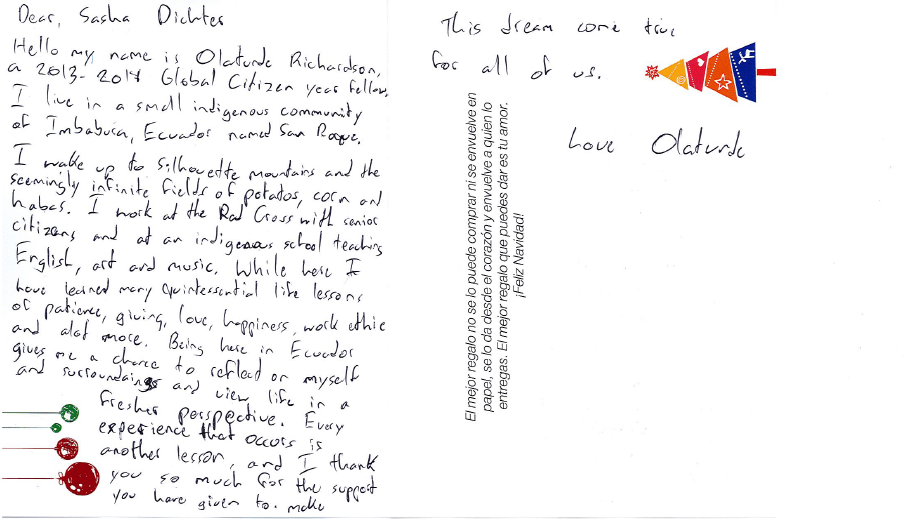
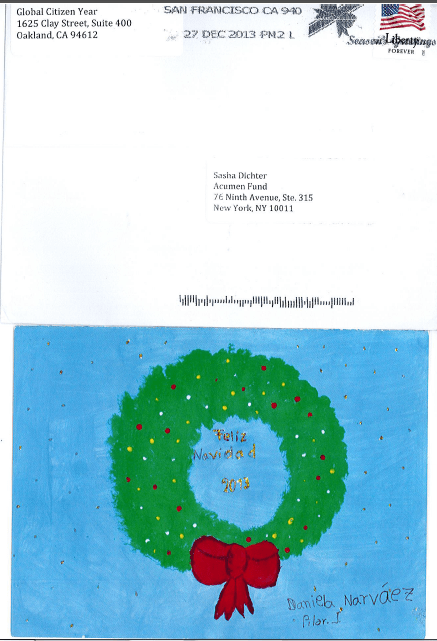
The second one was a thin envelope with a Christmas card.  It looked like a lot of other “Season’s Greetings” cards I receive from nonprofits.  And then I opened it up and found a handwritten note from Olatunde Richardson, who just graduated from high school and is spending the year in Ecuador as a Global Citizen Year Fellow.  Olatunde works at the local Red Cross, he teaches English, art and music (he’s a budding musician), and his note definitely isn’t going into the trash.

Now, if I were part of the inner circle of the first nonprofit, the one that sent me the big report, the report might help me understand their work in more detail, might equip me to tell their story better…assuming I’m already 100% sold on them, 100% passionate about their work, 100% cerebral, and 100% willing to do the work of distilling all of that down into a story I can tell.

Unfortunately I’m none of those things and I suspect few are.

But something as remarkable as a kid taking the time to write me a personal note from Ecuador?  That’s just enough to tip the scales, to give me something worth sharing because it is personal and it totally surprised me.  So it invites me in.

The handwritten note works because it isn’t trying to do everything, it isn’t trying to answer every question I might have about Global Citizen Year (because it couldn’t, and nothing could).  It is trying to say thank you in a personal, memorable way, and it succeeds.

I know, I know – you have too many people you need to connect with, you could never do this for every single one.

Except if you could.  What if it wasn’t you writing the notes but instead the 50 people who care most about your organization, telling a personal story?

Nice to meet you, Olatunde.

GCY_envelope

GCY_note


The perfect toy

Last week we got my son what he called “maybe the best present ever.”  It’s a Structures 200 Plank Set.Structures 200

Before buying it my wife and I kept on reading over the description to see if we were missing anything.  It is described as “200 identical wooden planks.”  Each of them is a three-inch long little pine rectangle.  No notches, no nothing, no different sizes.  The product description says: “No glue connectors required, simply stack wood planks to create buildings, monuments and geometric forms.”  200 identical little pieces of wood, along with “ideas for over 40 structures?”  Yup, 200 identical little pieces of wood, plus the clever idea to put them all together in a box and sell them for $49.99.

Really?  Yes, really.

And the truth is, it’s wonderful.  You can build bridges, staircases and vortexes.  The pieces are light enough and have enough friction that they don’t collapse.  It’s a blank canvas in a world where everything (especially toys) is over-engineered with too many instructions to follow.  It’s what Lego used to be before they figured out that if you sell a bunch of nondescript bricks each kid will max out at a thousand pieces, but if you sell them the Death Star and Ewok Village and an X-Wing Fighter and the Republic Attack Cruiser, you can keep on selling, well, forever.

So Legos as they are today win.  And Legos as they used to be (Structures 200) wins too, albeit at a smaller scale.  Why?  It’s because we can deliver one of two kinds of experiences to our customers.

At one extreme we have what Lego has become: each individual story perfectly constructed, honed down to the last piece, and that one special character that you can’t get anywhere else.  The edges have been smoothed off, you can have what everyone else has and talk about it with your friends.  You know exactly what you’re getting and it delivers.  All you have to do is buy it and follow the instructions.  (This is the big, institutionalized nonprofit, where any gift can be broken down into a small, digestible story and you can shop for product like you shop on Amazon.  Crank those babies out on the assembly line and sell ‘em like hotcakes.)

At the other end is the pure, blank canvas: create your own story, tell it in your own way.  You, the customer, are the creator and curator and artist, and we are the vehicle for your self-expression.  This is the startup, the dream, the “let’s build this thing together and we will change the world.”

Where things fall down is in between, where the story is neither crisp and clean enough to make a simple promise and deliver on it, nor is there an exciting blank canvas where big thinkers and first movers can make their mark.  Stuck in the middle is disappointing to everyone, and you have no customer whose problem you’re completely solving.

(By the way, blank canvases and products that deliver on their promises can co-exist within one organization, you just have to realize which is which and never forget that each of those gets sold to a different customer.)

Blank canvas

So, you looking?

Not long ago I bumped into a headhunter at a cocktail party, a woman I hadn’t seen in nearly a decade.  Her second sentence (second!), after, “How are you?” was, “So, are you looking for a job?”

Wow.

The easy questions in fundraising are around tactics, as in, “when is the right time to make an ask?”  There’s nothing wrong with “three-meeting before making an ask” and other rules of thumb, but questions like this one essentially miss the point.

(By the way, my take on this particular rule of thumb is that it is better to ask sooner than you’d like and better to and ask for more than you feel comfortable asking for.  This is primarily about getting through our own fears about asking – we usually take too long – and about recognizing that we are giving the person across the table an opportunity to do something important, and we should help them do something big, not small.)

No matter what approach you take, you’re never going to get out of the starting blocks until you’ve done the internal, personal work of getting out of that space where you see the person across from you as a transaction, as simple dollar signs.  No matter how you dress up your language, if you see your “prospect” as a means to and end then she’ll feel that way.  Whereas if you treat her as a person with whom you are building a real and substantive relationship, you can (counter-intuitively) talk comfortably, early on and directly about money.

It starts with you and how you see the world.  Are you building something, or just taking?